The global magazine and marketplace for classic car enthusiasts, by enthusiasts.


Filter
Classic Bentley, Lagonda for sale - Bentley, Lagonda cars for sale
-

1924 Bentley 3 Litre Speed Model 2 Seater By Gurney Nutting
Chassis No:612 Engine No: 628 Current Engine No: U.K. Registration No: NN 8126 Coachwork Sports 2 Seater By Gurney Nutting Chassis No 612 was delivered to A.B.Spencer who specified saloon coachwork by Gurney Nutting. Within two years, however, the car passed to his brother George Spencer who returned the car to Gurney Nutting with instructions to .. -
Bentley 4¼ Litre Sedanca 1938
Technical Specifications: Mark & Model: Bentley 4¼ Litre SedancaYear: 1938Registration plate: Guernsey registeredChassis Number: B-153-KUEngine Number: Z-3-BMEngine Capacity: 4257 ccTransmission: 4-speed manualMileage: Body style: 2-door SedancaInterior color: Black leathe.. -
1938 Bentley 4¼ Litre Sedanca
Technical Specifications Mark & Model: Bentley 4¼ Litre SedancaYear: 1938Registration plate: Jersey registeredChassis Number: B-187-LEEngine Number: E-9-BJEngine Capacity: 4257 ccTransmission: 4-speed manualMileage: Body style: 2-door SedancaInterior color: Cream le.. -
1923 Bentley 3 Litre TT Short Chassis Roadster
1923 Bentley 3 Litre TT 2-Seat RoadsterCoachwork by A.H. Storey & Sons Chassis No. 339Engine No. 719 - An original bodied 3 Litre with desirable one-off coachwork - Desirable short-chassis Tourist Trophy specification- Fantastic history including significant BDC racing- Wonderful.. -
1937 Bentley 4 ¼ Litre Vanden Plas 'Allweather' Tourer B179JY
An unusual and very interesting, attractive, practical four door open cabriolet configuration make this a particularly desirable Derby Bentley, being easy to access through large doors, and ‘wide-bodied’, giving increased spaciousness and elbow room, and nicely weather resistant, with well-constructed hood, wind up windows, tonneau cover, etc, i.. -
Have you seen this Bentley Le Mans Special? - Brooklands Birkin Racer
Who can tell me more about the whereabouts of the following car? I’m looking for information about a “Red Bentley” replica with a Mark VI chassis and a RR straight-8 B81 engine. The car was built in the Netherlands and was for sale roughly 25 years ago at Imparts in Ede. I even test-drove it there at the time. After that, it was exported to the .. -
1928 Bentley 4.5 Litre Lemans style tourer.
1928 Bentley 4.5 Litre Chassis No. KM3083 Engine No. KM3086 Registration No. UC 8791 Mint restored condition and all ready for some serious fun. This 4.5 Litre Bentley started life as a Martin Walter Saloon. in 2011 it was rebuilt to Lemans spec by the late Stanley Mann. Since converion it has .. -
1936 Lagonda LG45 Drop head Coupe
1936 Lagonda LG45 Drop head Coupe Chassis number: 12104 Registration number: HXV183 (Previous) Fully Nut & bolt restored some years ago; this car has seen very sparing dry weather only use ever since & has also been the winner of some Lagonda club awards. Unusually the c.. -
Derby Bentley Special 4-1/4
Sadly i am having to sell on my Bentley special ( Icarus). It is currently a work in progress and still needs finalising/ refining. A great opportunity to be able to buy a cheaper Derby special to finish with your own touch. Details on the car:The car was originally built by well known Bentley special builder and profe.. -
1924 Bentley 3-Litre Speed Model Tourist Trophy Two-Seater in the style of Jarvis | RM Sotheby's | The Woodcote Park Auction
To Be OFFERED AT AUCTION at RM Sothebys' The Woodcote Park Auction event, 8 July 2026. £90,000 - £110,000 GBP Tourist Trophy-style polished two-seater taper-tail body built in the style of Woolf Barnato’s Jarvis-bodied 3-LitreRetained by its consigning owner since 2009Driven extensively in current ownership on rallies a..


Bentley
GB, 1920 to date
(1) Bentley Motors Ltd, Cricklewood, London N.W.2., 1920 – 1931
(2) Bentley Motors (1931) Ltd, Derby, 1933 – 1945
(3) Bentley Motors (1931 Ltd, Crewe, Cheshire, 1946 to date
W.O. Bentley was already well-known as the importer of the D.F.P. car, a pioneer of aluminium pistons and a designer of successful rotary aircraft engines when his first Bentley 3-litre car for sale appeared at the 1919 London Show. This Bentley model, indelibly imprinted in the layman’s mind as the archetype of the Vintage sports car, had a long-stroke (80x149mm) single ohc engine with fixed head and dual magneto ignition developing about 70bhp in its early form. The Bentley 3-litre was at its best in long-distance events; a team of Bentley 3-litres with flat radiators (the only instance of this apart from the same year’s Indianapolis car) finished 2nd, 3rd, and 5th in the 1922 T.T., and the model accounted for the first two of the marque’s Le Mans wins, those of Duff/ Clement in 1924 and Davis/ Benjafield in 1927 on the badly damaged ‘Bentley Old No. 7’ – one of the legends of motor-racin history. Up to 1929 1.630 3-litres Bentley motorcars were made. 1924 saw the introduction of front wheel brakes and also the famous sports four-seater ‘Bentley Speed Model’ by Vanden Plas. Bentley cars are popularly known by the colours of the enamel on their radiator badges – ‘Bentley Red Label’ signifying a Speed Model short-chassis 3-litre, ‘Bentley Blue Label’ the early short, and long chassis which could and sometimes did carry limousine coachwork, and ‘Bentley Green Label’, a special 100mph Bentley type made in very small numbers.
In 1926 the Bentley company made a bid for the carriage trade with a big Bentley 6½-ltre six for sale on similar lines. A chassis cost £1.450, but the Bentley image made no impression in this market. However, the model was developed into the 180bhp ‘Bentley Speed 6’ of 1929, considered by many to be the best of the old-school Bentleys for sale, and responsible for the firm’s last two Le Mans wins – Barnato/ Clement in 1929, and Barnato/Kidston in 1930. In 1927 the Bentley 3-litre was developed into the Bentley 4½-litre, still with four cylinder, but with a 100bhp engine which was giving 130bhp by the time production ended. This admirable car could exceed 90mph in standard form, and was used by Barnato and Rubin to win LeMans in 1928. A supercharged version was listed in 1930; it had 182bhp, and did not have the approval of Bentley himself, but it was an excellent if thirsty road car, and won Sir Henry Birkin an unexpected 2nd place in the formule libre French G.P. of 1930. Bentley finances were always shaky, and even Woolf Barnato’s aid of 1927 did not last long; the Bentley company went down in the early summer of 1931 to the accompaniment of a splendid gesture – a 220bhp ohc Bentley 8-litre six, made in two wheelbase lengths, 12ft and 13ft. Only 100 of these eight-litres Bentleys were made, plus 50 examples of a rather uninspired inlet over exhaust valve 4-litre car.
Napier made an unsuccessful bid for the assets of the Bentley company, but were beaten by Rolls-Royce, who introduced their version of the Bentley at Olympia in 1933. This was an entirely different type, based on Derby’s contemporary 3.7-litre ohv push-rod ’20-25’. It had a 4-speed synchromesh gearbox, Rolls-Royce servo brakes, and sold for £1.460 with saloon bodywork. In this form, it could reach 90mph and merited its slogan ‘The Silent Sports Car’. It was not raced, of course, apart from E.R. Hall’s three consecutive second places in the T.T. (1934, 1935 and 1936). By 1936 it had grown into a Bentley 4¼-litre, the increase of capacity being necessitated by the rising weight of bespoke coachwork. An overdrive gearbox was standardized in 1939, and the 1940 Bentley Mk V had independent front suspension, though only a handful were made because of the war. The Derby Bentley car’s swansong was a creditable 6th place by H.S.F. Hay at Le Mans in 1949, on a ten-year-old machine with 60.000 road miles behind it. Cylinder capacity was unchanged at 4.257cc in 1946, but independent front suspension, was standard, and Bentely, like Rolls-Royce, had gone over to inlet over exhaust valves. Prices for the Bentley motorcars for sale rose from £2.997 to £4.474 in 1951 for the standard steel saloon, the first Rolls-Royce product to have a regular series-produced factory body.
Thereafter the Rolls-Royce and Bentley identities merges, though in 1952 there was a special ‘Bentley Continental’ version of the latter with fastback 2-door saloon body by H.J. Mulliner which gave 120mph on a 3.077:1 top gear. Capacity went up to 4.6 litres in 1952 and 4.9 litres in 1955. Automatic transmissions, already optional, became standard that year; power-assisted steering and air conditioning followed In 1957, and for 1960 the old six at long last gave way to a 6.2-litre V8 with full overhead valves, by which time only the radiator style distinguished one make from the other. The ‘Bentley Continental’ with separate chassis was discontinued at the end of 1966; 1972 Bentleys were the 6.745cc Bentley T saloon and the Bentley Corniche 2-door saloon and convertible. Even the price differential between the two sister makes was now a thing of the past, the Bentley T-series selling for the same £10.455 as the Rolls-Royce Silver Shadow.
Source: Georgano, encyclopedia of motorcar; MCS
The information is written with the greatest of care. However, if you have any suggested amendments please contact us at office@prewarcar.com
Lagonda
GB, 1906 – 1963
(1) Lagonda Motor Co Ltd, Staines, Middlesex
(2) Lagonda Ltd, Staines, Middlesex
(3) Lagonda Ltd, Feltham, Middlesex
(4) Aston-Martin-Lagonda Ltd, Newport Pagnell, Bucks.
Wilbur Gunn, the founder of the Lagonda Car Company, hailed over Springfield, Ohio. He came to England in about 1897. In 1898 he built an air-cooled cycle in a greenhouse at Staines. On this site the first vehicle to bear the Lagonda car name was assembled in 1900, an improved version of the air-cooled cycle; and it was here that Lagonda cars were to be built until 1947.
To his new product, the Lagonda car, Gunn gave the French form of the American Indian name for Buck Creek, the stream near his home town. In 1905 the Lagonda car company’s first racing success came when a V-twin cycle won the London-Edingburgh trial. This victory encouraged Gunn to enter the motor car field with a 20hp 4-cylinder Lagonda car. Developed in 1906, this first Lagonda car was brought out the following year as the Lagonda Torpedo. A 6-cylinder version followed; the Lagonda car carried Wilbur Gunn and Bert Hammond to win the Moscow – St Petersburg Reliability Trial in 1910. The big tourer Lagonda car was a result ‘greatly favoured’ by Tsar Nicholas II, and the Lagonda Car Company’s early fortune was made form exporting these Lagonda cars to Russia until war broke out in 1914.
At home a dapper Lagonda 14/4 replaced the earlier Lagonda 12/4 in 1909. This gave way in 1913 to an 11.1hp light Lagonda car of radically advanced design. Among its more striking innovations were a riveted monocoque body of unit construction; an anti-roll bar to assist the suspension; and the Lagonda car had the earliest known fly-off hand brake. The Lagonda car enjoyed a wide market, being subsequently enlarged into a 11.9 in 1920 and a 12/24 in 1924, though later Lagonda cars no longer had monocoque construction.
In 1925 Arthur Davidson designed the 1954cc ohv-engined Lagonda car which marks the beginning of the Lagonda as a sports car. The Lagonda 14/60 engine featured 4-fully-machined hemispherical combustion chambers, the first to be marketed, aspirated by interchangebale valves opposed at 90 degrees. Twin camshafts were carried high in the block of the Lagonda car. A Rubury braking system of prodigious efficiency was fitted. Grouped chassis lubrication nipples were featured, as was a clutch stop. The whole Lagonda car was superbly finished.
The Lagonda 2-litre Speed Model, a modified version of the 14/60 Lagonda car, was developed late in 1927 for the 1928 season. The chief difference between it and the earlier Lagonda car lay in the valve-timing overlap, twin carburetors on a direct manifold, and a raised compression ratio of 6.8:1. These alterations combined to give the Lagonda Speed Model tourer an acceleration from rest to 80mph in 50 seconds, and the new Lagonda car did well in competition. A 2½-litre 6-cylinder Lagonda car with push-rod operated ohv was introduced in 1926, and this was subsequently enlarged to 3-litres on Lagonda cars in 1928. For 1930 the chassis of the Lagonda 2-litre was lowered and during that year a supercharged Lagonda car became available. In 1932 came the last of the 4-cylinder 2-litres Lagonda cars, the Lagonda Continental, which had smaller wheels and a sloping radiator, and this finally gave way to the Lagonda 16/80, a 2-litre six with a push-rod operated ohv engine of Crossley manufacture. This Lagonda car was later fitted with an ENV preselector gearbox. This was an attractive car but, like all the Lagonda 2-litres, it suffered from excessive weight.
In the meantime a version of the 3-litre known as the Lagonda Selector Special appeared. This Lagonda car was fitted with a Maybach gearbox that gave eight forward speeds, four high and four low, by means of an internal reduction gear with semi-automatic control. This Lagonda car was something of a failure, however, and was quietly dropped.
At the 1933 Motor Show two outstanding Lagonda cars were introduced: the 1.104cc Lagonda Rapier, with twin overhead camshafts and the 4½-litre Lagonda M45, having a similar Meadows 6-cylinder ohv engine to that in the now defunct Invicta. At last a Lagonda car had real performance and it is noteworthy that the Lagonda Car Company made their own very attractive coachwork.
For 1935 two additional Lagonda car models made their appearance, the 4½ Lagonda Rapide and the Lagonda 3½-litre, both using the same shortened chassis. It was no doubt this complexity of models which caused the Lagonda car company to get into financial difficulties, and a victory at Le Mans by a Lagonda Rapide came too late to save the day.
When in the summer of 1935 Alan Good saved the Lagonda Car Company from absorption by Rolls-Royce, he appointed W.O. Bentley as chief designer. The Lagonda LG45 model with which Bentley attacked the Luxury market in 1936 had longer road springs and Luvax dampers, but retained the Lagonda M45R engine and chassis. Not until the 1936 Motor Show could Bentley’s influence on the Meadows engine be seen in its definitive form in Lagonda cars. The Sanction III unit featured an improved coss-flow inlet manifold cast integrally into the head, onto which the carburetors were now bolted directly. Various other improvements on the engine of the Lagonda cars including a lightened flywheel allowed the line on the revolution counter to be moved up to 4.000rpm.
The last of the 4½-litre Lagonda cars was the Lagonda LG6 of 1938. This Lagonda car had independent front suspension, hydraulic brakes and outboard rear springs, but still used the Meadows engine. The V12 engine, brought out for the 1937 Lagonda car season, is considered the finest of W.O. Bentley’s designs. This 180bhp unit could raise the Lagonda car’s speed from 7 to 103,45mph on top gear without snatching; and this flexibility could be supplemented by revving freely to 5.000rpm on the indirects. Regrettably the Lagonda car design was never developed fully, for production was stopped in 1940, a few months after Lagonda Rapide versions had been placed third and fourth at Le Mans.
In 1947 the Lagonda car firm was taken over by the David Brown complex. Contrary to spelling the end of the traditional Lagonda car, the new merger enabled Bentley’s last motor-car design to be realized. This was the Lagonda 2.6-litre model which appeared in 1948. Its brilliant but unorthodox layout embraced a true cruciform chassis, independent rear suspension unique amongst British cars, and a twin ohc 6-cylinder engine. A bored-out edition of the 2.6 Lagonda car was offered as the 3-litre in 1951, featuring luxurious styling, rich appointments and a top speed of 110mph. HRH the Duke of Edingburgh had two Lagonda cars for his personal use, and for many years was a honorary member of the Lagonda Club.
The Lagonda Rapide was announced in 1961. Using a DB4 engine of 3.996cc capacity, the Lagonda car was set up on a platform chassis with independent springing all round, servo-assisted disc brakes and a De Dion rear axle. An elegant, aluminium Superleggera body by Touring of Milan contributed greatly to the Lagonda car’s massive acceleration. The Lagonda Rapide’s top speed was a genuine 125mph with comfortable cruising at 120; its sumptuous finish and appointments were in kepping with a price of £5.000. Production of Lagonda cars ceased in 1963, though a 4-door saloon version of the V8 Aston Martin DBS built for Sir David Brown in 1970 bore the Lagonda emblem.
Source: Georgano, encyclopedia of motorcar; HAF
The information is written with the greatest of care. However, if you have any suggested amendments please contact us at office@prewarcar.com


Featured

1915 Rolls-Royce Silver Ghost Barker Tourer
⁃ An exceptionally rare original bodied pre-war Silver Ghost⁃ Desirable Barker tourer in exciting barn find condition⁃ ..
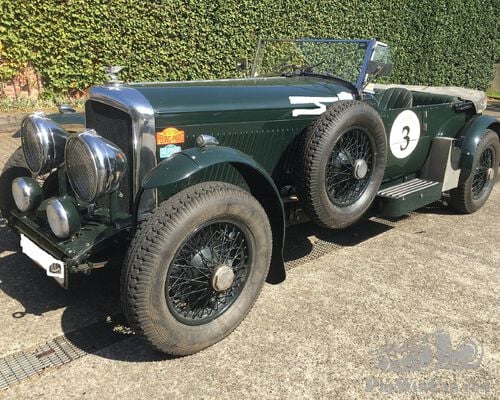
Bentley Derby Special Open Rally Car
This Bentley Derby, manufactured in 1935, has been rebuilt into a short and long-distance rally car. Full rebuilt engine in 2021, Since 2021 low mi..