The global magazine and marketplace for classic car enthusiasts, by enthusiasts.


Filter
Classic Benjamin, Stoewer for sale - Benjamin, Stoewer cars for sale
-

Benjamin Type C Economic 1922
Benjamin Type C Economic Company/HistoryBenjamin was a French manufacturer of Cyclecars between 1921 and 1927 and based on the north-west edge of Paris and the firm was established by Maurice Jeanson in Asnieres eight kilometres from the centre of Paris. The business started out with a range of cycle cars, identified.. -
1924 Stoewer type D3 roadster
Rare opportunity to buy a vintage 1924 Stoewer type D3 roadster in fully restored condition. More than € 50K were spent in 2018 and 2019 on its restoration . Detailed work invoices come with the car. A video can be sent on request . Price € 64000 ex Eibergen Netherlands imported EEC.


Benjamin (Benova)
France, 1921 – 1931
Maurice Jeanson, Asnières, Seine
The Benjamin was a typical attempt to build a 4-cylinder light car and still stay below the statutory French weight limit for cyclecars (350kg). Features on the Benjamin for sale were a 750cc sv engine and a 3-speed transaxle with no differential, and suspension followed Austin Seven lines: transverse at the front and quarter-elliptic at the rear. By 1923 this engine was giving 14bhp, long-chassis four-seater versions were catalogued, and an ohc Benjamin sports model was capable of 60mph. Unfortunately in 1924 there was an attempt by Benjamin at a true cyclecar for sale in the shape of a tiny staggered two-seater selling for 5.500fr. This had a 525cc air-cooled vertical twin 2-stroke engine and 2-speed gearbox mounted at the rear of a crude boat-shaped perimeter frame. There was also a similar 3-cylinder Benjamin 9cv model. Although Benjamin tried again with a rear-engined lightweight in 1925, this time with a 630cc 4-stroke motor, their regular offerings were now conventional machines powered by 945cc and 1100cc Chapuis-Dornier 4-cylinder engines, the latter available with ohv. These Benjamin cars had quarter-elliptic springing all round and worm drive. Four-wheel brakes were seen on the 1926 Paris Salon Benjamin cars for sale: these were the last Benjamins, though a year later the marque reappeared under the Benova name. The fours were continued, along with a small straight-8 using the new S.C.A.P. 1500cc ohv proprietary unit. The Benova was still quoted in 1931, when four 4-cylinder Benova models were offered, capacities ranging from 945cc to 2.1 litres.
Source: Georgano, encyclopedia of motorcar; MCS
The information is written with the greatest of care. However, if you have any suggested amendments please contact us at office@prewarcar.com
Stoewer
D, 1899 – 1939
(1) Gebrüder Stoewer, Fabrik für Motorfahrzeuge, Stettin, 1899 – 1916
(2) Stoewer-Werke AG vorm. Gebr. Stoewer, Stettin, 1916 – 1939
The Stoewer car factory developed out of the Stoewer ironworks and was among the pioneers of the German car industry. After manufacturing motor cycles, tricycles and quadricycles for two years, Stoewer turned to cars in 1899. The first Stoewer car had a rear-mounted 2-cylinder engine. 4-cylinder Stoewer cars followed in 1901, and electric Stoewer cars were also produced. Best known were the 2-cylinder Type T Stoewer car (2.280cc and 3/12PS), the 4-cylinder Stoewer P4 (3.052cc and 11/22PS), the Stoewer G4 (1.500cc and 6/12PS) and the 6-cylinder Stoewer P6 (8.820cc and 34/60PS), evolved in the 1905-1907 period all Stoewer cars with shaft-drive. The Stoewer B1 of 6/16PS and the Stoewer B6 of 9/22PS which appeared in 1910 were also built by Mathis under licence. The G4 Stoewer car was the basis for the Stoewer B5, which Stoewer car in 1912 became famous by setting up a record at Brooklands with 67.7mph. The new range of Stoewer cars which appeared in 1913 was also based on successful earlier cars. They were the Stoewer C1 (6/18PS), Stoewer C2 (10/28PS) and C3 Stoewer car (6-cylinder and 19/45PS). Shortly before the outbreak of World War 1 the Stoewer car range was headed by the F4 Stoewer car with a 4-cylinder, 8.8-litre 33/100PS ohc engine. After the war an enormous Stoewer car appeared, the Stoewer D7, using a 6-cylinder 11.2-litre 42/120PS aero engine, as well as some conservative sv 4- and 6-cylinder Stoewer cars with rear wheel and transmission brakes. Front wheel brakes appeared on Stoewer cars in 1925. Stoewer introduced 8-cylinder Stoewer cars in 1928. These were the Stoewer Superior, Stoewer Marschall, Stoewer Gigant and Stoewer Repräsentant with engines ranging from 2-litres and 45bhp to 4.9-litres and 100bhp. The Stoewer car firm re-entered the economy class in 1931 with the V5, a front-driven Stoewer car with a V4 1.188cc engine, followed by the front-drive models R140 (1.369cc), R150 (1.488cc) and R180 (1.769cc). Another 8-cylinder was the front wheel drive Greif V8 with a 2.488cc engine, which was replaced by the conventional 6-cylinder 3.609cc Arcona Stoewer car in 1938. In 1934 the 1½-litre 4-cylinder Stoewer car and 2½-litre V8 Stoewer car were shown at the Brussels Salon by Monsieur Dewaet under the name D.S. (Dewaet-Stoewer). The Greif Junior was built under Tatra licence with an opposed 4-cylinder 1.474cc engine. It succeeded the Röhr Junior. In the middle of the range was the Stoewer Sedina with a 4-cylinder engine of 2.4-litres.
Production of private Stoewer cars was given up at the outbreak of World War 2 in 1939. The Stoewer car factory was destroyed during the war and production of Stoewer cars was not resumed.
Source: Georgano, encyclopedia of motorcar; HON
The information is written with the greatest of care. However, if you have any suggested amendments please contact us at office@prewarcar.com


Featured
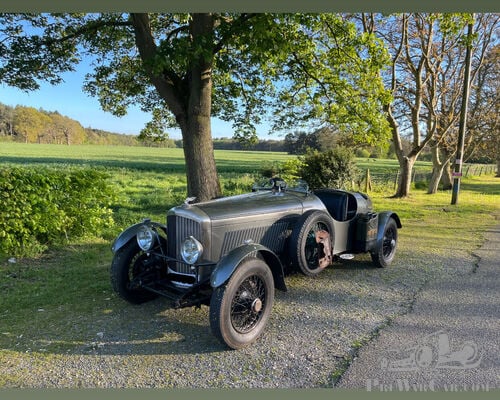
Derby Bentley Special 4-1/4
Sadly i am having to sell on my Bentley special ( Icarus). It is currently a work in progress and still needs finalising/ refining. A great o..

Lagonda LC Tourer 1934
The Lagonda story began in 1901 in Staines, a small town in the UK. The company enjoyed its greatest successes around 1935. During this period, the..

K3 Replica on KN Chassis
"The K3 Magnette must rank in the history books as the most famous and successful of all the record breaking MGs. With only 33 examples produced durin..