The global magazine and marketplace for classic car enthusiasts, by enthusiasts.


Filter
Classic Bugatti, Delahaye for sale - Bugatti, Delahaye cars for sale
-

1931 Bugatti Type 46 'Superprofilée' Coupe
1931 Bugatti Type 46 'Superprofilée' Coupe Chassis no. 46491 Engine no. 345 One of two chassis purchased from Roland Bugatti by Richard Baudens in the 1950s & wearing its first coachwork ever fitted to the car. 5,359cc SOHC Inline 8-Cylinder Eng.. -
1927 Bugatti Type 37A Grand Prix | RM Sotheby's | The Monterey Auction
To Be OFFERED AT AUCTION at RM Sothebys' The Monterey Auction event, 13 - 15 August 2026. $800,000 - $1,100,000 USD Please check back soon as our dedicated cataloguing team is preparing the description for this lot. To view this car and others currently consigned to this auction, please visit the RM website at rmsothebys.com/auctions/mo26/ -
1929 Bugatti Type 44 Tourer by Ghia.
1929 Bugatti Type 44 Tourer by Ghia. Chassis number: 44477 Registration Number: PA3304 (Italy Palermo.) WE WILL NEVER HAVE ANOTHER ONE LIKE IT!!! Simply the mosty original & untouched Bugatti we have ever had the pleasure of selling. This Glorio.. -
1938 Bugatti Type 57 Atalante by Gangloff | RM Sotheby's | The Monterey Auction
To Be OFFERED AT AUCTION at RM Sothebys' The Monterey Auction event, 13 - 15 August 2026. $1,500,000 - $1,800,000 USD A bespoke example for original owner Fernand CrouzetNumerous unique and special details throughout, as specified by Mr. CrouzetContinuously known ownership history since newWell-preserved concou.. -
1937 Delahaye 145 Cabriolet by Franay | RM Sotheby's | The Monterey Auction
To Be OFFERED AT AUCTION at RM Sothebys' The Monterey Auction event, 13 - 15 August 2026. $4,500,000 - $6,000,000 USD One of five competition 12-cylinder 145 chassis producedBelieved to be the car that famously beat Germany’s finest for the Prix du MillionFitted with astonishing custom roadgoing coachwork by Fran.. -
1937 Delahaye 135 Grand Prix | RM Sotheby's | The Monterey Auction
To Be OFFERED AT AUCTION at RM Sothebys' The Monterey Auction event, 13 - 15 August 2026. $250,000 - $400,000 USD Mr. Mann’s proven and very successful longtime vintage racing entrantBuilt by Pascal Morel to period Le Mans specificationRecipient of much sorting over the years by Competition Motors and Marcovicci-Wenz -
Bugatti Type 30 Grand Prix. Interesting history. Genuine Bugatti Molsheim parts
The shape of things to come…The Bugatti Type 30, introduced in 1922, marked a turning point in Ettore Bugatti’s engineering philosophy and it is where he really started to stretch his wings. The Type 30 was the first Bugatti to adopt the company’s new inline eight-cylinder engine, a jewel of engineering born from wartime aero research. At.. -
1937 Bugatti Type 57C
1937 Bugatti Type 57C Chassis Number TBA Freshly serviced & fully gone though by Marque specialist Ivan Dutton. Call For full details & more pictures: Richard Biddulph 07967260673 -
Bugatti 35 B Pur Sang
Bugatti 35 B Pur Sang,importée par un membre délégué de la FFVE il y’a une quinzaine d années.Participation à de nombreux Rallyes Bugatti.Tres bien fiabilisée.Carte grise Française collection.


Bugatti
D:F, 1909 – 1956, 1956 to date
Automobiles E. Bugatti, Molsheim, Bas-Rhin
Ettore Bugatti was perhaps the greatest maker of racing cars until his fellow Italian Ferrari began to dominate the scene in recent years. Born into an artistic family in Milan, Bugatti soon found that the graphic arts were not to his liking and turned to the mechanical. Drawn by speed and racing, at the age of 18 Ettore Bugatti attracted attention in early motorcycle and tricycle races in Northern Italy, enevitably applying his mechanical talent to the improvement and alteration of the machines.
In 1900, at the age of 19 he embarked on the design and production of his own Bugatti 4-cylinder, 90 x 120mm car with the help of Count Gulinelli, and won a medal for it at the Milan Exhibition in 1901. Baron de Dietrich who was attracted by the Bugatti machine and who was searching Europe for designs to produce at his Niederbronn works, signed an agreement with Bugatti to design for him. Bugatti moved to Niederbronn in 1902 to produce in the next two or three years a basic design of 4-cylinder, 114 x 130mm chain-driven chassis with variations, sold commercially as the De Dietrich-Bugatti, or in England as the Burlington, and occasionally raced by Bugatti himself. Engine dimensions varied, as was customary in those days, and larger engines were also listed.
De Dietrich was offering other designs at the same time, particulary the Turcat-Méry, and Bugatti’s car was not a commercial success; the arrangement came to an end around 1904, and Bugatti teamed up with Mathis, moving to Strasbourg, the district where Ettore was to remain for the rest of his active career.
The Mathis collaboration produced the Hermes car, which bore a strong resemblance to the earlier De Dietrich design, certainly in conception – 4 large cylinders, 4-speed gearbox, chain drive, semi-elliptic springs – but by now it had a modern type of radiator with a surrounding shell to replace the earlier exposed film type.
In 1906 Bugatti and Mathis fell out and separated, Bugatti going to the Deutz factory at Cologne to design and produce cars for them. Two chassis were produced, the first another typical 4-cylinder layout with an engine of 145 or 150 x 150mm and chain drive, and later a smaller 92x120mm car with, for the first time Bugatti’s design, a shaft drive.
During this period (about 1908) Bugatti produced at his own expense (and, it is said, in the cellar of his home at Cologne) the miniature Bugatti chassis, with a 4-cylinder, 60x100mm engine, and shaft drive which founded the thoroughbred line of his designs and enabled him later to produce his own car. This prototype (Type 10 in the Bugatti series) is still in existence.
There is at least some evidence that the creation of this Bugatti car owes something to the 1908 Coupe des Voiturettes Isotta Fraschini; it is more than likely that Bugatti saw and was inspired by these beautiful little cars. There is certainly no evidence that the Isotta Fraschini cars owe anything to Bugatti, and their designer Cattaneo has denied the suggestion. The overall conceptual similarity is, however, striking.
Whatever the origins of his thoroughbred, Ettore Bugatti found a backer who would help him to start up production of his own car at the end of 1909, in a disused dye work at Molsheim a few miles west of Strasbourg. Here production was started of the real Bugatti car, with 4-cylinder, 65x100mm, 1327cc and 2 valves per cylinder operated from an overhead camshaft with curved, sliding tappets and three chassis lengths; Bugatti Type 13 with a 6ft 6¾in wheelbase,the Bugatti Type 15, 7ft 10½in, and the Bugatti Type 17, 8ft 4½in and reinforced back springs for heavy bodywork.
Output was a few cars in 1910, but the Bugatti car caused a great deal of favourable comment at the 1910 Paris Salon, and in the early speed events it was entered in; commercial success, in spite of a high price, came immediately and several hundred Bugatti cars had been produced by 1914. During this period Bugatti also sold a licence to Peugeot for an 850cc Baby car(Peugeot Bebe), and kept his interest in large cars by producing a few chassis with a 4-cylinder 5-litre (100x160mm) ohc engine and reverting again to chain drive, for racing. The first chassis went to the aviator Roland Garros and survives as the famous Bugatti Black Bess. Other Bugatti cars competed unsuccessfully at Indianapolis in the 500 mile race in 1914 and 1915.
The early Bugatti 8-valve chassis had conventional semi-elliptic springs and radiators of squarish, 5-sided shape. At the end of 1913, Bugatti introduced his reversed quarter elliptic springs on the two long-length chassis, probably to simplify the fitting of the body: many of Bugatti’s design features show more originality than essential logic. This springs feature was to remain on all Bugatti’s chassis designs produced afterwards. At this time Ettore also introduced his design of oval Bugatti radiator, pearshaped, but later more like an inverted horse shoe.
Just before World War 1 Ettore produced a modified engine for voiturette racing, with 4 valves per cylinder (2 inlet, 2 exhaust), and an enlarged bore (66mm initially, later 68-69mm) giving more power, but the war prevented its use. Molsheim was soon occupied by the Germans and Bugatti found himself spending the next years in Paris working on aero engines.
In 1919 Ettore Bugatti reoccupied the factory himself, finding it happily undamaged, and resumed production of the 8-valve chassis and then the new 16-valve version. Wins at Le Mans in 1920 and at Brescia (1921) in voiturette races once more established his reputation and regular production of the car, now known as the Bugatti Brescia, followed steadily. The long-wheelbase chassis were now known as Bugatti Type 22 (7ft 10½in) and the Bugatti Type 23 (8ft 4½in) but the designation Bugatti Type 13 was retained for the short racing model. Improvements followed such as a crankshaft carried on ball bearings, better crank lubrication, a prettier radiator, and eventually 4-wheel brakes: in spite of these changes the similarity between the last chassis in 1926 and the first in 1910 is striking.
In 1922 Bugatti produced his first 8-cylinder production model, the Bugatti Type 30, with a 2-litre 60x88mm engine, an overhead camshaft and 2 inlet and 1 exhaust valve per cylinder. This 3-valve layout had been seen on the pre-war Bugatti Garros car(Black Bees) and the aero engines. Racing versions were entered in the 1922 French Grand Prix at Strasbourg, Friderich, Bugatti’s faithful mechanic, finishing 2nd. Production continued for the next few years of the 4-cylinder and 8-cylinder cars; an abortive attempt to produce a successful streamlined ‘Bugatti Tank’ with the 2-litre engine was made for the French GP at Tours in 1923 and then for 1924 Bugatti made the successful effort to produce a racing car which combined performance with aesthetic quality – the Bugatti Type 35 was the result.
The new 1924 car had the Bugatti Type 30 engine with its plain bearing crank replaced with a full ball and roller bearing, built-up unit, and a completely new chassis of fine lines carrying a handsome body, and first class brakes inside cast aluminium wheels. Tyre trouble prevented success in its first outing but soon success followed success, culminating in the world championship in 1926.
Although reluctant at first to fit a supercharger as his competitors had, Bugatti eventually in 1926 added one to the car to produce the Bugatti Type 35C (2-litre, 60x88mm), Bugatti Type 35B(2.3-litre, 60x100mm) and Bugatti Type 39 (1.5-litre, 60x66mm). A sports car version (Bugatti Type 35A) used the touring engine, and in 1926 a 4-cilinder (69x100mm, 1.5-litre) engine appeared, similar in layout to the 8-cylinder engine, but with a 5-(plain bearing crankshaft, which when fitted to the GP chassis became the main sports car version (Bugatti Type 37). Later this too had a blower fitted and became very potent (Bugatti Type 37A).
In the period 1926 -1929 a profusion of Bugatti models was listed for sale: racing types T35, T35B, T35C, T39; sports version Types 35A, T37, T37A; the touring model Type 30 replaced with a similar Type 38, later itself replaced by the 3-litre 8-cylinder Type 44 (69x100mm); Type 40 using the 4-cylinder engine from the Type 37; a splendid Bugatti Type 43GP sport four-seater using the Type 35B engine in a long-wheelbase chassis and catalogued as the fastest sports car in the world (110mph) which it was; and to crown all the Bugatti Royale.
The Bugatti Royale (Type 41) was to be Bugatti’s car of kings. It had a 12.7-litre (125x130mm) 8-cylinder engine of typical Bugatti layout producing over 250hp, fitted in an enormous chassis, intended to carry the works of the world’s finest coachbuilders. Although a batch of 25 was projected only six were built and indeed only three were sold (in 1932 – 1933), the financial crisis of 1929 intervening to spoil Bugatti’s plans.
Around 1930 Bugatti continued to produce fine cars mixed with oddities. The Bugatti Type 44 3-litre touring car became the Type 49 with the bore increased from 69 to 72mm, one of the best models. The Bugatti Type 46 5.3-litre with a 3-speed gearbox in the back axle was introduced as a small size Royale and several hundred were produced. A racing Bugatti 16-cylinder (Type 45, 47) was made, having some success in hillclimbs, and later an unsuccessful 4-wheel drive Type 53. The de luxe 5.3-litre had a new twin ohc engine fitted to become the Bugatti Type 50 of 4.9-litres, very exciting and exotic but rather too powerful to be safe, even in the racing version, the Type 54.
The GP Type 35 had a new engine with twin overhead camshafts fitted in 1931 to become the Type 51, a very successful and fine-looking car which was perhaps the most effective racing model Bugatti ever produced, but the search for power and the competition demanded a larger car. Thus in 1933 Bugatti produced the Type 59 3.3-litre racing car which was his last racing production except for specialized single-seaters. Meanwhile a sports version of the Type 51, the Bugatti Type 55, had appeared usually with a roadster body among the handsomest ever fitted to a car.
The touring equivalent of the Type 59, the Bugatti Type 57, was the last Molsheim model to go into production; about 800 T57’s were produced between 1934 and 1939. This had a twin-ohc 72x100mm, 3.3-litre engine, integral 4-speed gearbox, and a conventional Bugatti chassis with semi-elliptic springs at the front and reversed quarter-elliptic at the rear. Later supercharged versions (Type 57C) and sports versions (Type 57S, 57SC) were produced.
Production of Bugatti cars was interrupted by the war, and only sporadic and half-hearted attempts were made ( a few Bugatti Type 101 models were produced) to resume car manufacture after Ettore Bugatti’s death in 1947. In 1956 two Formula 1 GP cars were built. Known as the Bugatti Type 251, they had 2½-litre straight-8 engines mounted transversely behind the driver in a space frame. One was driven by Trintignant in the 1956 French GP at Reims, but retired, and the cars were never heard of again.
Bugatti is now part of the Volkswagen group and is still producing sport cars.
Source: Georgano, encyclopedia of motorcar; HGC
The information is written with the greatest of care. However, if you have any suggested amendments please contact us at office@prewarcar.com
Delahaye
France, 1894 – 1954
(1) Emile Delahaye, Tours, Paris, 1894 – 1898
(2) L. Desmarais et Morane, Tours, Paris, 1899 – 1906
(3) Automobiles Delahaye, Paris, 1906 – 1954
The Delahaye firm was established in 1845 and initially produced brick-making machinery, later launching out into stationary engines. The first Delahaye cars were very much on Benz lines with slow-running, rear-mounted horizontal engines and belt transmission. Radiators and frames were tubular; Archdeacon and Delahaye himself took 4th and 6th places respectively in the Paris-Marseilles-Paris Race of 1896, though the Delahaye firm took little interest in competition and their last appearance was in the Paris-Vienna (1902). By contrast, Delahaye were very interested in commercial vehicles, which made their debut in 1898 and bulked larger and larger in later years. In 1898 a 1.4-litre single and twins of 4½hp and 6hp were being made, the Paris Delahaye works were opened, and Charles Weiffenbach joined the Delahaye firm as Chief Engineer, a post he was to retain until after World War 2. By 1899, 600 Delahaye cars had been delivered, and production was running at 20 Delahaye’s a month. Emile Delahaye himself retired in 1901, when wheel steering was standardized, though the old belt-driven designs were still catalogued as late as 1904, and there was even a short-lived 1902 Delahaye model with front vertical engine and belt drive. More advanced was Delahaye Type 10B, a 2.2-litre 4-cylinder, still with aiv, but with Panhard styling, final drive by side chains, and detachable cylinder heads; this was followed by a bigger 4.4-litre Delahaye car said to develop 28bhp.
In 1904 detachable heads were found on both the 2.7-litre Delahaye Type 15B twin at £420, and on a big 4.9-litre 4-cylinder Delahaye car which also had a water-cooled exhaust system. T-head engines, gate change, and ht magneto ignition made their appearance in 1905, when the range included two twins and three 4-cylinder cars, the largest an 8-litre. The King of Spain bought one of these big Delahaye cars, with two hand and two foot brakes, and a foot-operated decompressor, in 1906. In 1907 licence-production of the Delahaye make was undertaken in Germany by Presto, transverse rear suspension was featured, and the small 2-cylinder model acquired shaft drive. In the usual French tradition L-head Monobloc engines appeared in 1908 on the 1.9-litre 12/16hp (Delahaye Type 32), but the chain-driven cars were listed as late as 1911. An even smaller 1.2-litre 4-cylinder Delahaye sold for £240 in 1909, and the new monobloc engines were used by White in America as the basis for their first petrol car, the 20/30. 1911 brought an interesting departure in the shape of the 3.2-litre Delahaye Type 44, a blockcast V6 with 4-speed gearbox. It sold for £470 in England, and this Delahaye was still being made in 1914. A 4-cylinder car was used for tests with the Parry Thomas electric transmission. Apart from such ingenious features as pressure lubcrication to the spring shackles, the other 1914 Delahaye models were conventional monobloc 4-cylinder machines, available with detachable wheels and electric lighting. They came in 1.6-litre, 2.3-litre, 2.6-litre, 3-litre, 4-litre and 5.7-litre sizes, all but the smallest with 4-speed gearboxes.
After World War 1 the Delahaye company settled down to 14 years of stodgy, dependable, and uninteresting cars, now with full electrical equipment and V-radiators, though at first the foot-operated transmission brake was retained. 4-cylinder Delahaye models were sold with 2.6-litre and 3-litre sv engines, but there was also a 4.1-litre six (Delahaye Type 82), with the unusual combination of detachable head and valve caps, which acquired front wheel brakes in 1921. All other Delahaye models were so equipped by 1925, but in the meanwhile the firm was ringing the changes on a complicated and dull range which included a 1.8-litre in sv and ohv versions, and two bigger inlet over exhaust fours, the 2.4-litre Delahaye 15/35hp and the 2.9-litre Delahaye 18/40hp. 4-speed gearboxes, pump cooling, and wooden wheels were regular features. In 1927 Delahaye formed a consortium with Chenard-Walcker, Donnet and (for a short while only) Unic, which was supposed to rationalize production, and did to the extent that it was hard to distinguish the 6-cylinder Delahaye for sale from its Chenard-Walcker counterpart, though the former had full overhead valves and the latter inlet over exhaust. These sixes appeared in 1928, the Delahaye cars coming in 2.5-litre and 2.9-litre sixes, with magneto ignition up to 1929, and coil thereafter. 1929 was also the last year for the V-radiatored Delahaye for sale, which gave way to an American-style ribbon-type. In 1930 there were also two 4-cylinder models, the smaller a straight-forward sv 1½-litre (Delahaye Type 109), which was still listed in 1932. A bigger 6-cylinder for sale (Delahaye Type 126) pointed the way to better things, and in 1934 independent front suspension was offered on the 2150cc Delahaye Super 12 4-cylinder and on the Delahaye 18CV Superlux, an ohv 6-cylinder which was also available with a Wilson gearbox.
In 1935 Delahaye bought the ailing Delage company, and in 1936 Delahaye were supplying 2.2-litre ohv 4-cylinder engines to Amilcar for installation in that firm’s Pégase model. More important, they had come out with two exciting 6-cylinder sports Delahaye models, both with ohv push-rod engines, independent front suspension, Bendix brakes, and synchromesh or Cotal gearboxes; the 3.2-litre Delahaye Coupe des Alpes had 110bhp, and the 3.5-litre Delahaye Type 135 120bhp. Both were capable of over 100mph in standard form, and the Delahaye 135s proceeded to take 2nd, 3rd, 4th and 5th places in the 1936 French Sports Car Grand Prix, following this up by wins in 1937 and 1939 Monte Carlo Rallies, and at Le Mans in 1938. A Delahaye type 135 also won the controversial ‘Fastest Sports Car Race’ at Brooklands in 1939, where the opposition included a 2.9-litre Alfa Romeo. There was a long-chassis version of Type 135, the Delahaye Type 148, and in 1937 came the Jean Francois-designed Delahaye Type 145, a short stroke 4½-litre ohv V12 with Cotal gearbox and De Dion rar axle; its output was 238bhp, and the two-seater was capable of 165mph. Delahaye tried very hard with this car during the 1938 GP season, even beating Mercedes-Benz at Pau, as well as finishing 4th in the Mille Miglia – a remarkable double. The Delahaye was outclassed, however, and even more so in 1939, despite the introduction of a single-seater version. A very few ‘cooking’ V12s with conventional rear axles, hydraulic brakes, and exotic roadster coachwork were sold by Delahaye in 1939 at £1485; though the 135 continued to do well.
During World War 2 Delahaye joined Baron Petiet’s G.F.A. (Groupe Francaise Automobile) selling organization, these initials appearing on the radiator badges of all post-war Delahaye cars, though the group ceased production in 1952. Production of the 4-cylinder Delahaye 134 as well as the Delahaye 135 was resumed in 1946, though the former did not last long. Output of the sports cars was now 130bhp, and narrower, more ornate radiator grilles were used. In 1948 came the 4½-litre Delahaye Type 175 series with hydraulic brakes; output was quoted as 185bhp, but they were not a success and were dropped from the range in 1951. Penal taxation was in any case making life difficult for France’s quality-car makers, and combined Delahaye and Delage sales dropped from 483 in 1950 to only 77 in 1951. In which year Delahaye won the Monte Carlo Rally for the second and last time. It also marked the introduction of the Delahaye company’s last new designs – a Delahaye jeep-type 4x4 with all-round independent suspension, and an improved 3½-litre, the Delahaye Type 235 with aerodynamic bodywork, its output increased to 152bhp, and still with mechanical brakes. The marque was still exhibiting at the Salon in 1953, but the following year Delahaye merged with Hotchkiss, and under the new management only trucks were made. After 1956 these too only bore the name of Hotchkiss.
Source: Georgano, encyclopedia of motorcar; MCS
The information is written with the greatest of care. However, if you have any suggested amendments please contact us at office@prewarcar.com


Featured

1915 Rolls-Royce Silver Ghost Barker Tourer
⁃ An exceptionally rare original bodied pre-war Silver Ghost⁃ Desirable Barker tourer in exciting barn find condition⁃ ..
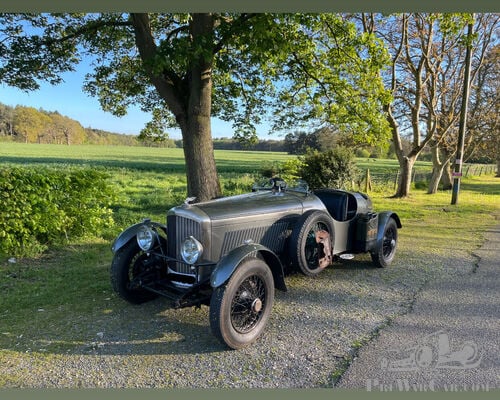
Derby Bentley Special 4-1/4
Sadly i am having to sell on my Bentley special ( Icarus). It is currently a work in progress and still needs finalising/ refining. A great o..

Alfa 6C1750 Spider
Alfa 6C1750 Spider with complete history from delivery in 1930 to first owner in Firenze till today with copy Libretto/license plate all the years