The global magazine and marketplace for classic car enthusiasts, by enthusiasts.


Filter
Classic D.K.W., Hanomag for sale - D.K.W., Hanomag cars for sale
-

Morris 8 1936 Rolling Chassis + Series E Engine + 4 speed Gearbox
Rare opportunity to acquire a Morris 8 1936 Rolling chassis to build a 1930s style special. Complete Rolling chassis includes following parts.Complete Chassis frame, Rear Axle with Crown Wheel & Pinion and Prop shaft, rear leaf springs, , front shock absorbers, 5 spoked 17” wheels, bishop cam Steering box (Overhauled), steering.. -
1931 Chrysler CG Imperial Convertible Coupe by LeBaron | RM Sotheby's | Sealed June
To Be OFFERED AT AUCTION at RM Sothebys' Sealed June event, Bidding Closes 24-26 June 2026. $225,000 - $275,000 USD Please check back soon as our dedicated cataloguing team is preparing the description for this lot. To view this car and others currently consigned to this auction, please visit the RM website at rmsothebys.com/auctions/s0626/ -
1933 Franklin Series 17-B Twelve Limousine | RM Sotheby's | Sealed June
To Be OFFERED AT AUCTION WITHOUT RESERVE at RM Sothebys' Sealed June event, Bidding Closes 24-26 June 2026. Offered Without Reserve | $150,000 - $200,000 USD Please check back soon as our dedicated cataloguing team is preparing the description for this lot. To view this car and others currently consigned to this auction, please visit the RM web.. -
1926 Rolls Royce 20hp Barker Barrel Sided Tourer
1926 Rolls Royce 20hp Barker Barrel Sided Tourer Call Richard 07967260673 for full pictures & details. An impeccable fully restored car with massive bills & original Barker Barrel sided body & colonial bonnet. Interesting history. -
1928 Triumph Super 7 Faux Cabrio Fabric bodied by Hoyal
1928 Triumph Super 7 Faux Cabrio Fabric bodied by Hoyal Registration Number: VP4380 Nut & bolt restored to as new. This is believed to be the only surviving example of the Triumph Super 7 with a fabric covered faux Cabrio body coachbuilt by Hoyal of Weybridge. The car has been fully rebui.. -
Ford model T 1914 touring
Very correct car in good restored condition . Runs good . Nothing to complain about !! -
1927 Franklin Series 11-B Sport Runabout by Walker | RM Sotheby's | Sealed June
To Be OFFERED AT AUCTION WITHOUT RESERVE at RM Sothebys' Sealed June event, Bidding Closes 24-26 June 2026. Offered Without Reserve | $50,000 - $75,000 USD Please check back soon as our dedicated cataloguing team is preparing the description for this lot. To view this car and others currently consigned to this auction, please visit the RM websi.. -
1928 Franklin Series 12-A Airman Convertible Sedan by Walker | RM Sotheby's | Sealed June
To Be OFFERED AT AUCTION WITHOUT RESERVE at RM Sothebys' Sealed June event, Bidding Closes 24-26 June 2026. Offered Without Reserve | $60,000 - $80,000 USD Please check back soon as our dedicated cataloguing team is preparing the description for this lot. To view this car and others currently consigned to this auction, please visit the RM websi.. -
1927 Rolls-Royce 20HP Open-Drive Brougham
Vintage and Prestige are proud to offer 1927 Rolls-Royce 20HP Open-Drive Brougham For SaleRegistration: FOE147Chassis no: GUJ 47This stunning 20HP will certainly be noticed along the road; finished in the striking colour combination of Yellow and Black, with yellow wire wheels to match. The door surround is also.. -
1902 Oldsmobile Curved-Dash
Chassisnumber: 4640Engine number: 4640 This 1902 Oldsmobile curved-dash "R" as it was called is the 15th oldest in the club register and the second oldest in EuropeIt's a monocylindre of around 1600cc and the steering is by means of a tiller, maybe more direct than a steering wheelAs member of the ..


D.K.W.
D, 1928 – 1966
(1) Zschopauer Motoren-Werke J.S. Rasmussen-Zschopau; Berlin-Spandau, 1928 – 1939
(2) Auto Union GmbH, Düsseldorf, Ingolstadt, 1950 – 1966
DKW was already a well-known producer of motorcycles when the firm’s first DKW car appeared in 1928 at the Leipzig Fair. It was produced in the former D-wagen works in Berlin, which were taken over by DKW. This first DKW model was characterized by its 2-stroke engine, a principle which DKW used for their DKW motorcycles and which they followed up to the end in 1966. The 584cc 2-cylinder engine developed 16.5bhp. The DKW car was a chassis-less wood-framed construction by Slaby (S.B.). A very popular two-seater sports version with an 18bhp engine was developed from this model. In 1930 the ‘DKW 4/8’ with a 780cc 22bhp engine appeared. 1931 saw the debut of DKW front-driven cars, the F1 with a 490cc and the DKW F2 with a 584cc engine. The front-wheel drive principle was adopted for several subsequent DKW models. In 1932 DKW became a member of the Auto Union Group. The 2-cylinder front-driven 589cc Reichsklasse and 684cc Meisterklasse and the DKW V4 rear-driven models 1054cc Sonderklasse and Schwebeklasse were among the most popular German cars up to 1939.
In 1945 the DKW works were nationalized together with all other Auto Union plants. Auto Union was re-established in 1949 in Düsseldorf and production of the first post-war DKW started in 1950. It was a 2-cylinder 2-stroke 690cc model called the DKW Meisterklasse F89, mechanically based on the last pre-war DKW model but with a new body. A range of DKW Sonderklasse models followed with a 3-cylinder 896cc engine; these were also known by the designation ‘DKW 3/6’ and were based on a 1940 prototype. The ‘1000’ model (3-cylinder, 981cc) was not marketed under the name DKW, but only as the Auto Union, although it was a true DKW. The Junior and the F11, F12 and F102 also had 3-cylinder 2-stroke engines but different bodies from the former models. All post-war DKW models had front-drive.
In 1957/1958 a sports vesion, the DKW Monza, was produced by Fritz Wenk of Heidelberg; ‘3/6’ 896cc, 40bhp and ‘1000’ 981cc, 44bhp engines were used, the latter also in a tuned version developing 55bhp. Chassis were original DKW while the bodies were specially made of fiberglass. This DKW model gained five world records at the Monza circuit and also was successful in several international ocmpetitions. DKW engines were available in several tuned versions and used for Formula Junior racing.
DKW cars are built in Brazil under licence by DKW-Vemag. The nationalized East-German factory also produced DKW’s , in 2- and 3-cylinder form, until 1956. In 1966 production of DKW cars was given up.
Source: Georgano, encyclopedia of motorcar; HON
The information is written with the greatest of care. However, if you have any suggested amendments please contact us at office@prewarcar.com
Hanomag
D, 1924 – 1939
Hannoversche Maschinenbau AAG vorm. Georg Egestorff, Hanover-Linden
Hanomag was founded before the turn of the century and was a well-known producer of locomotives when they made their first acquaintance with Hanomag road vehicles in 1905, producing steam lorries under Stolz patents. The first Hanomag private car appeared in 1924, and was the Hanomag 2/10ps two-seater, commonly known in Germany as the Hanomag Kommisbrot (army loaf). It was quite an unconventional design. The narrow wheeltrack eliminated the need for a differential, while the unique all-enveloping body nevertheless enabled two passengers to sit side by side. The single-cylinder ohv 499cc engine on the Hanomag Kommisbrot, was mounted in the rear, the axle being driven by chain. The Hanomag Kommisbrot was in production until 1928, by which time 15.775 had been built. It was followed by a conventional Hanomag 3/16ps sv 4-cylinder car and a number of other Hanomag models. Of these the Hanomag Garant and Hanomag Kurier (both of 1.089cc), Hanomag Rekord (1.494cc) and the Hanomag Sturm (6-cylinder, 2.250cc) were very popular. The latter two Hanomag models were also available in very attractive open tw-seater versions. Hanomag cars were successful in rallies and trials. The Hanomag car company pioneered the use of diesel engines in private cars and presented the Hanomag Rekord Diesel with a 1.910cc engine developing 35bhp in 1936. A world record for diesel-engined cars was gained in 1939 by an aerodynamic version of the Hanomag Rekord Diesel, which achieved a top speed of 95mph from a flying start. A 6-cylinder diesel engine was designed but was never used in a car because of the outbreak of World War 2. An aerodynamic 1.3-litre Hanomag saloon introduced in 1939 was credited with over 70mph for only 32bhp.
After the war Hanomag presented a new private car, the Hanomag Partner, at the Frankfurt Motor Show of 1951. This Hanomag was a front-driven three-seater with a 3-cylinder 2-stroke 697 engine. Although it was a very promising design this Hanomag car did not go into production. Hanomag today is an important producer of lorries and vans of up to 3½-tons payload.
Source: Georgano, encyclopedia of motorcar; HON
The information is written with the greatest of care. However, if you have any suggested amendments please contact us at office@prewarcar.com


Featured
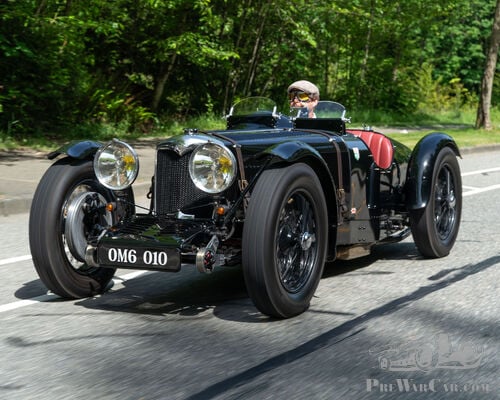
Riley 14/6 Special 1933
The ExperienceStep into the golden age of British motoring. This 1933 Riley 14/6 Special is a masterclass in pre-w..
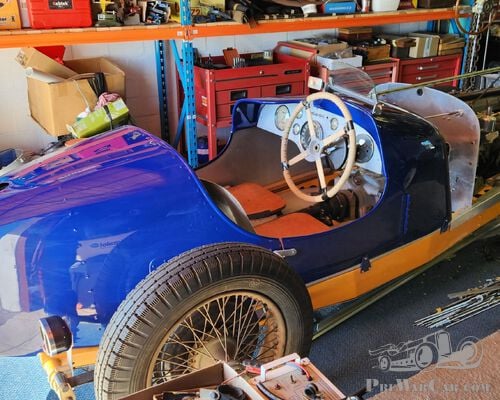
Riley TT Sprite
1935 6-cylinder TT Sprite replica. Chassis # 46A2722. Engine # 6A2722. Original Ulster Imp body. Restoration nearing completion. Engine, G..

Lagonda LC Tourer 1934
The Lagonda story began in 1901 in Staines, a small town in the UK. The company enjoyed its greatest successes around 1935. During this period, the..