The global magazine and marketplace for classic car enthusiasts, by enthusiasts.


Filter
Classic Hupmobile, Stoewer for sale - Hupmobile, Stoewer cars for sale
-

1924 Stoewer type D3 roadster
Rare opportunity to buy a vintage 1924 Stoewer type D3 roadster in fully restored condition. More than € 50K were spent in 2018 and 2019 on its restoration . Detailed work invoices come with the car. A video can be sent on request . Price € 64000 ex Eibergen Netherlands imported EEC. -
Mid 1920s Hupmobile R series open tourer project car
Mid 1920s Hupmobile R series open tourer project car. Chassis N° R 179775, castingnumber on engine 52900. Very good condition older restored chassis. Also work done on both engine and rearaxle. Radiator shell is straight but needs to be renickeled. A number of smaller parts are in boxes and not shown. Suitable inexpensive project car fo..


Hupmobile
US, 1908 – 1940
Hupp Motor Car Corp., Detroit, Mich.; Cleveland, Ohio
Robert and Louis Hupp, the founders of the Hupmobile company, started with a 2.8-litre 4-cylinder light runabout, with two bucket seats and a bolster tank, distinguished by a 2-speed sliding-type gearbox. This Hupmobile car sold for $750 and was joined in 1911 by a Hupmobile touring car with 3 forward speeds and a longer wheelbase of 9ft 2in, listed at only $900. Hupmobile, like Dodge and Chevrolet, adhered to the 4-cylinder sv unit for many years and made nothing else until 1924, though the Hupmobile cars acquired electric lighting and starting in 1914. A Hupmobile car with a 10ft 6in wheelbase was made available for seven-seater bodywork in 1916. Sales were good: 12.000 Hupmobile cars in 1913, and climbing up to 38.000 by 1923. By 1918 a rounded cowl and bonnet line had replaced the original angular configuration and fuel feed was by vacuum from a tank at the rear. Open Hupmobile car models were listed at $1.250. Aluminium pistons were featured in 1924 and balloon tyres on the Hupmobile car in 1925, the last year of the four. Interestingly enough, Hupmobile’s 4-litre straight-8 appeared in 1925, a year before the first six. This Hupmobile car was a conventional machine with contracting Lockheed hydraulic brakes, mechanical actuation being used on the 6-cylinder Hupmobile cars. The Hupmobile car company stayed in the medium-price field, sixes selling at $1.295 in 1929, while prices of the Hupmobile M-series sv eight started at $1.825. In 1929 Chandler’s plant in Cleveland was acquired and was used for the manufacture of the less expensive Huppmobile Hupps. Like most of America’s independent makes, the Hupmobile car company was hit hard by the Depression, sales of Hupmobile cars dropping from 50.374 in 1929 to 17.450 in 1931, although in the next two years, in 1932 and 1933 some very handsome Hupmobile cars were made.
In 1934 the Hupmobile Aerodynamic range with three-piece wrap-around windscreens and headlamps faired into the bonnet sides appeared. An experimental front wheel drive version was not proceeded with. The aerodynamic Hupmobile cars were made in 4-litre, 6-cylinder and 5-litre straight-8 forms, but sales were poor and the Hupmobile car factory closed down halfway through the 1936 season. It was reopened, but the 1937 and 1938 Hupmobile cars were of little interest apart from the standardization of automatic overdrive on the eights. Like Graham, Hupmobile tried to stay in business by adapting the body dies on the discontinued 810/812 Cord series to their conventional running gear. These Hupmobile Skylarks were built in the Graham factory; the last Hupmobile cars were completed in July 1940, but were sold as 1941 models.
Source: Georgano, encyclopedia of motorcar; MCS
The information is written with the greatest of care. However, if you have any suggested amendments please contact us at office@prewarcar.com
Stoewer
D, 1899 – 1939
(1) Gebrüder Stoewer, Fabrik für Motorfahrzeuge, Stettin, 1899 – 1916
(2) Stoewer-Werke AG vorm. Gebr. Stoewer, Stettin, 1916 – 1939
The Stoewer car factory developed out of the Stoewer ironworks and was among the pioneers of the German car industry. After manufacturing motor cycles, tricycles and quadricycles for two years, Stoewer turned to cars in 1899. The first Stoewer car had a rear-mounted 2-cylinder engine. 4-cylinder Stoewer cars followed in 1901, and electric Stoewer cars were also produced. Best known were the 2-cylinder Type T Stoewer car (2.280cc and 3/12PS), the 4-cylinder Stoewer P4 (3.052cc and 11/22PS), the Stoewer G4 (1.500cc and 6/12PS) and the 6-cylinder Stoewer P6 (8.820cc and 34/60PS), evolved in the 1905-1907 period all Stoewer cars with shaft-drive. The Stoewer B1 of 6/16PS and the Stoewer B6 of 9/22PS which appeared in 1910 were also built by Mathis under licence. The G4 Stoewer car was the basis for the Stoewer B5, which Stoewer car in 1912 became famous by setting up a record at Brooklands with 67.7mph. The new range of Stoewer cars which appeared in 1913 was also based on successful earlier cars. They were the Stoewer C1 (6/18PS), Stoewer C2 (10/28PS) and C3 Stoewer car (6-cylinder and 19/45PS). Shortly before the outbreak of World War 1 the Stoewer car range was headed by the F4 Stoewer car with a 4-cylinder, 8.8-litre 33/100PS ohc engine. After the war an enormous Stoewer car appeared, the Stoewer D7, using a 6-cylinder 11.2-litre 42/120PS aero engine, as well as some conservative sv 4- and 6-cylinder Stoewer cars with rear wheel and transmission brakes. Front wheel brakes appeared on Stoewer cars in 1925. Stoewer introduced 8-cylinder Stoewer cars in 1928. These were the Stoewer Superior, Stoewer Marschall, Stoewer Gigant and Stoewer Repräsentant with engines ranging from 2-litres and 45bhp to 4.9-litres and 100bhp. The Stoewer car firm re-entered the economy class in 1931 with the V5, a front-driven Stoewer car with a V4 1.188cc engine, followed by the front-drive models R140 (1.369cc), R150 (1.488cc) and R180 (1.769cc). Another 8-cylinder was the front wheel drive Greif V8 with a 2.488cc engine, which was replaced by the conventional 6-cylinder 3.609cc Arcona Stoewer car in 1938. In 1934 the 1½-litre 4-cylinder Stoewer car and 2½-litre V8 Stoewer car were shown at the Brussels Salon by Monsieur Dewaet under the name D.S. (Dewaet-Stoewer). The Greif Junior was built under Tatra licence with an opposed 4-cylinder 1.474cc engine. It succeeded the Röhr Junior. In the middle of the range was the Stoewer Sedina with a 4-cylinder engine of 2.4-litres.
Production of private Stoewer cars was given up at the outbreak of World War 2 in 1939. The Stoewer car factory was destroyed during the war and production of Stoewer cars was not resumed.
Source: Georgano, encyclopedia of motorcar; HON
The information is written with the greatest of care. However, if you have any suggested amendments please contact us at office@prewarcar.com


Featured

K3 Replica on KN Chassis
"The K3 Magnette must rank in the history books as the most famous and successful of all the record breaking MGs. With only 33 examples produced durin..
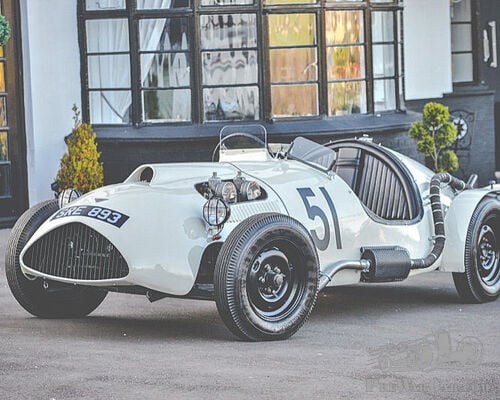
1933 Alvis 3.0 Special - One-Off Alloy Body | Period Competition Car | Featured in “Alvis – A Century of Drivers”
1933 Alvis 3. 0 Special - One-Off Alloy-Body | Period Competition Car | Featured in “Alvis – A Century of Drivers”
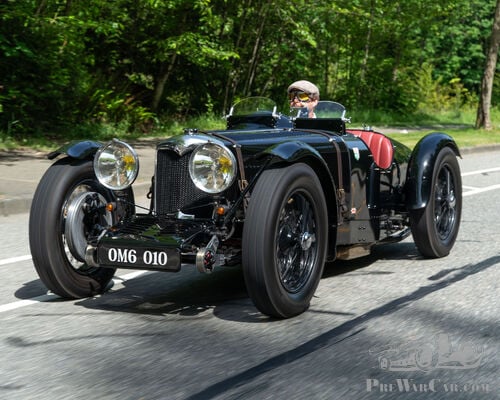
Riley 14/6 Special 1933
The ExperienceStep into the golden age of British motoring. This 1933 Riley 14/6 Special is a masterclass in pre-w..