The global magazine and marketplace for classic car enthusiasts, by enthusiasts.


Filter
Classic International, Stoewer for sale - International, Stoewer cars for sale
-

1924 Stoewer type D3 roadster
Rare opportunity to buy a vintage 1924 Stoewer type D3 roadster in fully restored condition. More than € 50K were spent in 2018 and 2019 on its restoration . Detailed work invoices come with the car. A video can be sent on request . Price € 64000 ex Eibergen Netherlands imported EEC. -
1901 International Charette 6HP - VCC Dated
1901 International Charette 6HP Double Phaeton Engine No. 62 Engine Displacement. 823VCC Dated 8 time London to Brighton finisher The International Motor Car Company, of London, England, was not related in any way to the more famous International Harvester Company of the United..


International
GB, 1898 – 1904
(1) International Motor Car Co, London, 1898 – 1900
(2) International Motor Car Co Ltd, London, 1900 – 1904
Oscar Seyd’s firm never built a car, though some International car offerings were assembled in their Great Portland Street Showrooms and a certain amount of work was also undertaken at the service depot in Kilburn, where International cars had been operating since 1896. The original International-Benz was in fact a French-built Roger, a car which had become hard to sell in France; International added their own improvements to the International car, among them a reverse, a British-built version of the ‘Crypto’ gear and bodywork made to their order. Single- and twin-cylinder variations on the Benz theme were offered until 1901, later International car being German-built after the demise of M. Roger’s company. In 1899 International presented a ‘light two-seater racing car’ with wheel steering, a Benz-based 12hp with wheel steering, pneumatic tyres and double phaeton coachwork on the International car at £800, and a 9hp ‘vibrationless’ flat-twin (not on Benz lines) in addition to their regular range of International car. International cars became a limited liability company in 1900, when two Coventry firms, Payne and Bates (Godiva) and Allard, were approached to make a new design for the International car. The Payne and Bates-built International car(possibly the twin-cylinder Royal with steel frame and wheel steering, offered for £367 10s) proved unsatisfactory, but Allard’s effort, the International Charette, introduced in November 1900, sold in some numbers. This International Charette car was a belt-driven light car with front vertical 823cc engine of De Dion type (designed to run at only 1.000rpm), a coal-shovel shaped bonnet and rack-and-pinion steering. It sold for £165. Early International cars were rated at 5hp (later increased to 6hp) and there were 2-speed and 3-speed variants. All International Charette chassis were delivered to London under their own power. This type International car was not offered after 1903 and apart form the Mountaineer motorcycle, the later cars of the International company were of French origin. The International Armstrong (1902) was a single-cylinder 1.100cc machine with shaft drive on Renault lines and this gave way in 1903 to the Aster-engined Portlands, also shaft-driven and offered in a variety of sizes from a 6hp single at £205 up to a big 24hp 4-cylinder car with a 4-speed gearbox.
The smallest International car, the Portland was still available in 1904, but by this time the International car company was mainly concerned with importing the Diamant car. International were defunct by 1905.
US, 1900
International Motor Carriage Co, Stamford, Conn.
This International car company showed a light car with a 2-stroke engine designed to run on paraffin at the Madison Square Garden show in 1900, but this International car did not go into production.
Source: Georgano, encyclopedia of motorcar; MCS, GNG
The information is written with the greatest of care. However, if you have any suggested amendments please contact us at office@prewarcar.com
Stoewer
D, 1899 – 1939
(1) Gebrüder Stoewer, Fabrik für Motorfahrzeuge, Stettin, 1899 – 1916
(2) Stoewer-Werke AG vorm. Gebr. Stoewer, Stettin, 1916 – 1939
The Stoewer car factory developed out of the Stoewer ironworks and was among the pioneers of the German car industry. After manufacturing motor cycles, tricycles and quadricycles for two years, Stoewer turned to cars in 1899. The first Stoewer car had a rear-mounted 2-cylinder engine. 4-cylinder Stoewer cars followed in 1901, and electric Stoewer cars were also produced. Best known were the 2-cylinder Type T Stoewer car (2.280cc and 3/12PS), the 4-cylinder Stoewer P4 (3.052cc and 11/22PS), the Stoewer G4 (1.500cc and 6/12PS) and the 6-cylinder Stoewer P6 (8.820cc and 34/60PS), evolved in the 1905-1907 period all Stoewer cars with shaft-drive. The Stoewer B1 of 6/16PS and the Stoewer B6 of 9/22PS which appeared in 1910 were also built by Mathis under licence. The G4 Stoewer car was the basis for the Stoewer B5, which Stoewer car in 1912 became famous by setting up a record at Brooklands with 67.7mph. The new range of Stoewer cars which appeared in 1913 was also based on successful earlier cars. They were the Stoewer C1 (6/18PS), Stoewer C2 (10/28PS) and C3 Stoewer car (6-cylinder and 19/45PS). Shortly before the outbreak of World War 1 the Stoewer car range was headed by the F4 Stoewer car with a 4-cylinder, 8.8-litre 33/100PS ohc engine. After the war an enormous Stoewer car appeared, the Stoewer D7, using a 6-cylinder 11.2-litre 42/120PS aero engine, as well as some conservative sv 4- and 6-cylinder Stoewer cars with rear wheel and transmission brakes. Front wheel brakes appeared on Stoewer cars in 1925. Stoewer introduced 8-cylinder Stoewer cars in 1928. These were the Stoewer Superior, Stoewer Marschall, Stoewer Gigant and Stoewer Repräsentant with engines ranging from 2-litres and 45bhp to 4.9-litres and 100bhp. The Stoewer car firm re-entered the economy class in 1931 with the V5, a front-driven Stoewer car with a V4 1.188cc engine, followed by the front-drive models R140 (1.369cc), R150 (1.488cc) and R180 (1.769cc). Another 8-cylinder was the front wheel drive Greif V8 with a 2.488cc engine, which was replaced by the conventional 6-cylinder 3.609cc Arcona Stoewer car in 1938. In 1934 the 1½-litre 4-cylinder Stoewer car and 2½-litre V8 Stoewer car were shown at the Brussels Salon by Monsieur Dewaet under the name D.S. (Dewaet-Stoewer). The Greif Junior was built under Tatra licence with an opposed 4-cylinder 1.474cc engine. It succeeded the Röhr Junior. In the middle of the range was the Stoewer Sedina with a 4-cylinder engine of 2.4-litres.
Production of private Stoewer cars was given up at the outbreak of World War 2 in 1939. The Stoewer car factory was destroyed during the war and production of Stoewer cars was not resumed.
Source: Georgano, encyclopedia of motorcar; HON
The information is written with the greatest of care. However, if you have any suggested amendments please contact us at office@prewarcar.com


Featured
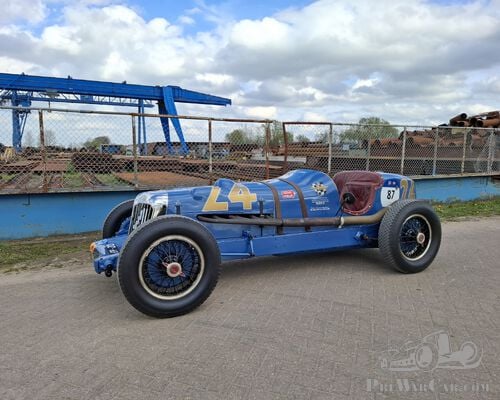
1932 - Graham " Lucenti " Indianapolis
Original participant of the 1932, 1934 and 1935 Indy 500. Best result: finishing 10th overall in the 1934 Indy 500 with driver “Herb” Ardinger...
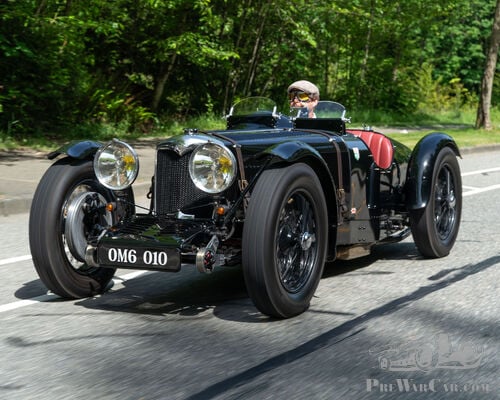
Riley 14/6 Special 1933
The ExperienceStep into the golden age of British motoring. This 1933 Riley 14/6 Special is a masterclass in pre-w..

1915 Rolls-Royce Silver Ghost Barker Tourer
⁃ An exceptionally rare original bodied pre-war Silver Ghost⁃ Desirable Barker tourer in exciting barn find condition⁃ ..