The global magazine and marketplace for classic car enthusiasts, by enthusiasts.


Filter
Classic Mitchell, Stoewer for sale - Mitchell, Stoewer cars for sale
-

Mitchell Type R Raceabout 1911
Een “race” wagen uit de vroege jaren 1910 , Voorzien van een indrukwekkende kop klep motor die 30 PK leverd. De motor heeft een startmotor , en slaat makkelijk aan. De versnellingsbak heeft 3 versnelling en is normaal te bedienen. Deze Mitchell is goed rijdend. De Mithchell was .. -
1924 Stoewer type D3 roadster
Rare opportunity to buy a vintage 1924 Stoewer type D3 roadster in fully restored condition. More than € 50K were spent in 2018 and 2019 on its restoration . Detailed work invoices come with the car. A video can be sent on request . Price € 64000 ex Eibergen Netherlands imported EEC.


Mitchell
US, 1903 – 1923
(1) Mitchell Motor Car Co, Racine, Wisc., 1903 – 1910
(2) Mitchell-Lewis Motor Co, Racine, Wisc., 1910 – 1916
(3) Mitchell Motors Co Inc, Racine, Wisc., 1916 – 1923
Mitchell and Lweis had been wagon builders since 1834, and their first Mitchell car was a light two-seater powered by a 7hp air-cooled 2-cylinder engine, using single chain drive, and priced at $1.200. In 1905 a 9hp engine was used on the Mitchell car, and air or water cooling was available. 4-cylinder engines of 18 and 30hp appeared in the 1906 Mitchell car range, and in 1907 shaft drive was employed on all Mitchell car models. Until 1910, 20 and 35hp fours were made, having pair-cast cylinders in 1910 when they were joined by a 50hp 6-cylinder Mitchell car. In 1913 a new range of T-head engines was introduced in a Mitchell car designed by René Petard and known as the ‘American-built French car’. A 40hp four and 50 and 60hp sixes were made in this Mitchell car range, which had high-cowled torpedo-style bodies and electric starters. Piston strokes were very long at 7 inches. At this time it was said that the Mitchell car company made 96% of all components. In 1916 a short-lived Mitchell 48hp V8 was made, and the following year the Mitchell car company settled down to making a range of conventional sixes of no great distinction. In 1920 a sloping radiator gave rise to the epithet, ‘the drunken Mitchell’ and this was hastily replaced by a vertical radiator for 1921. However, the company had lost a lot of money on their 1920 Mitchell car models, and few of the redesigned Mitchell cars were sold, as they lacked any distinctive qualities.
The 6-cylinder engines of the Mitchell car had acapacity of 4.7-litres. After production ceased in 1923, the Mitchell car factory was bought by Nash.
Source: Georgano, encyclopedia of motorcar; GNG
The information is written with the greatest of care. However, if you have any suggested amendments please contact us at office@prewarcar.com
Stoewer
D, 1899 – 1939
(1) Gebrüder Stoewer, Fabrik für Motorfahrzeuge, Stettin, 1899 – 1916
(2) Stoewer-Werke AG vorm. Gebr. Stoewer, Stettin, 1916 – 1939
The Stoewer car factory developed out of the Stoewer ironworks and was among the pioneers of the German car industry. After manufacturing motor cycles, tricycles and quadricycles for two years, Stoewer turned to cars in 1899. The first Stoewer car had a rear-mounted 2-cylinder engine. 4-cylinder Stoewer cars followed in 1901, and electric Stoewer cars were also produced. Best known were the 2-cylinder Type T Stoewer car (2.280cc and 3/12PS), the 4-cylinder Stoewer P4 (3.052cc and 11/22PS), the Stoewer G4 (1.500cc and 6/12PS) and the 6-cylinder Stoewer P6 (8.820cc and 34/60PS), evolved in the 1905-1907 period all Stoewer cars with shaft-drive. The Stoewer B1 of 6/16PS and the Stoewer B6 of 9/22PS which appeared in 1910 were also built by Mathis under licence. The G4 Stoewer car was the basis for the Stoewer B5, which Stoewer car in 1912 became famous by setting up a record at Brooklands with 67.7mph. The new range of Stoewer cars which appeared in 1913 was also based on successful earlier cars. They were the Stoewer C1 (6/18PS), Stoewer C2 (10/28PS) and C3 Stoewer car (6-cylinder and 19/45PS). Shortly before the outbreak of World War 1 the Stoewer car range was headed by the F4 Stoewer car with a 4-cylinder, 8.8-litre 33/100PS ohc engine. After the war an enormous Stoewer car appeared, the Stoewer D7, using a 6-cylinder 11.2-litre 42/120PS aero engine, as well as some conservative sv 4- and 6-cylinder Stoewer cars with rear wheel and transmission brakes. Front wheel brakes appeared on Stoewer cars in 1925. Stoewer introduced 8-cylinder Stoewer cars in 1928. These were the Stoewer Superior, Stoewer Marschall, Stoewer Gigant and Stoewer Repräsentant with engines ranging from 2-litres and 45bhp to 4.9-litres and 100bhp. The Stoewer car firm re-entered the economy class in 1931 with the V5, a front-driven Stoewer car with a V4 1.188cc engine, followed by the front-drive models R140 (1.369cc), R150 (1.488cc) and R180 (1.769cc). Another 8-cylinder was the front wheel drive Greif V8 with a 2.488cc engine, which was replaced by the conventional 6-cylinder 3.609cc Arcona Stoewer car in 1938. In 1934 the 1½-litre 4-cylinder Stoewer car and 2½-litre V8 Stoewer car were shown at the Brussels Salon by Monsieur Dewaet under the name D.S. (Dewaet-Stoewer). The Greif Junior was built under Tatra licence with an opposed 4-cylinder 1.474cc engine. It succeeded the Röhr Junior. In the middle of the range was the Stoewer Sedina with a 4-cylinder engine of 2.4-litres.
Production of private Stoewer cars was given up at the outbreak of World War 2 in 1939. The Stoewer car factory was destroyed during the war and production of Stoewer cars was not resumed.
Source: Georgano, encyclopedia of motorcar; HON
The information is written with the greatest of care. However, if you have any suggested amendments please contact us at office@prewarcar.com


Featured
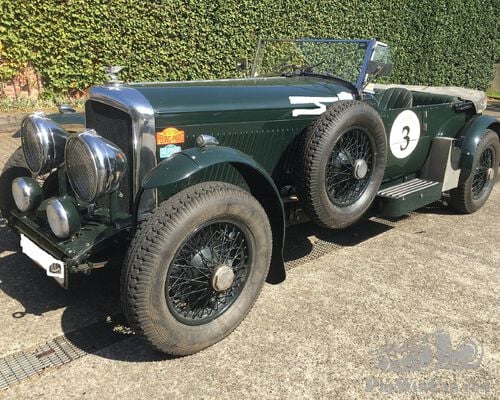
Bentley Derby Special Open Rally Car
This Bentley Derby, manufactured in 1935, has been rebuilt into a short and long-distance rally car. Full rebuilt engine in 2021, Since 2021 low mi..
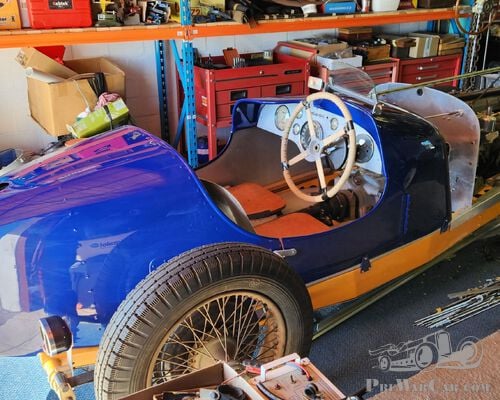
Riley TT Sprite
1935 6-cylinder TT Sprite replica. Chassis # 46A2722. Engine # 6A2722. Original Ulster Imp body. Restoration nearing completion. Engine, G..

Daimler Flat six 15 Saloon - Fluid Flywheel / pre-selector
The E20 was manufactured between 1935 and 1939. It offered the choice of a coachbuilt saloon, Sports Saloon, Fixedhead Coupé and Drophead Coupé bod..