The global magazine and marketplace for classic car enthusiasts, by enthusiasts.


Filter
Classic Skoda, Stoewer for sale - Skoda, Stoewer cars for sale
-

Scoda Popular Roaster
When Rudolf Höhn, a butcher from Zurich, Switzerland, saw the 1936 Skoda Popular Roaster finish second in its class at the Monte Carlo Rally, he wanted a modern car like that—with independent suspension and a transaxle system—and ordered one for himself. In October 1937, he took delivery of the vehicle—naturally equipped with the l.. -
1924 Stoewer type D3 roadster
Rare opportunity to buy a vintage 1924 Stoewer type D3 roadster in fully restored condition. More than € 50K were spent in 2018 and 2019 on its restoration . Detailed work invoices come with the car. A video can be sent on request . Price € 64000 ex Eibergen Netherlands imported EEC.


Skoda
CS, 1923 to date
(1) Akc. Spol. Drive Skodovy zavody, Plzen (Pilsen); Mlada Boleslav, 1923 – 1945
(2) Skoda np, Mlaa Boleslav, 1945 to date
Skoda was one of the most important industrial concerns of the Austro-Hungarian empire. After World War 1 it was included in the territory of the new Czechoslovak republic. The Skoda company branched out into car production, building Hispano-Suizas under licence. The first of these Skoda cars appeared in about 1923. The engine of the Skoda car was the 37.2hp 6-cylinder 6.6-litre, while the bodies were of Skoda’s own design. Production of Skoda cars was in the Skoda car works at Pilsen. In 1925 Skoda cars took over the Laurin & Klement works at Mlada Boleslav, and production of private cars under the Skoda car name began in this factory. The first Skoda cars were based on earlier Laurin-Klement designs. For the next few years the range of Skoda cars included various 4-, 6- and 8-cylinder models Skoda cars of conventional design. More advanced ideas were introduced with the Skoda 420 model in 1933. The engine of the Skoda car was a 995cc unit developing 20bhp, the chassis was on Tatra lines with a centre tubular layout and rear swing half-axles. The 420 Skoda car ushered in the 1930s range of Skoda cars with which Skoda became famous. The Skoda 420 developed into the Skoda Popular and the same technical features were to be found in the 4-cylinder Skoda Rapid (1.380cc and 22bhp) and the 6-cylinder Skoda Superb(2.480cc and 50bhp). Model 932 was an experimental Skoda car with rear engine. The Skoda Popular also appeared with a streamlined coupé body and this Skoda carwas quite successful in a number of sporting events, including the Monte Carlo Rally. All Skoda car models gradually increased capacity and output, and changed from side to overhead valves. The range of Skoda cars was supplemented by the 1.8-litre Skoda Favorit and the Skoda Monte Carlo with a Popular chassis and Rapid engine. In 1939 the Skoda car range consisted of four types, the most important Skoda car being the 1100 OHV (1.089cc and 32bhp) and the 6-cylinder, 3.140cc 85bhp model.
After World War 2, the Skoda 1100 OHV and 1200 OHV – based on pre-war designs –appeared, and these Skoda cars were developed into the well-known 40 or 50bhp Skoda Octavia with a capacity of 1.089cc, the Skoda Octavia Super (1.221cc and 45bhp) and the Skoda Felicia, a two-seater Octavia version with a 50bhp engine. The Skoda Octavia/ Felicia range was discontinued, with the exception of the station wagon Skoda cars, after the introduction of the Skoda 1000MB (MB for Mlada Boleslav) in 1964, a rear-engined 988cc 40bhp Skoda car. The Skoda Octavia wagons were discontinued in 1969, and a year later came a new version of the 1000MB Skoda car, the Skoda S110 with 1.107cc engine and disc front brakes. Even faster was the S110R coupé Skoda carof 1971. The 1972 Skoda car range embraced variations on the basic rear-engined theme with 48bhp, 53bhp and 62bhp power units. Disc front brakes were standard on Skoda car.
Skoda cars are now built as part of the Volkswagen AG group.
Source: Georgano, encyclopedia of motorcar; HON
The information is written with the greatest of care. However, if you have any suggested amendments please contact us at office@prewarcar.com
Stoewer
D, 1899 – 1939
(1) Gebrüder Stoewer, Fabrik für Motorfahrzeuge, Stettin, 1899 – 1916
(2) Stoewer-Werke AG vorm. Gebr. Stoewer, Stettin, 1916 – 1939
The Stoewer car factory developed out of the Stoewer ironworks and was among the pioneers of the German car industry. After manufacturing motor cycles, tricycles and quadricycles for two years, Stoewer turned to cars in 1899. The first Stoewer car had a rear-mounted 2-cylinder engine. 4-cylinder Stoewer cars followed in 1901, and electric Stoewer cars were also produced. Best known were the 2-cylinder Type T Stoewer car (2.280cc and 3/12PS), the 4-cylinder Stoewer P4 (3.052cc and 11/22PS), the Stoewer G4 (1.500cc and 6/12PS) and the 6-cylinder Stoewer P6 (8.820cc and 34/60PS), evolved in the 1905-1907 period all Stoewer cars with shaft-drive. The Stoewer B1 of 6/16PS and the Stoewer B6 of 9/22PS which appeared in 1910 were also built by Mathis under licence. The G4 Stoewer car was the basis for the Stoewer B5, which Stoewer car in 1912 became famous by setting up a record at Brooklands with 67.7mph. The new range of Stoewer cars which appeared in 1913 was also based on successful earlier cars. They were the Stoewer C1 (6/18PS), Stoewer C2 (10/28PS) and C3 Stoewer car (6-cylinder and 19/45PS). Shortly before the outbreak of World War 1 the Stoewer car range was headed by the F4 Stoewer car with a 4-cylinder, 8.8-litre 33/100PS ohc engine. After the war an enormous Stoewer car appeared, the Stoewer D7, using a 6-cylinder 11.2-litre 42/120PS aero engine, as well as some conservative sv 4- and 6-cylinder Stoewer cars with rear wheel and transmission brakes. Front wheel brakes appeared on Stoewer cars in 1925. Stoewer introduced 8-cylinder Stoewer cars in 1928. These were the Stoewer Superior, Stoewer Marschall, Stoewer Gigant and Stoewer Repräsentant with engines ranging from 2-litres and 45bhp to 4.9-litres and 100bhp. The Stoewer car firm re-entered the economy class in 1931 with the V5, a front-driven Stoewer car with a V4 1.188cc engine, followed by the front-drive models R140 (1.369cc), R150 (1.488cc) and R180 (1.769cc). Another 8-cylinder was the front wheel drive Greif V8 with a 2.488cc engine, which was replaced by the conventional 6-cylinder 3.609cc Arcona Stoewer car in 1938. In 1934 the 1½-litre 4-cylinder Stoewer car and 2½-litre V8 Stoewer car were shown at the Brussels Salon by Monsieur Dewaet under the name D.S. (Dewaet-Stoewer). The Greif Junior was built under Tatra licence with an opposed 4-cylinder 1.474cc engine. It succeeded the Röhr Junior. In the middle of the range was the Stoewer Sedina with a 4-cylinder engine of 2.4-litres.
Production of private Stoewer cars was given up at the outbreak of World War 2 in 1939. The Stoewer car factory was destroyed during the war and production of Stoewer cars was not resumed.
Source: Georgano, encyclopedia of motorcar; HON
The information is written with the greatest of care. However, if you have any suggested amendments please contact us at office@prewarcar.com


Featured
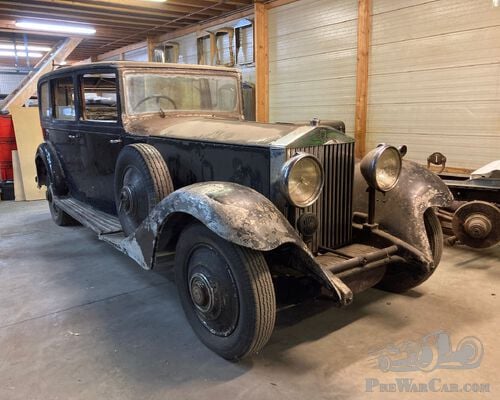
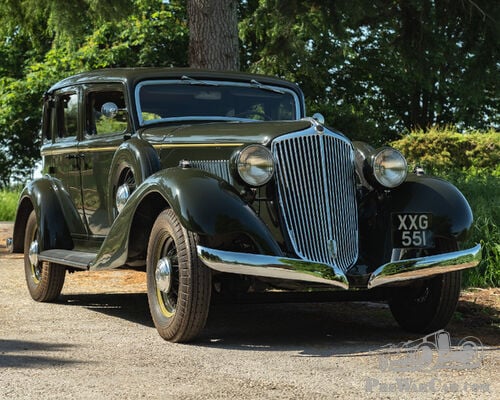
Graham Model 64 Standard Eight 'Blue Streak'
UK Registration No: XXG 551Chassis No: 1801069MOT: ExemptH&H ClassicsKelham Hall | Newark, Nottinghamshire
Rolls-Royce
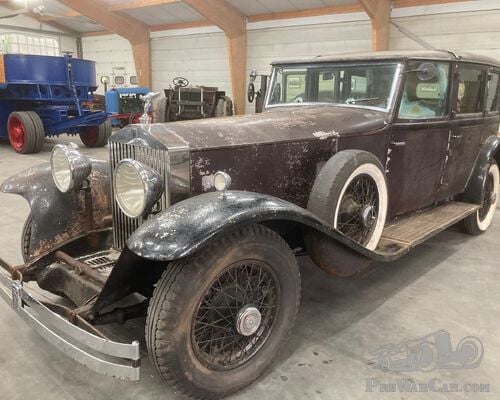
Rolls-Royce Phantom ll chassisnummer 287 AJS. bouwjaar 1932, Links gestuurd, Brewster Keswick Sedance Towncar