The global magazine and marketplace for classic car enthusiasts, by enthusiasts.


Filter
Classic DB, Stoewer for sale - DB, Stoewer cars for sale
-

1924 Stoewer type D3 roadster
Rare opportunity to buy a vintage 1924 Stoewer type D3 roadster in fully restored condition. More than € 50K were spent in 2018 and 2019 on its restoration . Detailed work invoices come with the car. A video can be sent on request . Price € 64000 ex Eibergen Netherlands imported EEC. -
D.B. 6 Monoposto; the first genuine single-seater by Deutsch & Bonnet
D.B. 6 Monoposte - Deutsch Bonnet Grand PrixThe very first D.B. monopostoExceptionally well-documented competition historyRaced extensively by René Bonnet (1947–1950)Eligible for events as Monaco Historic Grand Prix This D.B. 6 Monoposto is a unique survivor from the early post-war years..


D.B.
France, 1938 – 1961
Automobiles D.B., Champigny-sur-Marne, Seine
Deutsch and Bonnet were building ‘specials’ based on 11CV traction avant Citroëns in 1938. In 1947 limited production began again, the first DBs being competition machines largely built up from reconditioned components, using 1½-litre and 2-litre engines and 4-speed gearboxes. A new DB car based on the Dyna-Panhard ran at Montlhéry in 1948, while in 1949 the Deutsch and Bonnet (DB) company produced a 500cc single-seater version for Formula III, with the Panhard engine mounted in the nose, and independent swing-axle rear suspension. Some 100mph Citroën-based Deutsch and Bonnet (DB) convertibles were also made, but after 1950 Deutsch and Bonnet (DB) devoted all their energies to Panhard derivatives. Though never a major force in Formula III, the Deutsch and Bonnet (DB) cars gained numerous International Class Records and won the Index of Performance at Le Mans five times (1954, 1956, 1959, 1960 and 1961). Also Laureau’s Deutsch and Bonnet (DB) won the 1954 TT outright. An attempt to contest the 2½-litre GP Formula of 1954 with the alternative permitted size of 750cc supercharged was a fiasco, and little came of the curious Deutsch and Bonnet (DB) Monomills (the same cars with blowers removed) with which Deutsch and Bonnet tried to popularize one-class racing in France. Equally abortive were experiments with twin engines and 4-wheel drive (for sale in 1952) and with rear-mounted Renault engine and 5-speed gearboxes (for sale in 1953). The production Deutsch and Bonnet (DB) sports coupés used regular Panhard mechanical components allied to light alloy bodywork (fiberglass from 1955) and were marketed in various engine capacities from 610cc (30bhp) to 1300cc (65bhp). M.A.G. low-pressure superchargers were listed from 1954, and disc brakes were an option a year later on Deutsch and Bonnet (DB). The standard 1958 Deutsch and Bonnet (DB)model was the Rallye coupé with a 55bhp 850cc engine. Deutsch and Bonnet (DB) remained faithful to Panhard until the partnership was dissolved in 1961. René Bonnet continued the manufacture of cars in the Champigny works under his own name.
Source: Georgano, encyclopedia of motorcar; MCS
The information is written with the greatest of care. However, if you have any suggested amendments please contact us at office@prewarcar.com
Stoewer
D, 1899 – 1939
(1) Gebrüder Stoewer, Fabrik für Motorfahrzeuge, Stettin, 1899 – 1916
(2) Stoewer-Werke AG vorm. Gebr. Stoewer, Stettin, 1916 – 1939
The Stoewer car factory developed out of the Stoewer ironworks and was among the pioneers of the German car industry. After manufacturing motor cycles, tricycles and quadricycles for two years, Stoewer turned to cars in 1899. The first Stoewer car had a rear-mounted 2-cylinder engine. 4-cylinder Stoewer cars followed in 1901, and electric Stoewer cars were also produced. Best known were the 2-cylinder Type T Stoewer car (2.280cc and 3/12PS), the 4-cylinder Stoewer P4 (3.052cc and 11/22PS), the Stoewer G4 (1.500cc and 6/12PS) and the 6-cylinder Stoewer P6 (8.820cc and 34/60PS), evolved in the 1905-1907 period all Stoewer cars with shaft-drive. The Stoewer B1 of 6/16PS and the Stoewer B6 of 9/22PS which appeared in 1910 were also built by Mathis under licence. The G4 Stoewer car was the basis for the Stoewer B5, which Stoewer car in 1912 became famous by setting up a record at Brooklands with 67.7mph. The new range of Stoewer cars which appeared in 1913 was also based on successful earlier cars. They were the Stoewer C1 (6/18PS), Stoewer C2 (10/28PS) and C3 Stoewer car (6-cylinder and 19/45PS). Shortly before the outbreak of World War 1 the Stoewer car range was headed by the F4 Stoewer car with a 4-cylinder, 8.8-litre 33/100PS ohc engine. After the war an enormous Stoewer car appeared, the Stoewer D7, using a 6-cylinder 11.2-litre 42/120PS aero engine, as well as some conservative sv 4- and 6-cylinder Stoewer cars with rear wheel and transmission brakes. Front wheel brakes appeared on Stoewer cars in 1925. Stoewer introduced 8-cylinder Stoewer cars in 1928. These were the Stoewer Superior, Stoewer Marschall, Stoewer Gigant and Stoewer Repräsentant with engines ranging from 2-litres and 45bhp to 4.9-litres and 100bhp. The Stoewer car firm re-entered the economy class in 1931 with the V5, a front-driven Stoewer car with a V4 1.188cc engine, followed by the front-drive models R140 (1.369cc), R150 (1.488cc) and R180 (1.769cc). Another 8-cylinder was the front wheel drive Greif V8 with a 2.488cc engine, which was replaced by the conventional 6-cylinder 3.609cc Arcona Stoewer car in 1938. In 1934 the 1½-litre 4-cylinder Stoewer car and 2½-litre V8 Stoewer car were shown at the Brussels Salon by Monsieur Dewaet under the name D.S. (Dewaet-Stoewer). The Greif Junior was built under Tatra licence with an opposed 4-cylinder 1.474cc engine. It succeeded the Röhr Junior. In the middle of the range was the Stoewer Sedina with a 4-cylinder engine of 2.4-litres.
Production of private Stoewer cars was given up at the outbreak of World War 2 in 1939. The Stoewer car factory was destroyed during the war and production of Stoewer cars was not resumed.
Source: Georgano, encyclopedia of motorcar; HON
The information is written with the greatest of care. However, if you have any suggested amendments please contact us at office@prewarcar.com


Featured
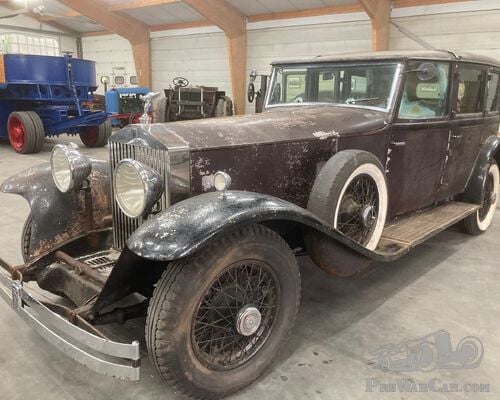
Rolls-Royce
Rolls-Royce Phantom ll chassisnummer 287 AJS. bouwjaar 1932, Links gestuurd, Brewster Keswick Sedance Towncar

1915 Rolls-Royce Silver Ghost Barker Tourer
⁃ An exceptionally rare original bodied pre-war Silver Ghost⁃ Desirable Barker tourer in exciting barn find condition⁃ ..

Daimler Flat six 15 Saloon - Fluid Flywheel / pre-selector
The E20 was manufactured between 1935 and 1939. It offered the choice of a coachbuilt saloon, Sports Saloon, Fixedhead Coupé and Drophead Coupé bod..