The global magazine and marketplace for classic car enthusiasts, by enthusiasts.


Filter
Classic Stoewer, Swift for sale - Stoewer, Swift cars for sale
-

1914 Swift Cyclecar | The Ernie Warren Collection Auction | 13th June 2026
A 1914 Swift Cyclecar.Reg No. W 3150.Car No. 1304.Engine No. E5473.Grey with brown interior.Exploiting the fashion for cyclecars in the pre-WWI period, Swift replaced their single-cylinder 7hp car with the twin-cylinder 972cc engine. Featuring thermos-syphon cooling, magneto ignition, leat.. -
1924 Stoewer type D3 roadster
Rare opportunity to buy a vintage 1924 Stoewer type D3 roadster in fully restored condition. More than € 50K were spent in 2018 and 2019 on its restoration . Detailed work invoices come with the car. A video can be sent on request . Price € 64000 ex Eibergen Netherlands imported EEC. -
1904 Swift 7HP - VCC Dated
1904 Swift 7HPRegistration No - BS8487Chassis No - 176Engine No - 2886 - VCC Dated - Electric starting- 4 seat London to Brighton vehicle - Rare English Marque- Many time London to Brighton Finisher - Ready for use Swift of Coventry gained and adapted its skills ..


Stoewer
D, 1899 – 1939
(1) Gebrüder Stoewer, Fabrik für Motorfahrzeuge, Stettin, 1899 – 1916
(2) Stoewer-Werke AG vorm. Gebr. Stoewer, Stettin, 1916 – 1939
The Stoewer car factory developed out of the Stoewer ironworks and was among the pioneers of the German car industry. After manufacturing motor cycles, tricycles and quadricycles for two years, Stoewer turned to cars in 1899. The first Stoewer car had a rear-mounted 2-cylinder engine. 4-cylinder Stoewer cars followed in 1901, and electric Stoewer cars were also produced. Best known were the 2-cylinder Type T Stoewer car (2.280cc and 3/12PS), the 4-cylinder Stoewer P4 (3.052cc and 11/22PS), the Stoewer G4 (1.500cc and 6/12PS) and the 6-cylinder Stoewer P6 (8.820cc and 34/60PS), evolved in the 1905-1907 period all Stoewer cars with shaft-drive. The Stoewer B1 of 6/16PS and the Stoewer B6 of 9/22PS which appeared in 1910 were also built by Mathis under licence. The G4 Stoewer car was the basis for the Stoewer B5, which Stoewer car in 1912 became famous by setting up a record at Brooklands with 67.7mph. The new range of Stoewer cars which appeared in 1913 was also based on successful earlier cars. They were the Stoewer C1 (6/18PS), Stoewer C2 (10/28PS) and C3 Stoewer car (6-cylinder and 19/45PS). Shortly before the outbreak of World War 1 the Stoewer car range was headed by the F4 Stoewer car with a 4-cylinder, 8.8-litre 33/100PS ohc engine. After the war an enormous Stoewer car appeared, the Stoewer D7, using a 6-cylinder 11.2-litre 42/120PS aero engine, as well as some conservative sv 4- and 6-cylinder Stoewer cars with rear wheel and transmission brakes. Front wheel brakes appeared on Stoewer cars in 1925. Stoewer introduced 8-cylinder Stoewer cars in 1928. These were the Stoewer Superior, Stoewer Marschall, Stoewer Gigant and Stoewer Repräsentant with engines ranging from 2-litres and 45bhp to 4.9-litres and 100bhp. The Stoewer car firm re-entered the economy class in 1931 with the V5, a front-driven Stoewer car with a V4 1.188cc engine, followed by the front-drive models R140 (1.369cc), R150 (1.488cc) and R180 (1.769cc). Another 8-cylinder was the front wheel drive Greif V8 with a 2.488cc engine, which was replaced by the conventional 6-cylinder 3.609cc Arcona Stoewer car in 1938. In 1934 the 1½-litre 4-cylinder Stoewer car and 2½-litre V8 Stoewer car were shown at the Brussels Salon by Monsieur Dewaet under the name D.S. (Dewaet-Stoewer). The Greif Junior was built under Tatra licence with an opposed 4-cylinder 1.474cc engine. It succeeded the Röhr Junior. In the middle of the range was the Stoewer Sedina with a 4-cylinder engine of 2.4-litres.
Production of private Stoewer cars was given up at the outbreak of World War 2 in 1939. The Stoewer car factory was destroyed during the war and production of Stoewer cars was not resumed.
Source: Georgano, encyclopedia of motorcar; HON
The information is written with the greatest of care. However, if you have any suggested amendments please contact us at office@prewarcar.com
Swift
GB, 1900 – 1931
(1) Swift Motor Co Ltd, Coventry, Warwickshire, 1900 – 1919
(2) Swift of Coventry Ltd, Coventry, Warwickshire, 1919 – 1931
Swift progressed from sewing-machines through bicycles, motor tricycles and quadricycles to cars. Their first Swift car was a voiturette with a tubular chassis, powered by an MMC single-cylinder engine of De Dion type, but with an original transmission system. There was direct drive on both the 2-forward speeds of the Swift car, provided by two rings of teeth on the crown wheel and two pinions. The design of the Swift car was unreliable, for the rear axle was unsprung and attached to a flexible chassis. This was soon dropped on the Swift car in favour of normal transmission, and the axle was sprung from 1903. These single-cylinder Swift cars, with various makers’ engines installed, were the only Swift car offerings until 1904, when an excellent Swift-made twin of 10hp was added. Bigger 3- and 4-cylinder Swift cars were made at the time, and in 1909 a short-lived single-cylinder 7hp Swift car, also sold by Austin was added, but most sales came from the 2-cylinder light Swift car. In 1912 this Swift car was replaced by a 7hp 2-cylinder cyclecar with shaft drive, made by the Swift Cycle Co Ltd. For 1914 the Swift Light Car, which Swift car was virtually the cyclecar with a pressed steel, in place of tubular, chassis, was offered by the Swift Motor Co Ltd. The Cycle Co made no further Swift cars, and the formation of Swift of Coventry in 1919 merged the two companies. An 1.100cc 4-cylinder Swift Ten replaced the 2-cylinder car in 1914. This Ten Swift car was continued after World War 1, with a new 2-litre Swift Twelve beside it. The latter Swift car had 4 forward speeds but was otherwise similar. After this, only 4-cylinder Swift cars were made, irrespective of current fashions. These Swift cars were immensely strong and simple, inefficient in terms of power output but not utility. The Swift Ten was redesigned on more modern lines in 1923. A slightly smaller engine with detachable head and coil ignition was made in unit on the Swift car with a 3-speed gearbox, though the model Swift car reverted to a magneto in 1925. As the 12/35hp Swift car, the Swift Twelve was brought up-to-date with the same features, becoming the 14/40hp Swift car in 1926. In the same year the Ten’s engine was enlarged to 1.200cc. Wire wheels were optional on Swift cars from 1927, and 4-speed gearboxes came in 1929. The 1930 Ten Swift car had a narrow ‘ribbon’ radiator shell, and was available with Swallow 2-door saloon coachwork as well as fabric saloon and tourer styles. This Swift car was supplemented in 1931 by the 8hp Cadet 2-door saloon which in its cheapest form the Swift car cost only £149. Swift cars could not compete with the mass-producers, however, and the Swift car make died shortly after.
CDN, 1911
Swift Motor Car Company of Canada Limited, Chatham, Ont.
One prototype Swift car, possibly based on the US Anhut, was produced by this Swift car firm of marine-engine builders.
Source: Georgano, encyclopedia of motorcar; TRN, HD
The information is written with the greatest of care. However, if you have any suggested amendments please contact us at office@prewarcar.com


Featured
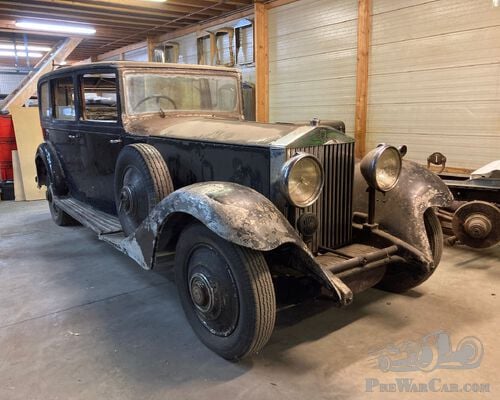

1915 Rolls-Royce Silver Ghost Barker Tourer
⁃ An exceptionally rare original bodied pre-war Silver Ghost⁃ Desirable Barker tourer in exciting barn find condition⁃ ..
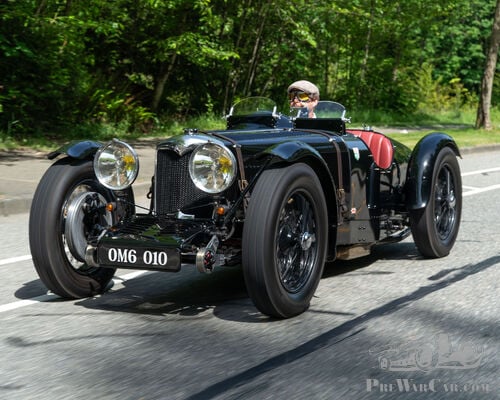
Riley 14/6 Special 1933
The ExperienceStep into the golden age of British motoring. This 1933 Riley 14/6 Special is a masterclass in pre-w..