The global magazine and marketplace for classic car enthusiasts, by enthusiasts.


Filter
Classic Lion Peugeot, Tatra for sale - Lion Peugeot, Tatra cars for sale

Lion-Peugeot
France, 1906 – 1913
(1) Les Fils de Peugeot Frères, Beaulieu-Valentigney, 1906 – 1910
(2) SA des Automobiles et Cycles Peugeot, Audincourt, 1910 – 1913
The Lion-Peugeot car started as an independent venture by Robert Peugeot in the motor cycle factory at Beaulieu-Valentigney, which had been used for Lion-Peugeot car manufacture until the establishment of the SA des Automobiles Peugeot in 1897. These Michaux-designed voiturettes Lion-Peugeot cars were produced in direct competition with the cars from Audincourt, and the original chain-driven single at £125 filled a gap left by the discontinuation of the original Peugeot Baby. Already the Lion-Peugeot car company were trying their hand in the Coupe des Voiturettes, but made no impression in 1906 or 1907 against Sizaire-Naudin and Delage. The first of the classic racing V-twin Lion-Peugeot cars made its appearance in 1908, and from 1909 to 1911 the Lion-Peugeot car marque was renowned for some very odd machines, which took advantage of regulations more concerned with bores than with strokes. The 1909 Lion-Peugeot cars, victorious in both the Catalan Cup and the Coupe itself, were made with 1.9-litre engines, a single of 100x250mm and a twin of 80x192mm, the former having three valves per cylinder, but the peak of Lion-Peugeot cars was reached in 1910 with the fantastic Lion-Peugeot VX5, an 80x280mm V-twin with twin carburetors, developing 95bhp. The driver of the Lion-Peugeot car had to look round, rather than over the engine. There was a companion 65x260mm V4, really two twins in series. In spite (or perhaps because) of this, Lion-Peugeot cars had to be content with 2nd place in that year’s Coupe des Voiturettes. They tried once again in 1911 with a Lion-Peugeot V4, this time using the relatively modest stroke/bore rato of 2:1.
By 1910, the production Lion-Peugeot cars had grown up into 1.7-litre transverse V-twins with 3-speed gearboxes and shaft drive, though chain-driven versions were still available on Lion-Peugeot cars as late as 1911. The reunion of the two rival Peugeot companies, however, signaled the end of these eccentricities: though a touring V4 Lion-Peugeot car was announced in 1911 and was made with a 4-speed gearbox, pressure lubrication, and pedal-operated rear-wheel brakes, the Lion-Peugeot car designation was dropped at the end of 1913. The 1.9-litre VD Peugeot of 1914 marked the end of this line of development and none of the Lion-Peugeot car derivatives survived World War 1.
Source: Georgano, encyclopedia of motorcar; MCS
The information is written with the greatest of care. However, if you have any suggested amendments please contact us at office@prewarcar.com
Tatra
CS, 1923 to date
(1) Tatra-Werke AG, Koprivnice, 1923 – 1935
(2) Ringhoffer-Tatra-Werke AG, Koprivnice, 1935 – 1941
(3) Tatra, np, Koprivnice, 1945 to date
At first the Tatra car was a continuation of the Nesselsdorf, producing the pre-war Types T and U Tatra cars, the latter a 6½-litre ohc 6-cylinder. The first real Tatra car of 1923 was completely different from the last Nesselsdorf models. After his return from Steyr, Hans Ledwinka produced a car which became one of the classics in the history of automobile design. This Tatra car was characterized by an air-cooled opposed-twin engine of 1.056cc developing 12bhp, a central tubular frame, and special rear swing axles and differential. It was known as the Type 11, and was the basis of later Tatra car models, commercial vehicles as well as private Tatra cars. Type 12 was identical with the Type 11, but this Tatra car had 4-wheel brakes. The Tatra car design was not intended for sporting events, but nevertheless two of these Tatra cars participated in the 1925 Targa Florio and gained 1st and 2nd place in the 1.100cc class, driven by Fritz Hückel and Kart Sponer. These were standard production Tatra cars, except that two inlet valves instead of one were fitted, and the front transverse-leaf springing was replaced by swinging half axles. Josef Vermirovsky was another competition driver on the small Tatra carmodel; his successes with Tatra cars included winning a 5.000 kilometre (3.107 miles) trial from Leningrad via Tiflis to Moscow in 1925. About 25.000 Tatra cars of Types 11 and 12 were built up to 1930. Some 4-cylinder Tatra cars followed, built on the same lines with air-cooled opposed engines, central tubular frames and swing axles: the Tatra 30 (1.680cc, 40bhp) and Tatra 52 (1.910cc, 40bhp). There were also the in-line 6-cylinder Type 70 Tatra car of 3.400cc and 60bhp, and the 6-litre V12 Type 80 Tatra car with 100bhp, both featuring the same frame construction and swing axles. The Type 80 Tatra car was built only in limited numbers, like the single-cylinder, 528cc 3-wheeler Tatra car (Type 49).
The next important development was the Tatra 57 which appeared in 1932. This Tatra car had the central tubular frame and swing-axles which were traditional by this time, and an air-cooled opposed 4-cylinder engine of 1.160cc developing 22bhp. Engine capacity of the Tatra car was later increased to 1.690cc, and this Tatra car was built until 1938. The German Röhr Junior was the Tatra 57 design built under licence. Under the name of Austro-Tatra the light Tatra cars were also manufactured in Vienna.
Ledwinka and Tatra were destined to make automobile history again with the Tatra Type 77 of 1934. The all-enveloping body of the Tatra car was built strictly to aerodynamic principles. A central box-type frame was used, and in its forked rear end – behind the rear axle – an air-cooled V8 engine of 3.400cc was placed. It developed 70bhp and gave the Tatra car a maximum speed of 95mph. The 1937 Tatra 87 incorporated the same technical principles and this Tatra car used a basically similar body. Engine capacity of the Tatra car was reduced to 2.960cc; output was 75bhp – a result of weight reduction. This Tatra car was capable of 100mph. In the same year the Tatra 97 was introduced with the same body, but an opposed 4-cylinder unit of 1.760cc and 40bhp was fitted. After the district of Koprivnice had come under German occupation, and the restriction of numbers of types which had been introduced in Germany in the 1930s was enforced in Czechoslovakia too, production of the Tatra 97 ceased and only the 87 Tatra car was continued until about 1941. In 1945, after the war, the Tatra car factory were nationalized by the Czechoslovak government, and production of Tatra cars was devoted to the front-engined Type 57B Tatra car and the rear-engined Tatra Type 87. These Tatra car were replaced in 1948 by a single model, the 2-litre rear-engined Tatraplan, derived from the pre-war Type 97 Tatra car. This Tatra car was made until 1954, after which there was a three-year period when no private Tatra cars were made. In 1957 the Tatra 603 was introduced; this Tatra car again had an air-cooled V8 engine of 2.472cc mounted in the rear. The Tatra car is still in production today as the T3-603, with twin-carburettor engine, servo-assisted disc brakes, and powere assisted steering, although Tatra concentrate on commercial vehicles and railway carriages. In preparation for 1973 was the 3.4-litre T613, a development of the existing theme.
Source: Georgano, encyclopedia of motorcar; HON
The information is written with the greatest of care. However, if you have any suggested amendments please contact us at office@prewarcar.com


Featured

Lagonda LC Tourer 1934
The Lagonda story began in 1901 in Staines, a small town in the UK. The company enjoyed its greatest successes around 1935. During this period, the..
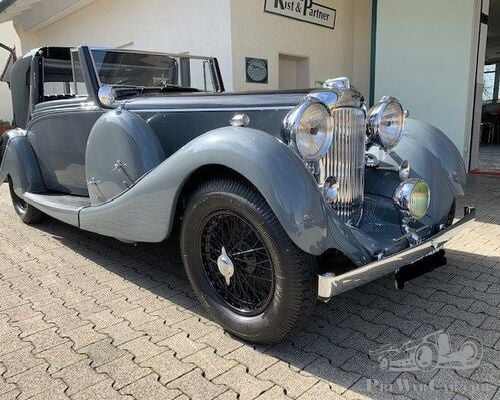
Lagonda LG 45 Coupe de Ville Sedanca by Mayfair
The successor to the M45, the LG45 was built around the same highly capable, competition-proven 4.5-litre Meadows inline-six engine, but featured r..
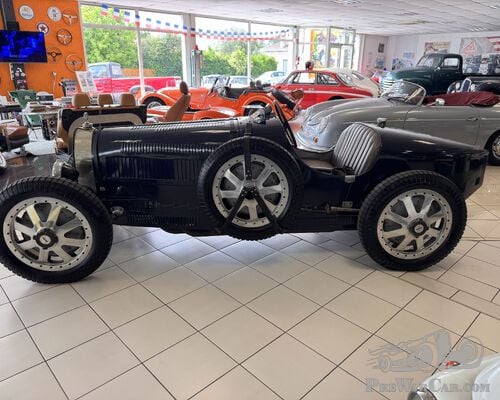
Bugatti 35 B Pur Sang
Bugatti 35 B Pur Sang,importée par un membre délégué de la FFVE il y’a une quinzaine d années.Participation à de nombreux Rallyes Bug..