The global magazine and marketplace for classic car enthusiasts, by enthusiasts.


Filter
Make a choice:
- Cars
-
Make >>
-
Year >>
-
- Bikes
- Parts & more
-
Make of car >>
-
Manufacturer >>
-
Category >>
- Bicycles & more
-
Year >>
-
Countries


A Bullnose for a British bulldog
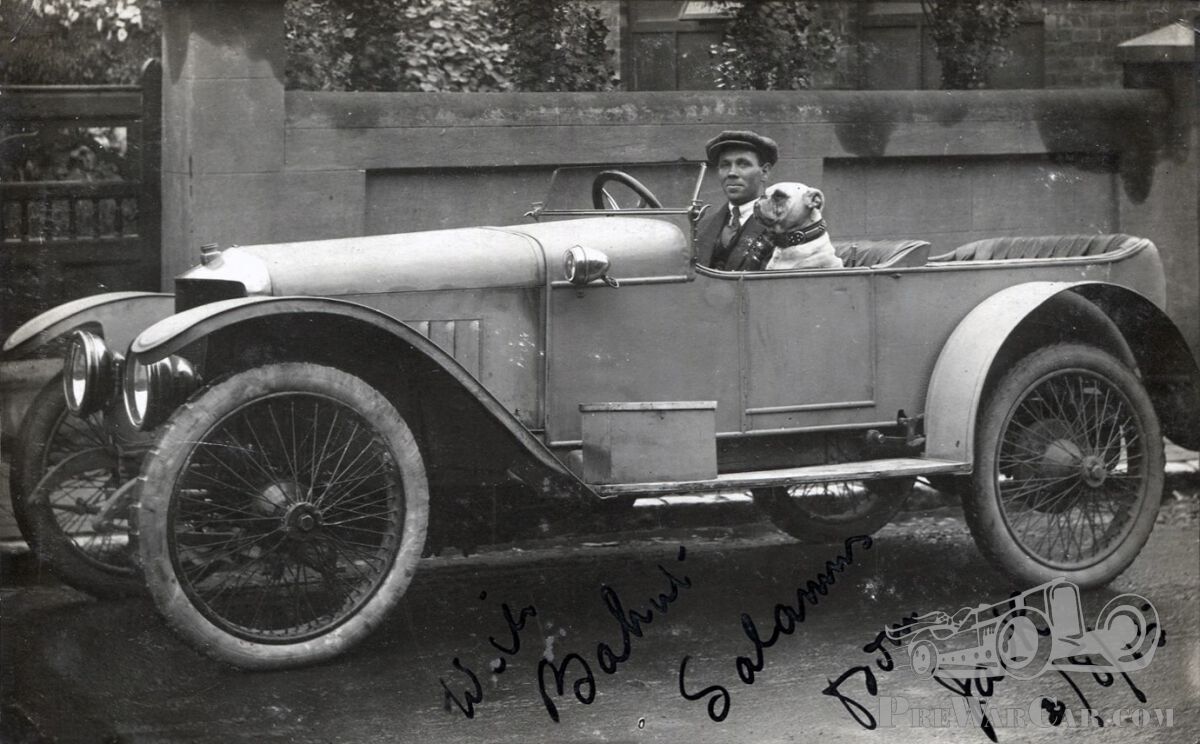

We’ve seen man’s best friend next to drivers or passengers in old motors before. But the majority of these were fashion pups and groomed poodles. The ones wearing exclusive goggles or tartan cover blankets matching the owner’s coat or the car’s upholstery. Pooch as fashion accessory.
This canine companion is of a different kind. It’s a bulldog, and you are probably aware of the longstanding association with British culture of this particular breed. “To many the Bulldog is a national icon, symbolising pluck [courage] and determination,” wrote the BBC — another British icon.
Apart from the bulldog, the rest of the setting on this picture seems very British, too, but unfortunately we don’t know anything about its origin. Oh, there is a date of 1915, but the words written next to that don’t give too much of a clue either, well not to us. That leaves us with the car. Somehow the dog immediately made us think this has to be a Morris Bullnose. At least the radiator kind of fits that name. But it’s not that. Could this be an early AC? Over to you again!
Words Jeroen Booij. Picture source unknown.
Published:
Wednesday March 23rd, 2022
Facebook
LinkedIn
Twitter
WhatsApp
Email
Copy
Comments
Jeroen Booij
28 March 2022, 14:53
Thank you gentlemen. Some very interesting and well substantiated comments here!
Read more
Mark Ashton
26 March 2022, 11:46
I own an Alfonso & have studied the mark for many years. What a wonderful photo.
Yes defo Hispano Suiza, very unusual ‘deluxe’ radiator which was an option on all Alfonso models around 1913-1915.
Some radiators were pointed & a very few were curved at the front.
While many were ‘coupe vent’ (the radiator cap was located under the bonnet & not visible) but many were soon converted to radiator caps on top of the radiator as in the photo. By the early 1920’s the owner would have followed the fashion & mounted the ‘stork’ mascot on the radiator cap.
Pity we cannot quite see the ‘Hispano Suiza’ written on front of radiator, steering wheel does look correct & angle of column should be 32 degrees.
Mudguard construction is correct, more curved than the early 1913 models.
Read more
Yes defo Hispano Suiza, very unusual ‘deluxe’ radiator which was an option on all Alfonso models around 1913-1915.
Some radiators were pointed & a very few were curved at the front.
While many were ‘coupe vent’ (the radiator cap was located under the bonnet & not visible) but many were soon converted to radiator caps on top of the radiator as in the photo. By the early 1920’s the owner would have followed the fashion & mounted the ‘stork’ mascot on the radiator cap.
Pity we cannot quite see the ‘Hispano Suiza’ written on front of radiator, steering wheel does look correct & angle of column should be 32 degrees.
Mudguard construction is correct, more curved than the early 1913 models.
Francisco Carrion
25 March 2022, 09:38
I have to disagree with the last comment.
In the first Hispano-Suiza book of Emilio Polo there is a photograph of an Hispano Suiza 16 valves with a radiator exactly like this one, which must not be confused with the typical pointed radiators used in other Hispano Suizas of the period.
The CAV electrical system was the very first one used in Hispano Suiza cars.
The wheels are "Riley patent system" , used in many cars in the 1910s... but we have to look at the chassis of the car, suspensions, rear brakes or steering wheel. In my opinion, 100% Hispano Suiza.
Read more
In the first Hispano-Suiza book of Emilio Polo there is a photograph of an Hispano Suiza 16 valves with a radiator exactly like this one, which must not be confused with the typical pointed radiators used in other Hispano Suizas of the period.
The CAV electrical system was the very first one used in Hispano Suiza cars.
The wheels are "Riley patent system" , used in many cars in the 1910s... but we have to look at the chassis of the car, suspensions, rear brakes or steering wheel. In my opinion, 100% Hispano Suiza.
David GREEN
25 March 2022, 13:50
I am fully persuaded it is an Hispano-Suiza. There are additional details such as the ends of the front axle that are very unusual and appear to be unique to the Hispano-Suiza. I have looked up the history of CAV lamps and their first electric lamp was no later than 1909, and the F-type, which is similar to that on the unknown car, is no later than 1912, so I stand corrected on that. I do have two questions: is the bodywork original, and are the side vents on the bonnet also original? The latter appear to be part of a let-in panel.
Read more


Mark Walker Walker
24 March 2022, 23:45
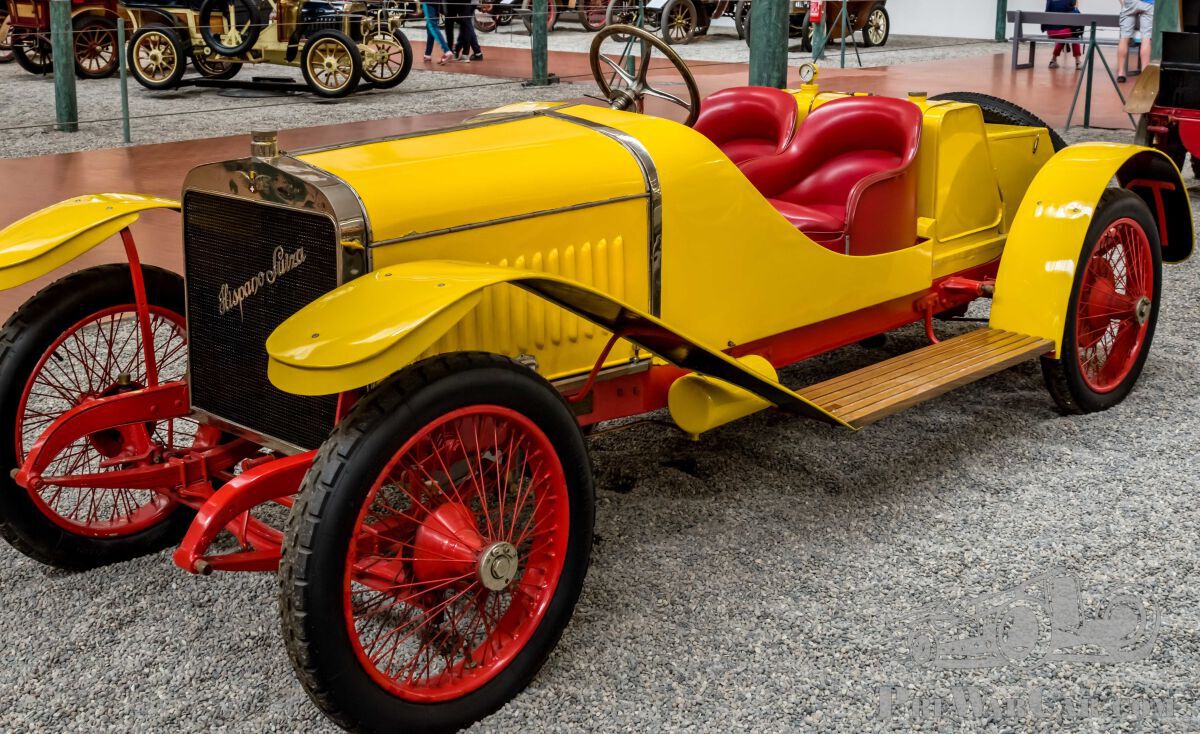
There are a number of distinctive Alfonso features on your photo that are visible on the yellow Schulmpf car:
-Wood filled front dumb irons.
-Chassis mounted oil tank.
-Steering wheel spokes.
-Rear spring front mounting visible on lightened photo.
-Rear brake drum compared to wheel centre.
Putting those details together I don't see it can be anything other than an Alfonso.
Read more
-Wood filled front dumb irons.
-Chassis mounted oil tank.
-Steering wheel spokes.
-Rear spring front mounting visible on lightened photo.
-Rear brake drum compared to wheel centre.
Putting those details together I don't see it can be anything other than an Alfonso.
David GREEN
24 March 2022, 15:53
The date is 3/8/1915. The words are 'With Bahut Salamns from Jack'. Jack is presumably the driver, and probable owner of the car. The phrase 'Bahut Salamns' is likely Bengali (slightly mis-spelt) and translated would indicate 'Many greetings'. I am guessing that the photograph was taken in West Bengal, probably Kolkata (formerly Calcutta). The background looks vaguely English, but to a well-tuned eye, the garden gate doesn't look quite right for England.
Now to the car. The headlamps look to be CAV electrics. 1913 is just possible as a date of manufacture, but anything before that would likely have been acetylene. The hubs look very Hispano-Suiza, but the radiator is a real worry. It is true that a few early Hispano-Suizas had V-shaped radiators, but they appear usually to have been black. More importantly, the filler cap never seems to have been that far forward on Hispano-Suiza's. The radiator in the photograph also appears to have a slight forward tilt, suggesting it is perpendicular to the curvature of the radiator at the point of insertion. Photographs of early Hispano-Suizas with V-radiators do have electric headlamps but not in the CAV-style. Finally, there is a photograph of the Hispano-Suiza assembly workshop taken in June 1913 that shows it to be small and surprisingly unsophisticated. All in all, I suspect it may not be an Hispano-Suiza, particularly if the photograph was taken in West Bengal.
It cannot be a Morris either. The nearest it would be would be the wonderful but ill-fated F-type, which had the requisite spoked wheels, but not the right hubs. The F-type appeared in 1923/1924 and would therefore be far too late for consideration.
Finally, the wheels are very large and look to be standard 'Colonial' size; that is 880mm and not 820 mm. This would support the need for high ground clearance. I suspect it is a British car, but I have yet to work out the make.
Read more
Now to the car. The headlamps look to be CAV electrics. 1913 is just possible as a date of manufacture, but anything before that would likely have been acetylene. The hubs look very Hispano-Suiza, but the radiator is a real worry. It is true that a few early Hispano-Suizas had V-shaped radiators, but they appear usually to have been black. More importantly, the filler cap never seems to have been that far forward on Hispano-Suiza's. The radiator in the photograph also appears to have a slight forward tilt, suggesting it is perpendicular to the curvature of the radiator at the point of insertion. Photographs of early Hispano-Suizas with V-radiators do have electric headlamps but not in the CAV-style. Finally, there is a photograph of the Hispano-Suiza assembly workshop taken in June 1913 that shows it to be small and surprisingly unsophisticated. All in all, I suspect it may not be an Hispano-Suiza, particularly if the photograph was taken in West Bengal.
It cannot be a Morris either. The nearest it would be would be the wonderful but ill-fated F-type, which had the requisite spoked wheels, but not the right hubs. The F-type appeared in 1923/1924 and would therefore be far too late for consideration.
Finally, the wheels are very large and look to be standard 'Colonial' size; that is 880mm and not 820 mm. This would support the need for high ground clearance. I suspect it is a British car, but I have yet to work out the make.
Francisco Carrión Cárdenas
23 March 2022, 10:09
Yes, Hispano Alfonso XIII with very rare pointed radiator, but still some can be seen with this kind of radiator in period photos, specially rare models like the 16 vale models.
Read more