The global magazine and marketplace for classic car enthusiasts, by enthusiasts.


Filter
Make a choice:
- Cars
-
Make >>
-
Year >>
-
- Bikes
-
Location >>
- Parts & more
-
Make of car >>
-
Manufacturer >>
-
Category >>
- Bicycles & more
-
Year >>
-
Countries


A rough-and-ready Renault, or an Arrol in Australia?
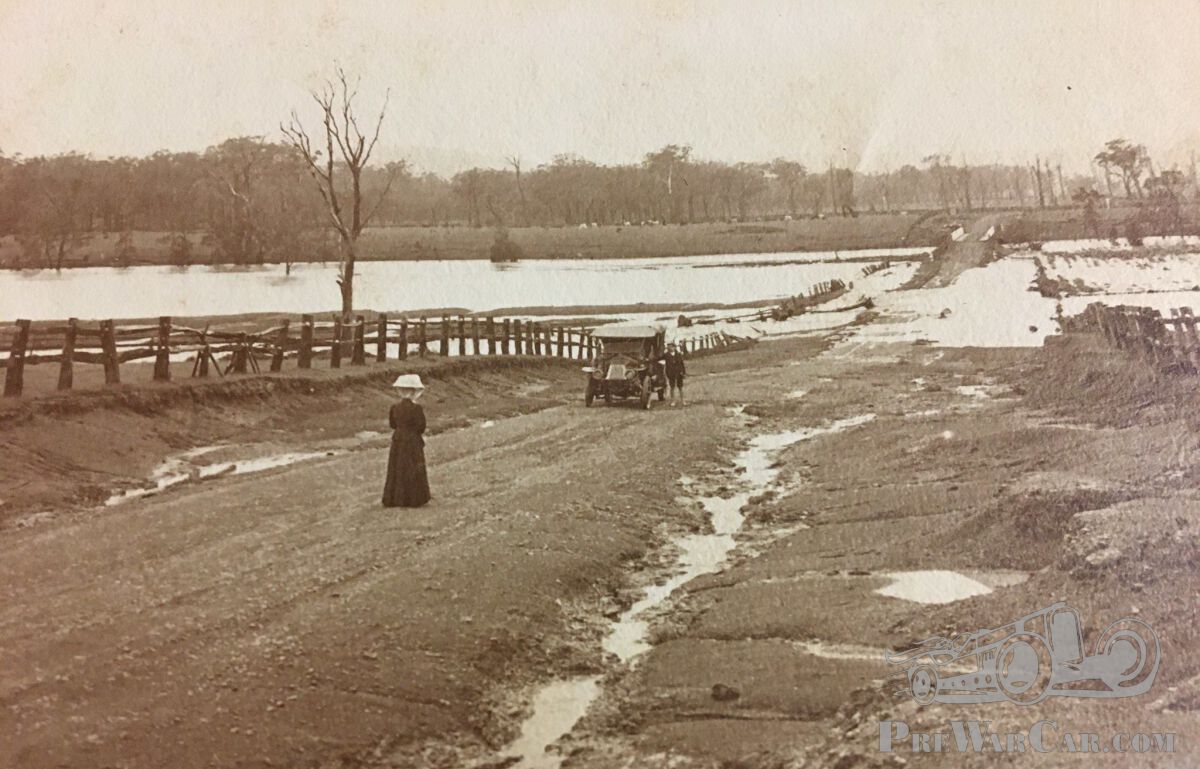
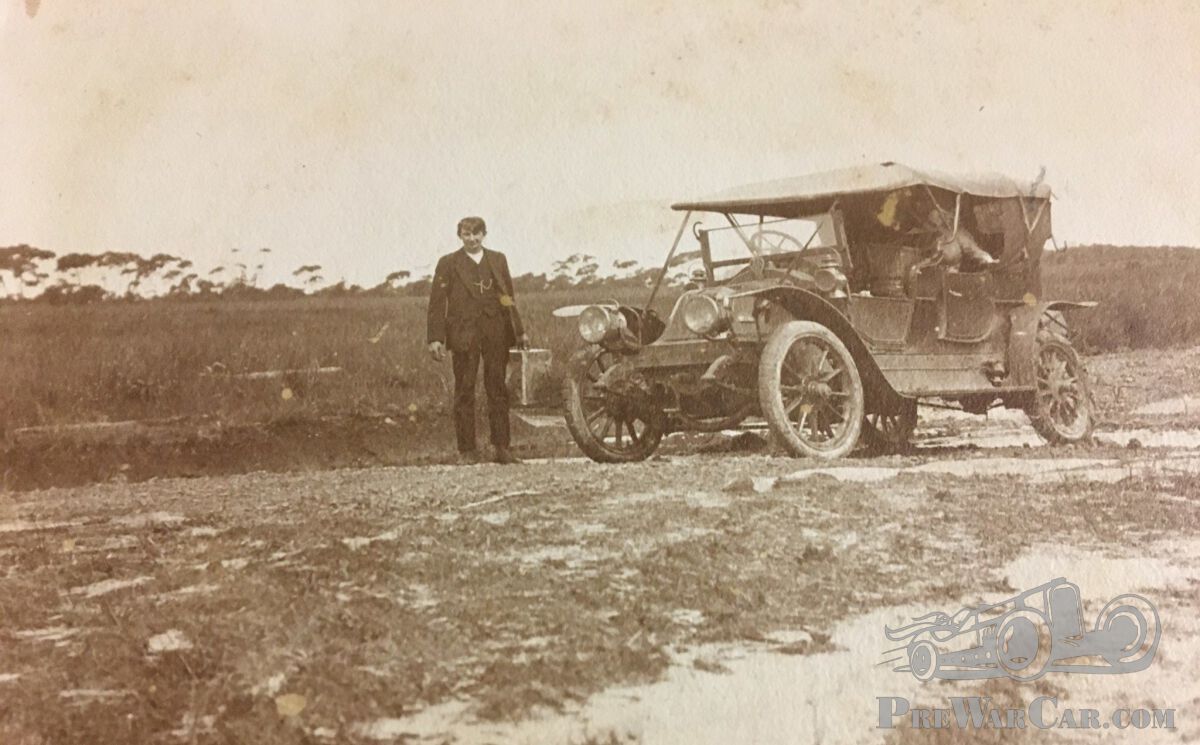


We have received these two interesting photos from a reader in Australia with the request that we might be able to identify them, so of course we'll do our best. First of all, though, we'll say that we're impressed to see what is obviously an expensive car being used in some rough conditions. Typically, photographs of such cars are posed shots depicting a family of aristocrats or wealthy industrialists in their best clothes and with all the brass well-cleaned. This fellow has more of the look of a prospector or some such outdoorsman about him, and his car certainly looks like it's taken a bit of a beating.
We're supposing the location must be Australia, but we have some doubts because of the blanket of snow which seems to have completely covered the land at some point, though it is starting to thaw. Snow is not unheard of in Australia's more temperate regions but, even so, the location looks more like grassland and one does not expect to find so much snow there. Having said that, snow has fallen before on Alice Springs and Ayers Rock, so we're not going to rule anything out.
Unfortunately, if the location is Australia, that doesn't give us much help with the identification of the car. Australia had no significant car-makers of its own until Holden put the 48-215 into production in 1948. Up to that point, both British and American cars were popular over there, many of them being shipped in knock-down form and locally assembled. Some European cars were popular, too, though, and today we know early Renaults have quite a following in the Antipodes.
Of course, it's very likely that this car is a Renault. The combination of a coal-scuttle bonnet and aft-of-engine radiator almost guarantees it, but your scribe has made the mistake of assuming a similar car to be a Renault before now, and it was swiftly pointed out to him that it was, in fact, an Arrol-Johnston. Indeed, there were doubtless several Arrol-Johnstons supplied new to Australia, so it remains an option. Then again, there were still other, lesser-known marques making use of the same bonnet style and radiator arrangement, so who's to say? We can't be certain, but we hope one of our readers can.
Words: Zack Stiling
We're supposing the location must be Australia, but we have some doubts because of the blanket of snow which seems to have completely covered the land at some point, though it is starting to thaw. Snow is not unheard of in Australia's more temperate regions but, even so, the location looks more like grassland and one does not expect to find so much snow there. Having said that, snow has fallen before on Alice Springs and Ayers Rock, so we're not going to rule anything out.
Unfortunately, if the location is Australia, that doesn't give us much help with the identification of the car. Australia had no significant car-makers of its own until Holden put the 48-215 into production in 1948. Up to that point, both British and American cars were popular over there, many of them being shipped in knock-down form and locally assembled. Some European cars were popular, too, though, and today we know early Renaults have quite a following in the Antipodes.
Of course, it's very likely that this car is a Renault. The combination of a coal-scuttle bonnet and aft-of-engine radiator almost guarantees it, but your scribe has made the mistake of assuming a similar car to be a Renault before now, and it was swiftly pointed out to him that it was, in fact, an Arrol-Johnston. Indeed, there were doubtless several Arrol-Johnstons supplied new to Australia, so it remains an option. Then again, there were still other, lesser-known marques making use of the same bonnet style and radiator arrangement, so who's to say? We can't be certain, but we hope one of our readers can.
Words: Zack Stiling
Published:
Monday March 18th, 2024
Facebook
LinkedIn
Twitter
WhatsApp
Email
Copy
Comments
Tim Hewitt
27 March 2024, 08:21
John Stokes
24 March 2024, 22:23
It's been driven through a flooded section of road.
Read more
Paul Elwell-Sutton
24 March 2024, 11:37
The car could be a SCAR (Société de Construction Automobile de Reims) from 1912, but is more likely a Renault CC variant also from about 1912.
There is at least one SCAR in New Zealand, belonging to the Northland branch of the Vintage Car Club of New Zealand (VCCNZ), so possibly others were imported to the Antipodes.
Read more
There is at least one SCAR in New Zealand, belonging to the Northland branch of the Vintage Car Club of New Zealand (VCCNZ), so possibly others were imported to the Antipodes.
Richard B.
23 March 2024, 14:40
Although, that is a river there, isn't it, so hmm...
The case the man is carrying in the second photo is an interesting shape. It reminds me of instrument cases my father had for old theodolites. Perhaps he could have been a surveyor?
Read more
The case the man is carrying in the second photo is an interesting shape. It reminds me of instrument cases my father had for old theodolites. Perhaps he could have been a surveyor?
Richard B.
23 March 2024, 14:25
On the upper left you can see the trees reflected, not commonly seen in snow :)
Read more
Steve Diggins
18 March 2024, 03:50
I think what you are seeing here is water, not snow and parts of Australia are well-known for that. The American cars you mention were all built in Canada.
Read more
The road/track goes over a bridge in the background, with the river flowing underneath.