The global magazine and marketplace for classic car enthusiasts, by enthusiasts.


Filter
Make a choice:
- Cars
-
Make >>
- Bikes
-
Location >>
- Parts & more
-
Make of car >>
-
Manufacturer >>
-
Category >>
- Bicycles & more
-
Year >>
-
Countries


About what is it? Quiz #465: 1921/1922 Rumpler Tropfenwagen



Today the answer to last week`s quiz. We were very happy with the (huge) amount of (good) answers. Although it was not as easy for everyone as we hoped, most of you were able to tell us what car it is! Some might have remembered some earlier features we did about this amazing machine. So wonderful to see how enthusiastic you are, and that you all join in!
Just for fun, the statistics from last week: there were 39 participants in total. 35 of them gave the correct answer. And 4 people gave an incorrect answer. 11 participants send in their answer too late (not before Monday). And 3 participants used too many words (more than 100). Out of these 39 participants, 18 have participated before in this season. And 21 are new. At last, we have allocated 72 points in total. But to who? Now let`s go over to the answer to last week’s quiz and of course the winner.
The car on the photograph is indeed one of the first series (1921 or 1922) Rumpler Tropfenwagens. They were designed by aircraft manufacturer Edmund Rumpler. "On the 23rd of 1921, the prototype of the ‘R-T-Au’ (Rumpler Tropfen-Auto) was presented at the Berlin Automobile Exhibition," as Kay Hottendorff told us. Many of you probably recognised the make by the raindrop shape of the car. “This shape was chosen because a falling drop of water assumes a perfect streamline form in its passage from the clouds to the earth”, as described in the magazine Popular Science Monthly.
It was “the first streamlined production car”, as Sujit Gupta mentioned, “with a drag coefficient of 0.28.” A first in many ways. Paul Elwell-Suttton and Chris Mooney told us “the world's first curved glass windscreen and side windows”. And Henk Visscher described very clearly the various types that were produced; “ the production (1921-1925) included three successive series; main differences concerned wheelbase (290cm, 336cm, 304cm) and engine (2310cc Siemens-Halske W6, 2580cc Siemens-Halske W6, 2610cc Benz 4-cyl. inline)."
The specific car on the photograph is one of the earlier versions, as the photograph comes from out of the Popular Science Monthly published back in February 1922. Very likely a short wheelbase Type Ru 0A 104 from 1921. A 5-seater with an ohv Siemens & Halske W6-engine which was mounted ahead of the rear axle. The engine, transmission, and final drive were assembled together and installed as a unit. Leslie Verpoorte explained also “The Rumpler invented rear swing axles were suspended by trailing leaf springs, while the front beam axle was suspended by leading leaf springs”. The 2,580 cc. and 36 hp (27kW) could do 70 mph.
Gerd Klioba also told us about its successor, “the also teardrop-shaped LWB-only Ru 4A 106, had a conventional inline four engine and rounded fenders. In 1922, Benz acquired a license for Edmund Rumpler's Tropfenauto, only one Tropfenauto was built with Benz badges”. Sujit Gupt added to this “its top speed of 70 MPH attracted Mercedes who came out with Mercedes Benz-Tropfenwagen race cars. Auto Union later 'copied' the design for its race cars. The Rumpler also inspired the design of Mercedes 130H, 150H, and 170 H.”
Although the car was very comfortable and progressive for its time, the car was “an economic disaster” as one of you described. Most of the approximately 100 cars that were produced were sold (cheaply) to taxi companies in Berlin, Germany. We know that there are two Tropenwagens still around, both of them are in Germany. One is currently in the Deutsches Museum in Munich and the other one in the Deutsches Technikmuseum Berlin.
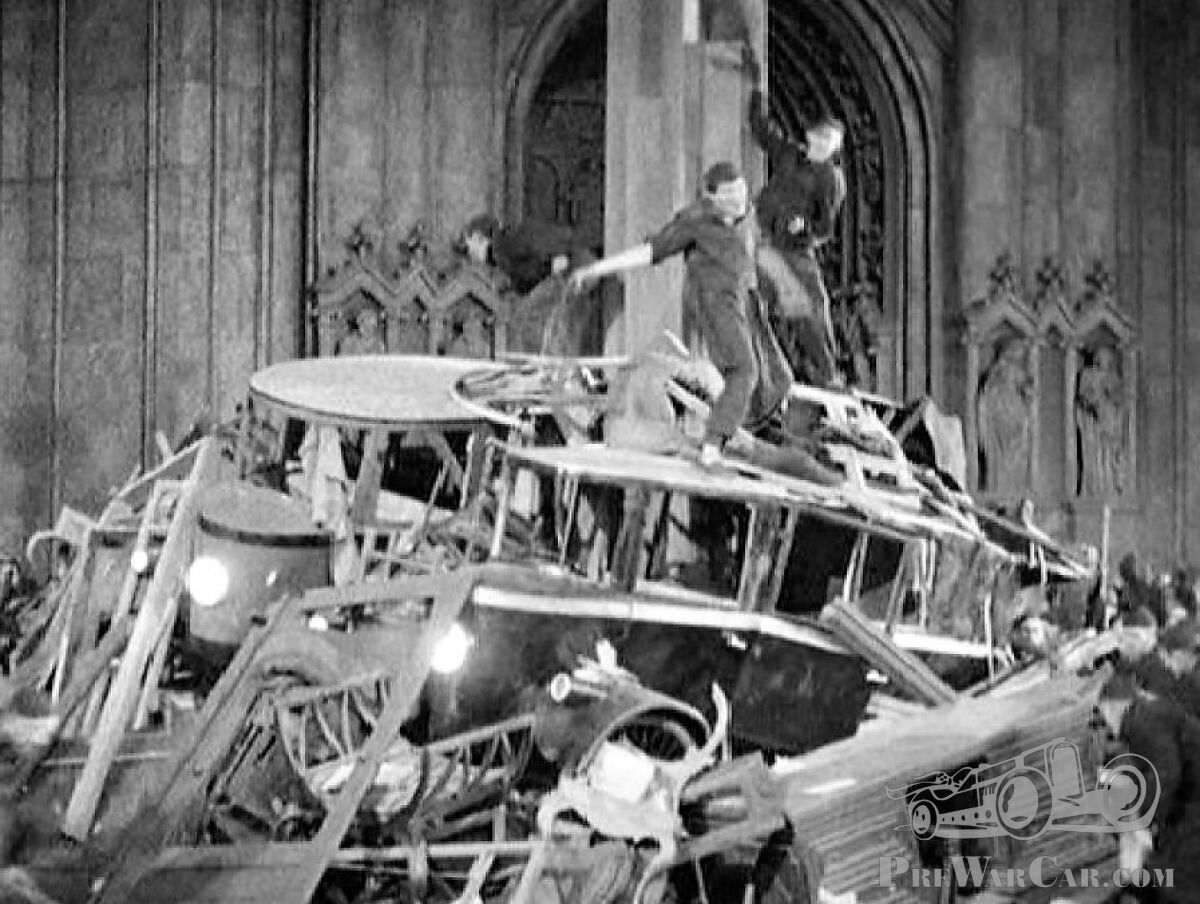
Fritz Hegemann told us “this is his dream car and is still hoping to find one in a shed…” Some of you mentioned that lots of them were burned and destroyed in the classic 1927 film `Metropolis`, as they illustrated the evil future. But you never know Fritz...
It was difficult to choose a winner this week. But we finally made a decision. In our eyes, the complete answer that was given about the specific car on the photograph was given by Fritz Hegemann! Congratulations Fritz! After dividing all the points, this is the current top 5:
1. Gerd Klioba
2. Alan Spencer
3. Henk Visscher
4. Luc Ryckaert
5. Fritz Hegemann
Published:
Saturday March 17th, 2018
Facebook
LinkedIn
Twitter
WhatsApp
Email
Copy