The global magazine and marketplace for classic car enthusiasts, by enthusiasts.


Filter
Make a choice:
- Cars
-
Make >>
- Bikes
-
Location >>
- Parts & more
-
Make of car >>
-
Manufacturer >>
-
Category >>
- Bicycles & more
-
Year >>
-
Countries


Flight of fancy: America's Queen of Diamonds, her whims and her SS1


Mabel Boll may not be a household name today, but in the 1920s she had a way for making a headline, not to mention stealing hearts. Born in 1893 to a bartender of Rochester, New York, she had to make her way in life by selling cigars for a short time, but her golden hair and deep, imploring eyes ensured that she didn't stay peddling tobacco for long. An older businessman, Robert Scott, swept her off her feet, and they married in 1909. They divorced in 1917, but in 1922 she married again, to Colombian coffee magnate Hernando Rocha. Rocha showered her with jewels, and seemed to be able to give her anything her heart desired. Mabel became a well-known figure in high society and was often splashed across the papers as the "Queen of Diamonds," it being said that she would wear $400,000 worth of jewellery in public.
As she entered her thirties, the "vividly blonde" Mrs. Boll became no less vivacious; if anything, she became even more so. Her spirit of adventure was captured by the burgeoning world of aviation, and she had riches enough to have a go at the old flying lark herself—at least, in a passive capacity. Like most of the world, she had read of Charles Lindbergh's 1927 transatlantic flight from New York to Paris, and she came to the conclusion that she should be the first woman to fly (i.e. be flown) across the Atlantic. It has been suggested that the inevitable publicity was as much of a motivating factor as the novelty and thrill of the experience itself, but it was to be a frustratingly difficult feat to achieve. Mabel offered $100,000 to the first pilot who would fly her over the ocean, but it seemed impossible to find a pilot and co-pilot who would both consent to it. Whether this was because they deemed it inappropriate to attempt such a risky journey with a lady passenger, or because they were unsettled by the mercurial blonde's past form, is hard to say. Possibly, nobody wanted to end up like J. Errol Boyd, whom Mrs. Boll apparently attacked with an alligator handbag on a previous flight because she disagreed with his decision to make an emergency landing in bad weather...
Nevertheless, Mabel succeeded in making the acquaintance of several leading long-distance aviators, including Wilmer Stultz and Oliver LeBoutillier, who agreed to take her as a passenger aboard the fabric-covered Wright-Bellanca WB-2 monoplane Columbia, for the first ever non-stop flight from New York to Havana in March, 1928. For this, she was rewarded with a picture on the front page of the New York Times. Mabel continued to solicit for an Atlantic crossing, and there was now a greater desire among Lindbergh and his Orteig Prize challengers from 1927 to be the first team to perform the journey with a woman. Mrs. Boll required no further encouragement but, unfortunately for her, Amelia Earhart and Germany's Thea Rasche had appeared and were equally enthusiastic. Alas for Mabel, she was all ready to set off from Newfoundland in Columbia when her pilot defected to join a South Pole expedition. Earhart, meanwhile, got airborne from Newfoundland in the Fokker F.VII Friendship, and 20 hours and 40 minutes later, landed victorious in Burry Port, Wales. It was the right outcome, really—Earhart was, by all accounts, a more sincere and suitable aviatrix, even though she did not pilot Friendship herself.
The low-priced car with the high-class look
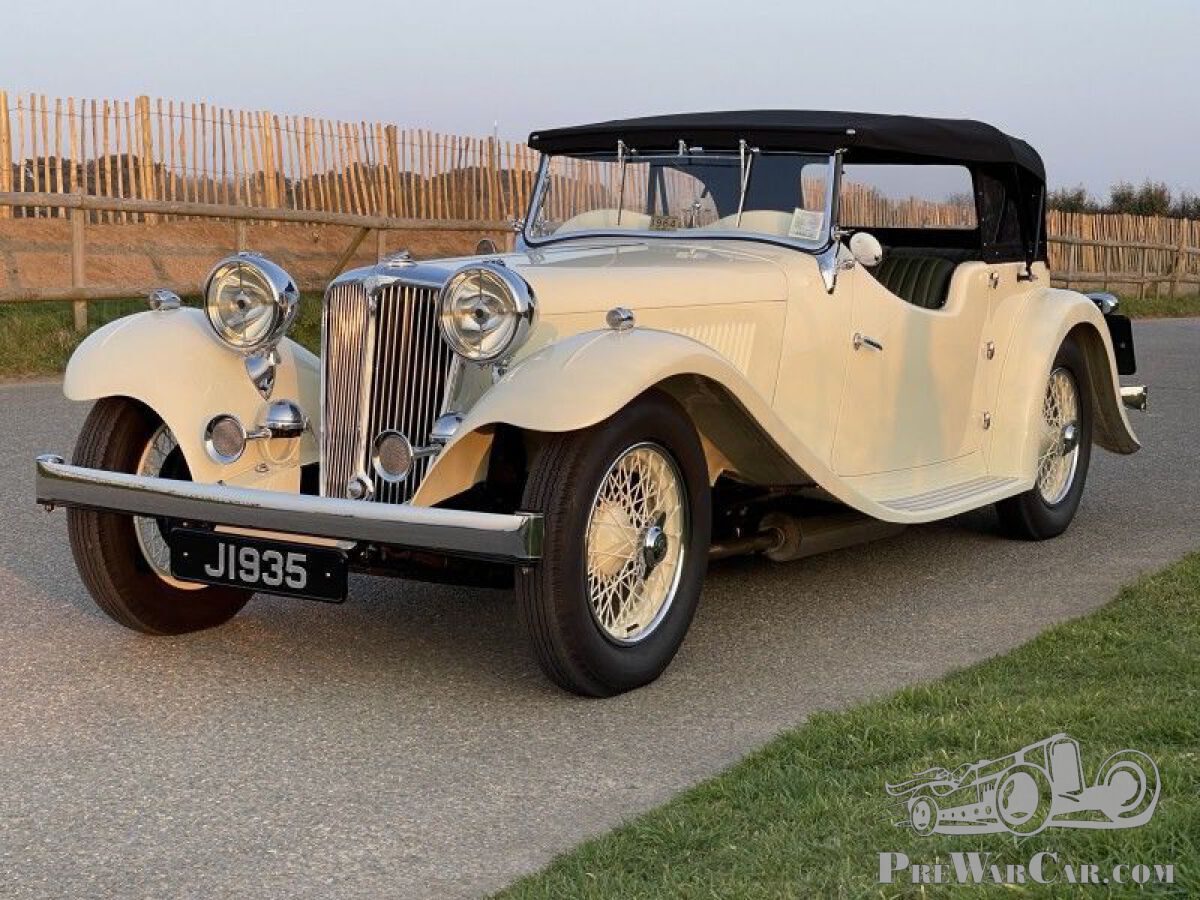
We're afraid we don't know an awful lot about Mabel's taste in motor cars, or whether she was enthusiastic about motoring generally, but it goes without saying that she would have bought the very best machines available, whether she was inclined towards sports cars or luxury conveyances. By 1935, she was known as the Countess de Porceri, having wed Henri de Porceri, a Polish count, at a ceremony in Paris in 1931, though they divorced in 1933. It is as the Countess that we find her recorded as the owner of this elegant little 1935 SS1 tourer.
The SS1 itself was launched in 1931, after William Lyons had negotiated for a supply of Standard 16hp chassis onto which his Swallow Sidecars concern could fit its own, more exotic coachwork. Chassis modifications allowed the floor to be lowered five inches and the engine to be moved back seven inches, resulting in a model with almost exaggeratedly rakish dimensions. It looked like an extremely expensive car and yet its most notable quality besides its dramatic styling was its low price—the Daily Express hailed it as "The car with the £1,000 look for £310." During 1932, the chassis and styling were subject to numerous improvements, and in March, 1933, the four-seat tourer joined the existing saloon and coupé models. In October, 1933, the 16hp engine grew from 2,054 c.c. to 2,143 c.c., and the optional 20hp likewise was raised from 2,552 c.c. to 2,663 c.c., giving a top speed of 75 m.p.h. The 16hp tourer went on sale for just £335, with its 20hp sister at £340.
The SS1 had reached more or less the end of its development by 1935 and was an ideal little runabout for a woman of means like the Countess. It's a pity we don't know more about her adventures with the car, and whether she used it in Britain or Europe, but it seems likely that she may have shipped it to America, because by 1964 (15 years after Boll's death) it was resident in Hawaii. In 2013, it was brought back to the British Isles and was comprehensively restored, finally being put back on the road in 2019.
Finished in a very pleasant and rather understated cream, and fitted with the 20hp engine which, to the best of our knowledge, the Countess herself might have specified, it looks to us very much like the perfect car for fair-weather outings and maybe the odd concours d'élégance. It happens that it's for sale right now with Le Riche Automobile Restorers Ltd. on the island of Jersey, so why not think about a new toy for the summer?
More information is available here.
Published:
Tuesday February 11th, 2025
Facebook
LinkedIn
Twitter
WhatsApp
Email
Copy
Comments
David Grimstead
21 February 2025, 20:00

Ivo Braeken
12 February 2025, 10:42
That Mabel Boll loved beautiful things is crystal clear. In the early 'thirties she came to Europe and promptly bought the Minerva's flagship, the Model AK convertible. The car went across the pond, but was soon sold on to a certain General Cox. That is what still lingers in my memory of the article that was written about it in the blog Pre1930rally. The car fell off a trailer on the way to an event, landed upside down in a ditch (in many stories embellished as a ravine) and then ended up with a Belgian collector who restored it to its full glory. I had the honour of witnessing this at the time.
With a bit of luck you can see it in action in the film Bonhoefer, which will hopefully be released in cinemas soon. The film can already be seen in Canada and the U.S.A. It also appeared earlier here on PreWarCar—see the photograph.
--------------------------------------------------------------
Dat Mabel Boll van mooie dingen hield staat als een paal boven water. Begin jaren dertig kwam ze naar Europa en kocht zich prompt het vlaggeschip van Minerva. Het model AK, cabriolet. De wagen ging mee over de plas, maar werd al vrij snel weer verder verkocht aan een zekere generaal Cox. Dat is wat nog in mijn herinnering sluimert van het artikel dat er over geschreven is in het blog pre1930rally. De wagen viel van een trailer op weg naar een evenement, op zijn kop in een gracht. (in vele verhalen opgesmukt tot ravijn) en kwam daarna terecht bij een Belgische verzamelaar die hem terug in volle glorie herstelde. Ik had destijds de eer hier getuige van te mogen zijn.
Met een beetje geluk kan u hem in aktie zien in de film Bonhoefer, die hopelijk binnenkort nog in de zalen zal verschijnen, In Cananda en de VS is de film reeds te zien. Hij verscheen ook al eerder hier op prewarcar, Zie bijlage.
Read more
With a bit of luck you can see it in action in the film Bonhoefer, which will hopefully be released in cinemas soon. The film can already be seen in Canada and the U.S.A. It also appeared earlier here on PreWarCar—see the photograph.
--------------------------------------------------------------
Dat Mabel Boll van mooie dingen hield staat als een paal boven water. Begin jaren dertig kwam ze naar Europa en kocht zich prompt het vlaggeschip van Minerva. Het model AK, cabriolet. De wagen ging mee over de plas, maar werd al vrij snel weer verder verkocht aan een zekere generaal Cox. Dat is wat nog in mijn herinnering sluimert van het artikel dat er over geschreven is in het blog pre1930rally. De wagen viel van een trailer op weg naar een evenement, op zijn kop in een gracht. (in vele verhalen opgesmukt tot ravijn) en kwam daarna terecht bij een Belgische verzamelaar die hem terug in volle glorie herstelde. Ik had destijds de eer hier getuige van te mogen zijn.
Met een beetje geluk kan u hem in aktie zien in de film Bonhoefer, die hopelijk binnenkort nog in de zalen zal verschijnen, In Cananda en de VS is de film reeds te zien. Hij verscheen ook al eerder hier op prewarcar, Zie bijlage.
The latest sales advert for this SS1 states that it was delivered new to Countess Porceri/Mabel Boll in February, 1935. She was then still living at her villa in the south of France and did so until at least late in 1936 but, according to the February 6th, 1935, Bystander magazine, for that month at least Countess Porceri was staying in London with her son Robert Scott II., often mingling with other guests at the Dorchester Hotel. Perhaps they even visited Mabel’s sister Lillian, married to Leicester hosiery equipment manufacturer Dr. Edwin Wildt since 1925.
Mabel’s son was born on November 12th, 1913, during her first marriage, meaning that early in 1935 he had only recently turned twenty-one. He had lived mostly with his grandparents or uncle George Boll in Rochester, N.Y., but did live with Mabel and her mother in Paris for a while from 1923, returning to live in Rochester by 1930. Did he take the SS1 back to the U.S.A. after his 1935 London visit? If so, he could only have owned it for a few years because he died in 1942, by then a respected Manhattan jeweller.
Of Mabel Boll and her cars, there are a few recorded sightings. Notorious for her desire to fly but not as a pilot, neither was she was notable as sports car owner or even an owner-driver.
Fleeing from a threat of a robbery attempt on her jewellery in Nice around 1925, she had to be taken from Gare de Lyon to a Barclays bank vault in an armoured car. With more newly-acquired wealth after the death of Hernando Rocha in a car accident in Columbia in 1928, she was described in New York “being whisked from luncheon to shop to aviation field in her green Rolls-Royce” and later reports claimed she had also used a bright green Rolls in Paris. In England in June, 1928, she was reported to have motored up to see her sister, viâ the Shady Lane arboretum in Leicester, but was also photographed alighting from her chauffeur-driven 1928 Minerva at a hotel in Nice before taking it back to New York that year.
Divorcing Count Porceri in August, 1933, she purchased her Duesenberg by February, 1934. Reports of what happened next do vary but she was described first arriving from Paris at a French Riviera hotel “with her maid and chauffeur.” Reuters’ news-agency reported May 16th, 1934: “Soon she and a good-looking young man became a familiar sight to residents as they raced along the coast in sports cars.”
She took over the Villa Florentina, St. Jean, Cap Ferrat overlooking the sea but seemingly refused to let her 27-year-old suitor, hotel owner and dancer Georges Charlot, move in. Rebuffed, he tried unsuccessfully to commit suicide by shooting himself in her garden, resulting in hospital treatment. Mabel, Reuters then said, “drove up in his blue sports car” at the nursing home in Nice where he was recovering. Two hours later she had to evade a crowd of paparazzi to re-enter the car and escape. She returned to collect him later in an ambulance, which drove off in the direction of her villa.
After her sojourn in London with her son in 1935, she was in London in September, 1936, “at the Savoy with only a French maid to guard her £250,000-worth of jewels while she drove about London for six days” before returning viâ Paris to her Riviera Villa. There she continued to use her Franay-bodied Duesenberg until at least the end of the year but, when war threatened, she left it there and returned to the U.S.A. for good. She married again in spring, 1940, having already bought a house in Florida, where she was seen with her husband and son, but died in New York in 1949.