The global magazine and marketplace for classic car enthusiasts, by enthusiasts.


Filter
Classic A.B.C., Du Pont for sale - A.B.C., Du Pont cars for sale
-

1930 Vintage Caravan | Brightwells | Auction Ends: Wed 24th Jun
Circa 1930s Restored Vintage Caravan with believed to be First World War Carriage Components; fully renovated; electric hook up; including a copy of a newspaper dated 1918 found on an interior shelfThis charming and highly unusual vintage caravan is believed to date from the 1930s, presenting a rare opportunity to acquire a beautif.. -
1929 Du Pont Model G Two-Passenger Speedster by Merrimac | RM Sotheby's | The Monterey Auction
To Be OFFERED AT AUCTION at RM Sothebys' The Monterey Auction event, 13 - 15 August 2026. $800,000 - $1,200,000 USD One of the most beautiful American automobiles of its generationThe 1929 New York International Automobile Show display carOne of three two-passenger “taper tail” models with an external spareOne .. -
Unknown tricycle from around 1900
Unknown tricycle , built around 1900 , one of the oldest vehicles in Germany in unrestored condition .For sale .Who can provide information about the builder ??? -
1931 Beverley Barnes 22/90hp Sports Chassis
Technical Specifications:Mark & Model: Beverley Barnes 22/90hp Sports ChassisYear: 1931Registration plate: UnregisteredChassis Number: 603Engine Number: 603Engine Capacity: 2732 ccTransmission: 4-speed ManualMileage:Body style: Rolling chassis..


A.B.C.
US, 1906 – 1910
(1) Autobuggy Manufacturing Co, St Louis, Mo. 1906 – 1908
(2) A.B.C Motor Vehicle Manufacturing Co, St. Louis, Mo. 1908 - 1910
Originally known as the Autobuggy, this car was a typical high-wheel motor buggy whose excellent ground clearance made it popular in rural America. Powered by a 10/12hp 2-cylinder engine, it used a system of friction transmission by cone and two bevel wheels, one for forward movement, one for reverse. This gave a maximum speed of 30mph in either direction. Later models included more conventional roadsters with 2-or 4-cylinder air- or water-cooled engines. The company name was derived from the initials of the designer, A.B. Cole.
GB, 1920 – 1926
A.B.C. Motor Ltd, Hersham, Surrey
A.B.C engines for cyclecars (and also complete motorcycles) had been made before the war. The first production cars employed castings, stampings and forgings supplied by Harper Bean Ltd, and were fitted with a 24bhp air-cooled, flat-twin overhead-valve engine of 1.203cc designed by Granville Branshaw. Unfortunately this unit, built down to a cost, was noisy, hard to start, inefficiently lubricated and liable to breakages, especially of the very long, exposed push-rods. However, in conjunction with the car’s low weight, it made the A.B.C. exceptionally fast for its size, being capable of over 60mph with very good acceleration. The A.B.C. handled well, too. By 1925 the engine was quieter and more reliable, having been given more positive lubrication, and stronger valve gear and castings. One drawback remained; because the fuel tank filler was on top of the ‘radiator’, the tank was liable to be topped up with water by garage hands who did not recognize an air-cooled car. About 1500 A.B.C.’s were made. To the end, both electric starters and four wheel brakes were extra.
Source: Georgano Autoencyclopedie, GNG, TRN
The information is written with the greatest of care. However, if you have any suggested amendments please contact us at office@prewarcar.com
Du Pont
US, 1920 – 1932
(1) Du Pont Motors Inc, Wilmington, Del., 1920 – 1923
(2) Du Pont Motors Inc, Moore, Pa., 1923 – 1932
E. Paul du Pont’s company built quality cars in limited numbers, total production being 537 vehicles of all Du Pont types. First of the line was a Du Pont 4.1-litre sv four with their own engine, selling for $2.600, but this gave way to proprietary-engined sixes, initially powered by Herschell-Spillman. The 1925 Du Pont Model D had a 6-cylinder 5-litre Wisconsin engine with overhead valves that developed 75bhp, a constant-mesh gearbox, and Lockheed hydraulic brakes to all four wheels. Its successor, the Du Pont Model E, could be had with a supercharger, but the best-known, and best, Du Pont was the Du Pont Model G speedster introduced in 1928. With its narrow straight wings copied from the Amilcar, Woodlite headlamps and grille concealing the radiator, the last a pioneering feature, the Du Pont Model G was not a good-looking car, but it was a very effective one. Like all the DuPont speedsters it had four forward speeds. The 5.3-litre, sv straight-8 engine, by Continental, gave 114bhp at 3600rpm with catalogued modifications. With the latter, 100mph was guaranteed. In the 1929 Le Mans 24 Hours race the Du Pont Model G proved itself faster than the other American entries, Stutz and Chrysler. Touring bodywork was, of course, available on the Du Pont car, and in 1931 came the long wheelbase (12ft 2 in) Du Pont Model H, built in a Stearns Knight frame. The later Du Pont cars were assembled in the Indian motorcycle factory at Springfield, after E. Paul du Pont had acquired this concern.
Source: Georgano, encyclopedia of motorcar; TRN
The information is written with the greatest of care. However, if you have any suggested amendments please contact us at office@prewarcar.com


Featured

K3 Replica on KN Chassis
"The K3 Magnette must rank in the history books as the most famous and successful of all the record breaking MGs. With only 33 examples produced durin..
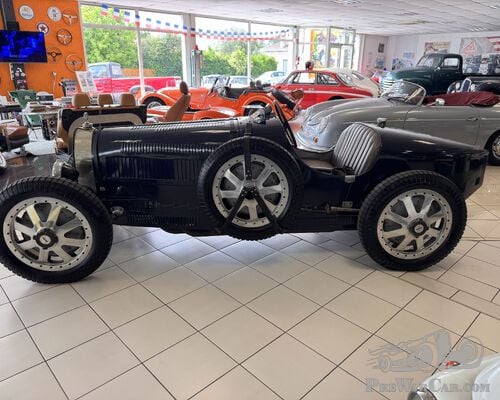
Bugatti 35 B Pur Sang
Bugatti 35 B Pur Sang,importée par un membre délégué de la FFVE il y’a une quinzaine d années.Participation à de nombreux Rallyes Bug..