The global magazine and marketplace for classic car enthusiasts, by enthusiasts.


Filter
Classic Star, A.C. for sale - Star, A.C. cars for sale
-

AC 16 / 66 - 1935 / 6 Cylinder / British Racing Green
AC (Acédès) 16/66 Drophead Coupe, year 1935. Chassis number L34X, engine number UBS.29X. Original British registration: DPC918. Colour: dark British Racing Green combined with a beige leather interior and light brown carpet trimmed with beige borders. The car is fitted with a black vinyl hood and a light brown mohair tonneau.. -
1921 AC Empire | Brightwells | Auction Ends: Wed 24th Jun
From a deceased estate; current owner 50+ years; last driven about seven years ago; Anzani engine; bespoke coachwork based on an AC prototype; interesting history file; further details to follow -
AC Royal Six Cylinder Project
1926 AC Royal – Restoration Project with Extensive History We are pleased to offer this charming and unusual 1926 AC Royal six-cylinder, recently reacquired from a private owner. The car was originally part of a collection we purchased in Africa around 10 years ago and was subsequently sold to its most recent keeper, who has sadly passed away. This..


Star
GB, 1898 – 1932
Star/ Starling/ Stuart
(1) Star Motor Co, Wolverhampton, Staffs., 1898 – 1902
(2) Star Engineering Co, Wolverhampton, Staffs., 1902 – 1909
(3) Star Cycle Co, Wolverhampton, Staffs., 1905 – 1909
(4) Star Engineering Co Ltd, Wolverhampton, Staffs., 1909 – 1928
(5) Star Motor Co Ltd, Wolverhampton, Staffs., 1928 – 1932
Edward Lisle Sr’s Star Motor Co, an offshoot of the Star Cycle Co, produced its first Star car in 1898, and offered the Star car for sale in the following year. The Star car was a Benz-based machine, with a single-cylinder, water-cooled 3½hp engine, belt primary drive and chain final drive. It was an improvement in that water circulation on the Star car was assisted by a pump. In 1900 there followed a 2-cylinder Star car with 3 forward speeds, still on Benz lines. 1901 brougth De Dion-engined single-cylinder Star cars, and 1902 an 8hp twin of Panhard type in addition. Other, larger Star cars of Panhard ancestry joined the 8hp, up to a 20hp four Star car. By 1904, although a De Dion-powered single and Panhard-type twin were still there, the bigger machines were of Mercédès pattern, these Star cars came with honeycomb radiators, mechanically-operated inlet valves and pressed-steel frames. All veteran Star cars up to 1914 were extremely well-made, well-furnished, conventional, rather expensive cars lacking in technical originality, showing a line of development appearance in the 1907 range. The best-known Star car of the veteran period was the excellent 15hp Star car of 1909, a shaft-driven 2.8-litre four which had become the 3-litre 15.9hp by 1914. A great variety of other Star cars, basically similar models were turned out, not only by Star but also by the Star Cycle Co. The latter, run by Edward Lisle Jr, had made motor tricycles and bicycles, and produced the Starling car in 1905. It had 2 forward speeds and a De Dion single-cylinder engine, but was otherwise of Panhard type, with armoured wood frame and chain drive. One year later the Star car company supplemented it with the more modern Stuart car, which had 2-cylinders, 3-speeds and shaft drive. This name was dropped in 1908, all models being called Starlings, but these too, disappeared in 1909 when Star cars cheaper line was entrusted to the new Brion Motor Co, a more indepented concern that was still run by Edward Lisle Jr. So popular was the Star car that its makers were among the six largest in the country before 1914.
The 15.9hp Star car was continued after World War 1, together with another sv four Star car of pre-war origin, the 20hp Star car of 3.8-litres. A modern light Star car of fashionable type, the 11.9hp, arrived in 1921. This Star car used a 1.795cc sv engine with a detachable head, made in unit with a 3-speed gearbox which had central change. By 1924, the 11.9 Star car had grown up into the 2-litre 12/25hp Star car. It shared cylinder dimensions with the 18hp Star car, which was a new 3-litre six. The 12/25 Star car could be had as a very fine fast touring car with overhead valves and 54bhp, in which form the Star car was called 12/40hp. Thereafter, the Star car range reverted to its pre-war complexity. By 1927, there were three sv Star car models and two additional and more up-to-date Star cars with overhead valves. The 14/40hp Star car, new in 1926, was a solid 2-litre, ohv machine which in spite of having only 4-cylinders and 3 forward speeds, this Star car was a notably smooth and flexible car, thanks to a 5-bearing crankshaft. The ohv 20/60hp Star car, a 2½-litre six with the same bore and stroke as the 14/40 and a 7-bearing crankshaft, was the most luxurious Star car. A light six, the popular ohv 18/50hp, joined the Star car range in 1928, the year of the Star car company’s acquisition by Guy, and replaced the 14/40 Star car for 1929. By this time, the sv Star cars had gone, leaving the two sixes. As the 18hp Star Comet and the 21hp Star Planet, these Star cars were revised with handsome bodies and very full, luxurious equipment, including one-shot chassis lubrication, thermostatically-controlled radiator shutters and a built-in jacking system. Two other engines, of 14hp (2-litres) and 24hp (3.6-litres) were also obtainable in Star cars for 1932, as alternative Comet and Planet power units. These Star car were the last new Star cars, for they were too expensive to make, and the times favoured the mass-produced economy car. Production of Star cars ended in March 1932, but the unsold stock was sold by McKenzie and Denley of Birmingham, and the Star car was quoted in the Buyer’s Guide lists until 1935.
US, 1903 – 1904
(1) Star Automobile Co, Cleveland, Ohio
(2) H.S. Moore, Cleveland, Ohio
This Star car was driven by a single-cylinder, watercooled engine of 1.9-litres, mounted beneath the front seat, with false bonnet and coil radiator in front. A champion planetary transmission and double chain drive was used on this Star car. Both two- and five-seater Star cars were made, the latter with rear entrance.
US, 1908
Star Automobile Co, Chicago, Ill.
Star runabouts were offered in three models, selling for $500, $600 and $700 respectively. The smallest Star car was an open two-seater, and shaft drive was employed on all Star cars.
US, 1908
Model Automobile Co, Peru, Ind.
The short-lived Star car from Peru was offered in conventional 2- and 4-cylinder forms. The twin was chain-driven, while the big, expensive four Star car ($4.000) had shaft drive.
US, 1922 – 1928
Durant Motor Co of New Jersey, Elizabeth, N.J.; Lansing, Mich; Oakland, Calif.
William Crapo Durant’s Star Four was one of the most serious attempts to take away some of the Model T Ford’s market, for the cheapest practical car. Unlike the Ford, the Star car was an assembled machine.The Star car had a 2.2-litre, 4-cylinder engine by Continental, and was conventional in design in every way except the gearbox, which was separate; a feature common to all the vehicles in Durant’s empire, but very unusual in American mass-produced cars by the early 1920s. The touring Star car cost only $443 in 1923, which helped Star to be the seventh biggest seller in America that year. The Star car was sold outside the United States as the Rugby. In 1926, a 2.8-litre six Star car was introduced. Front wheel brakes appeared in 1927 but a year later the Star car make disappeared in the collapse of the Durant interests. By this time, 250 Star cars a day were being turned out. Only the Four was still called the Star car for the 1928 model year, as the Six was now known as the Durant Model 55.
Source: Georgano, encyclopedia of motorcar; TRN, GMN, MJWW, TRN
The information is written with the greatest of care. However, if you have any suggested amendments please contact us at office@prewarcar.com
A.C.
GB, 1908 to date
(1) Autocars and Accessories Ltd, West Norwood, London S.E. 1908-1911
(2) Autocarriers (1911) Ltd, Thames Ditton, Surrey 1911-1922
(3) A.C. Cars Ltd, Thames Ditton, Surrey 1922 to date
This make succeeded the Weller and was a John Weller design developed from a commercial 3-wheeler, the AutoCarrier (hence the initials) with a single-cylinder rear-mounted moiv engine, 2-speed epicyclic gear and tiller steering. These side-by-side two-seater A.C. Sociables were made up to World War 1 and sold for less than £100, but in 1913 the company brought out a 10hp 4-cylinder light car with a 3-speed gearbox in the rear axle; the engine was a 1.100cc Fivet. A modernized version with electrics and a disc transmission brake appeared with the 1½-litre side valve Anzani engine in 1919, the giving way to A.C.’s own power unit in 1925 – the fours were dropped at the end of 1928. Also at the 1919 London show was Weller’s famous 1.991cc single ohc wet-liner six, an advanced power unit for its day. It did not get into production unitl 1922, but it remained in the catalogue until 1963, by which time output had gone up from around 35bhp to 103bhp. Under the aegis of S.F. Edge, the company’s director from 1921 to 1929, A.C.’s were raced, through their main interest was long-distance record work. A 4-cylinder car took 57 records at Brooklands Track in 1921; J.A. Joyce’s 16-valve ohc 1500cc single-seater covered 100 miles in the hour from a standing start in 1922; and Gillet broke the World’s 24-hour Record at Monthlhéry in 1925 on a 2-litre six. The 6-cylinder car of the Hon. Victore Bruce and W.J. Brunell became the first British entry to win the Monte Carlo Rally in 1926. In 1925 4-cylinder cars sold from £300, the cheapest six being £90 dearer, 4-wheel brakes were an optional extra, being standard on the 2-litre by 1927. All these cars retained the rear-axle gearbox, though the disc transmission brake did not last long.
Financial difficulties supervened in 1929, and virtually no cars were made for a couple of seasons, though the 1930 Magna series boasted hydraulic brakes. Th Hurlock brothers bought the company in 1930, and the 2-litre emerges in 1933 as a sporting machine with mechanical brakes and a conventionally-mounted 4-speed gearbox, in 56bhp and 66bhp versions. These cars were made on a bespoke basis, prices starting at around £435. Pre-selector boxes were available from 1934 and standard 1935 versions had synchromesh, while cars sold in 1936 had engines of 60 and 70bhp with an 80bhp sports engine available in a special short-chassis two-seater model. A 90bhp super-charged engine was listed in 1939.
A.C. resumed car production in 1947 with a saloon in the modern idiom. This had a 74bhp engine, and hydro-mechanical (full hydraulic from 1950) brakes, but retained its semi-elliptical springing up to the end of production in 1957. Some 3-wheeled monocars for invalids were made with 250cc B.S.A. motor cycle engines, and in 1953 came the Petite, a 3-wheeler roll-top convertible with rear-mounted 350cc Villiers power unit; despite a price of under £400, this never really became popular and was dropped in 1958. 1954 saw the advent of the Ace sports two-seater, a tubular-framed machine with all-independent suspension designed by John Tojeiro. With an 85bhp A.C. engine it could top the 199mph mark, and was later made also with 2-litre and 2.2-litre Bristol and 2.6-litre Dagenham Ford engines. Front disc brakes were standardized in 1960. In 1963 this car was developed into the Cobra (inspired by the American Carroll Shelby) with disc brakes all round and a 4.7-litre oversquare American Ford V8 engine developing 330bhp.
A Cobra finished 4th at Le Mans in 1964, but between 1965 and 1968 Shelby American Inc were responsible for the marketing of the 7-litre type, all Cobra production being abandoned in the latter year. From 1966, however, A.C. offered a luxury convertible or hardtop with Frua bodywork and a 7-litre Ford V8 engine, available with a 4-speed manual or an automatic gearbox. This 428 series was continued into 1973 at a price of £7.010. A.C. also made a special single-seater 3-wheeler for invalids with single-gear automatic transmission, wheel or handlebar steering, and fiberglass coupé body, powered by a 500cc 4-stroke twin engine.
Source: Georgano, encyclopedia of motorcars. MCS
The information is written with the greatest of care. However, if you have any suggested amendments please contact us at office@prewarcar.com


Featured

K3 Replica on KN Chassis
"The K3 Magnette must rank in the history books as the most famous and successful of all the record breaking MGs. With only 33 examples produced durin..
Rolls-Royce
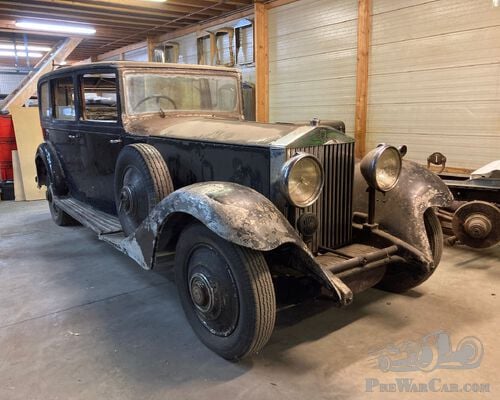
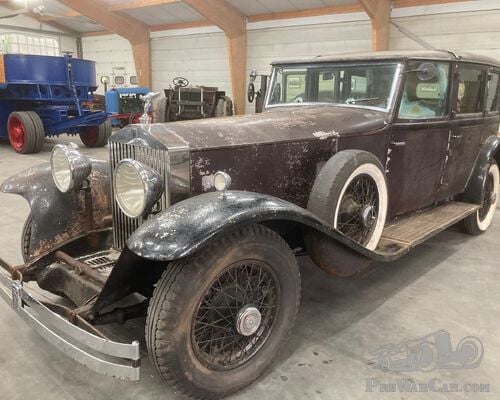
Rolls-Royce Phantom ll chassisnummer 287 AJS. bouwjaar 1932, Links gestuurd, Brewster Keswick Sedance Towncar