The global magazine and marketplace for classic car enthusiasts, by enthusiasts.


Filter
Classic Rolland-Pilain, Adler for sale - Rolland-Pilain, Adler cars for sale
-

Rolland Pilain
I am selling a 1913 Rolland Pilain RP 10HP in very good condition. It has a standard registration document in my name, and the MOT will be carried out prior to the sale. -
Adler 1913 Touring
Very unrestored . Is a real eye-catcher in the present condition. Previous owner has run it recently.Danish registration document .Price : please ask.


Rolland-Pilain
France, 1906 – 1931
SA des Etablissements Rolland-Pilain, Tours
Unusual among French marques of its period, Rolland Pilain cars made their greatest impact after World War 1. Their first product was a 20hp 4-cylinder model Rolland Pilain cars with a monobloc engine, though smaller 2.2-litre shaft-driven Rolland Pilain cars were available in 1909 and a 3-speed 1½-litre Rolland Pilain 8/10CV in 1910, in which year the Rolland Pilain car company was also experimenting with ‘valveless’ engines and 4-wheel brakes. Though racing was in the doldrums, the Rolland Pilain car company went to the trouble of building a big chain-driven Rolland Pilain car for the 1911 Grand Prix de France, and a complex 1912 range started with a Rolland Pilain 9CV of 1.7-litres and went up to a chain-driven 4-cylinder 60 Rolland Pilain car of 130x270mm. The 6-cylinder Rolland Pilain 18CV had a ‘valveless’ engine, and even in 1913 chain drive was still optional on the biggest fours of 20CV and 24CV Rolland Pilain cars. Only 1.9-litre and 4-litre 4-cylinder Rolland Pilain cars with sv monobloc engines and unit gearboxes were listed in 1914.
These basic types of Rolland Pilain cars, still with pedal-operated transmission brakes, were available again after World War 1, but far more advanced was the 2.2-litre Rolland Pilain 14/16 of 1921, which boasted not only overhead valves and a detachable head, but also front-wheel brakes (hydraulic at the front and mechanical at the rear). This Rolland Pilain car was still catalogued in 1926. Even more ambitious was the 2-litre twin ohc straight-8 GP Rolland Pilain car of 1922, with desmodromic valves, ball-bearing crankshafts and 4-wheel hydraulic brakes. A victory of a Rolland Pilain car at San Sebastian in 1923 was the limit of the success of Rolland Pilain cars on the circuits, but the type found its way into the catalogue as the Type A22 Rolland Pilain car at 90.000fr, and one of the racers also ran with a 2-litre, 6-cylinder cuff-valve Schmid engine. In 1925 came a 2-litre ohv 4-cylinder Rolland Pilain car with 4-wheel mechanical brakes, selling for £725 in England, while a 1½-litre development, the Rolland Pilain D26, was introduced for 1927. In 1929 Rolland-Pilain car, along with several other French firms, tried a Franco-American theme by introducing a range of big luxury chassis with sv Continental engines. Both the 6-cylinder, 3-litre, and the 4-litre straight-8 Rolland Pilain cars had centralized chassis lubrication, though the elegant bodywork of the Rolland Pilain car was marred by the use of artillery wheels. At the 1930 Paris Salon the Rolland Pilain car company shared a stand with the BNC (also going through a Franco-American phase), but this was the end, though the Rolland Pilain car firm’s Paris depot was still advertising spare parts for Bignan as well as Rolland Pilain cars in 1934.
Source: Georgano, encyclopedia of motorcar; MCS
The information is written with the greatest of care. However, if you have any suggested amendments please contact us at office@prewarcar.com
Adler
D, 1900 – 1939
(1) Adler Fahrradwerke vorm. Heinrich Kleyer AG 1900 – 1906
(2) Adlerwerke vorm. Heinrich Kleyer AG, Frankfurt/Main 1906 – 1939
This well-known bicycle and typewriter firm had already built components for Benz as well as a few De Dion tricycles when their first car appeared in 1900. This closely resembled the contemporary Renault, with tubular frame, shaft drive, and front-mounted 400cc single-cylinder De Dion engine; suspension was full-elliptic all round and steering was by tiller, but both these archaisms had gone by 1901 when a bigger 510cc power unit was standardized. By 1902 the company were making their own engines, an 850cc single and a 1.7-litre twin, there were four forward speeds, and the lateral radiators continued the Renault idiom.
With the arrival of Edmund Rumpler in 1903 the Adler idiom crystallized, even if this experimental swing-axle suspension did not pass beyond the prototype stage. Characteristics of the new models were side valves in an L-head, dual ignition, pressed-steel frames, and rectangular radiators. Four cylinders were preferred, though singles were still offered in 1905, and twins as late as 1909. By 1905 there were 4-cylinder cars of 2.8-litres, 4-litres and 7.4-litres, this last figuring in Adler’s Herkomer Trophy entry, and attracting an order from Kaiser Wilhelm II in 1907. If the 1906 Kleinwagen, a 1.032cc aiv V-twin with water cooling and steel artillery wheels, marked a retrograde step, by 1907 the company had adopted the unit gearbox, and were experimenting with ioe engines, achieving a 3rd place in the Prince Henry trials. There were also some modest short-stroke fours. A 2-litre 8/15ps was followed a year later by the successful 1.555cc 7/15. This developed into the 1.8-litre 7/15, popular in England as the 12hp. These small Adlers had dual ignition, but foot accelerators were found only on the bigger cars as late as 1913. There was a fast 5.2-litre 76bhp ioe model for the 1910 Prince Henry Trials, and a smaller 3.2-litre version was offered to the public. It evolved into the 15/40 of 1913, with 3.8-litre and 69bhp, used as the basis for Adler’s unsuccessful 1914 T.T. racers. Their Knight-engined 1911 cars did not progress beyond the prototype stage, but very attractive was that year’s new model, the 1.3-litre K voiturette, initially with pair-cast cylinders, but offered in 1913 with Monobloc engine and a choice of side-by-side or tandem seats. Rear suspension was full-elliptic. It did 50mhp and 38mpg, and was well received by Britons, who bought it under the name of Morgan-Adler Carette. There were also some large sv fours, the 4.8-litre 19/45 appearing in 1911, followed in 1912 by a 7.8-litre 30/70, and in 1914 by a V-radiatored 9.1-litre monster, top of a nine-model range. Also new was an enlarged K, the 1.552cc KL with four-seater bodywork and semi-elliptic rear springs.
A selection of the more popular 1914 types reappeared in 1919, and even in 1922 a replacement for the KL, the 6/22PS, retained a fixed head and reverted to a separate gearbox. Adler’s first sixes came in 1925, these boasting alloy pistons, detachable heads, and front wheel brakes. The 10/50 had a 2.6-litre Monobloc engine, but the 4.7-litre 18/80 was of biblock type. Also new was an essay in the American idiom, Becker’s 1.550cc 4-cylinder Favorit. Three years later it had been joined by a 2.9-litre six and a 3.9-litre straight-8, both with hydraulic brakes, these being offered on an enlarged and modernized Favorit in 1929.
At the Geneva Show in 1932 Adler presented their new 1.5-litre Trumpf with front-wheel drive and independent wheel suspension, a design of H.G. Röhr. This first front-driven car was followed by the 1-litre Trumpf Junior, the 1.7-litre Trumpf and the 2-litre model. The competition versions of these models – very often fitted with aerodynamic bodies – were very successful in the years from their appearance to the outbreak of World War 2. Streamlined Trumpf and Trumpf Junior cars gained 22 international records in 1935 and 1936 on the Avus and the Darmstadt Autobahn. A win in the Leinster Trophy Race of 1934, a Team Prize at Spa in 1936 in the 2-litre class, a 2-litre class win and 6th place overall at Le Mans in 1937 were only a few of the victories. In 1937 Adler introduced a rear-wheel driven model again, the 2.5-litre with 6-cylinder 50bhp engine, aerodynamic body and swing axles. The sports version of this type developed 80bhp.
Production of private ceased in 1939. Some prototypes of the Trumpf Junior were produced after the war and were on show at the Hanover Fair 1948, but production was not taken up. Instead of this, production of motorcycles was resumed, lasting until 1957.
Source: Georgano, encyclopedia of motorcar; HON
The information is written with the greatest of care. However, if you have any suggested amendments please contact us at office@prewarcar.com


Featured
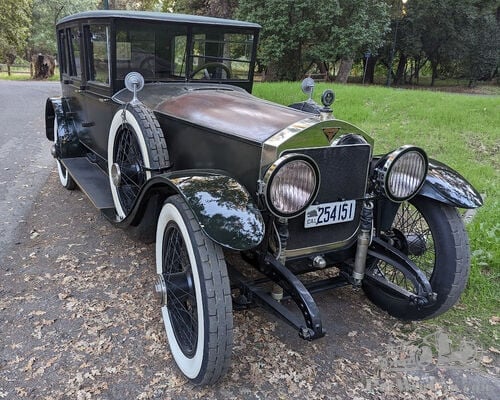
1916 Simplex, Crane model 5
1916 Simplex, Crane MODEL 5CUSTOM MADE HISTORIC PRESERVATION VEHICLE – READY TO TOUR!This Simplex recently completed th..
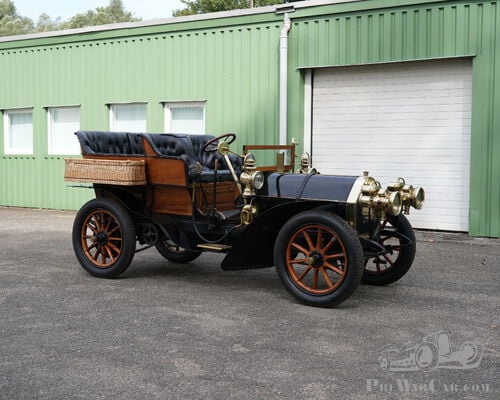
1904 Aster 16/20 HP Four-Cylinder Five-Seat Rear-Entrance Tonneau
Powerful four-cylinder engineFour-speed gearboxChain driveFive seatsMore than €100,000 recently invested
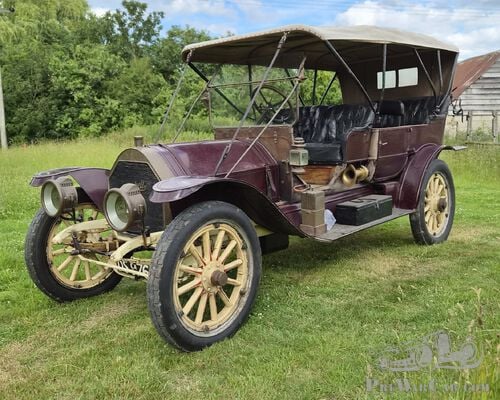
1910 Mitchell Model S - 50HP Six Cylinder
Based in Racine, Wisconsin and being the largest wagon manufacturer in the USA, Mitchell-Lewis produced their first motor car in 1903. Sales grew ..