The global magazine and marketplace for classic car enthusiasts, by enthusiasts.


Filter
Classic Albion, Hansa for sale - Albion, Hansa cars for sale
-

Two Hansa cars from 1937, offered together as a restoration project pair
OverviewTwo 1937 Hansa (Borgward) cars, stored indoors for decades, offered together. Both are largely complete: bodies (roof, doors, fenders, windscreen frame), chassis with front axle and radiator, wheels, interior (seats, steering wheel), plus engine and gearbox present on both cars. Condition is consistent with long-term dry storage —.. -
1901 Albion A1 Dogcart 8HP Twin Cylinder - VCC Dated
1901 Albion Model A1 8HP Twin Cylinder Dog CartRegistration No. BS8677Chassis No. 45E Established in 1899 in Finnieston Street Glasgow by Dr Thomas Blackwood Murray and Norman Fulton, the Albion Motor Company were once the largest provider of commercial vehicles in the British Empire. Albion were famed for their relia..


Albion
GB, 1900 – 1913
Albion Motor Car Co Ltd, Scotstoun, Glasgow
Still active as a truck manufacturers within the Leyland Group, Albion was founded at the end of 1899 by T. Blackwood Murray and Norman Fulton, late of Arrol-Johnston and their early products were dogcarts with varnished-wood bodywork much in the Arrol-Johnston idiom, with 2-cylinder opposed-piston underfloor engines, low tension magneto ignition, and Murray’s patent governor. Wheel steering replaced the tiller in 1902, and a year later Albion began production of a 16hp vertical-twin which was made for many years, usually with solid tyres, and often with shooting-brake bodywork. ‘Cars for country houses’, especially Scottish ones, were a speciality of the house, though rather less rustic was a side-valve 5.6-litre chain-driven four introduced in 1906. This 24hp model had a seven-year production run. The last Albion passenger car was a 15hp Monobloc four with side valves in a T-head and worm drive, which sold for £475 in 1912. At the end of 1913 Albion elected to concentrade on commercial vehicles, though large shooting brakes using the 15hp engine continues to be made.
Source: Georgano, encyclopedia of motorcar; MCS
The information is written with the greatest of care. However, if you have any suggested amendments please contact us at office@prewarcar.com
Hansa
D, 1906 – 1939
(1) Hansa Automobil – Gesellschaft mbH, Varel, 1906 – 1914, Bielefeld, 1913 – 1914
(2) Hansa-Lloyd-Werke AG, Varel, 1914 – 1929, Bremen, 1929 – 1931
(3) Hansa-Lloyd und Goliath-Werke Borgward & Tecklenborg, Bremen, 1931 – 1937
(4) Hansa Lloyd-Goliath-Werke Carl F.W. Borgward, Bremen, 1937 – 1939
The Hansa works were founded with the intention of producing small cars. The first was a Hansa 7/9ps car with a single-cylinder 720cc De Dion engine based on the French Alcyon. The Hansa appeared in 1906, and was sold under the name HAG. After a few more models with proprietary engines such as Fafnir the Hansa 6/14ps appeared in 1907 with a 4-cylinder engine of the Hansa company’s own design. A wide range of models was offered during the following years. Among them were the Hansa Types D (10/30PS, 2.612cc) and Hansa E (15/50PS, 3.815cc) of 1911 with overhead valves, a feature which was rare at that time. Hansa cars were produced in considerable numbers and Hansa cars were renowned for their high technical standard and their good workmanship.
In 1913 Hansa took over the Westfalia works at Bielefeld and Hansa cars were built there in 1913 and 1914. The Hansa Type F (2.515cc) took part successfully in the 1914 Austrian Alpine Trial. In 1914 Hansa merged with Lloyd, the firm adopting the name Hansa-Lloyd. The production of Hansa cars was carried on until World War 1. After the war Hansa concentrated on light and medium-sized cars which were marketed as Hansa. The Lloyd factory specialized in the heavier cars and commercials, which were sold as Hansa-Lloyds. Post-war models were the Hansa P 8/36PS with a 4-cylinder 2.063cc engine, also available in a short-wheelbase sports version, and two cars, a 13/60PS (6-cylinder, 3.262cc) and a 16/70PS (8-cylinder, 3.996cc) which were equipped with American Continental engines.
In 1929 Hansa was taken over by Borgward-Goliath. Production in the Varel works ceased and Hansa private cars were subsequently built only in Bremen. The Hansa Konsul, Hansa Senator, Hansa Matador and Hansa Imperator were family and prestige cars with 4-, 6-, and 8-cylinder engines with capacities up to 5.8-litres and outputs to 100bhp. The 3.2-litre Hansa Senator was an unusually large four for the period, and the Hansa Matador had a 2.6-litre Continental engine, and the combination of independent rear suspension and a backbone frame. In 1933 the small Hansa 400 was introduced. It had a 2-cylinder 2-stroke rear engine of 400cc and was later available with a 500cc engine. A new model, the Hansa 1100, with all independent suspension appeared in 1934. It was in production until 1939 and became very popular. Other models were the 6-cylinder ‘Hansa 1700’ (also available in a twin-carburettor sports version), the ‘Hansa 2000’ and the ‘Hansa 3500’ Privat.
After 1938 Hansa cars were marketed as Borgwards. In 1958 the Hansa name was revived for the flat-four Goliath; it had previously been used as a type name for some Borgwards.
Source: Georgano, encyclopedia of motorcar; HON
The information is written with the greatest of care. However, if you have any suggested amendments please contact us at office@prewarcar.com


Featured
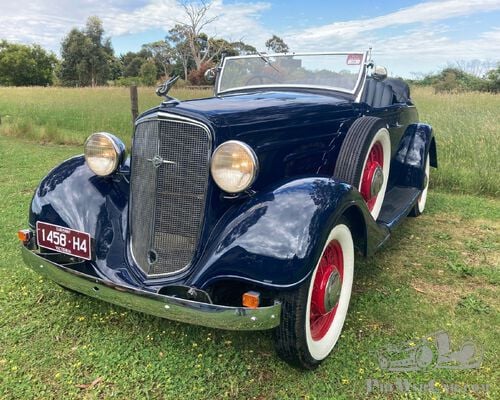
1934 Chevrolet Standard Roadster
1934 Chevrolet Standard Roadster This vehicle was delivered to Australia from Chevrolet and the body was manufactured by Holden Body Works w..
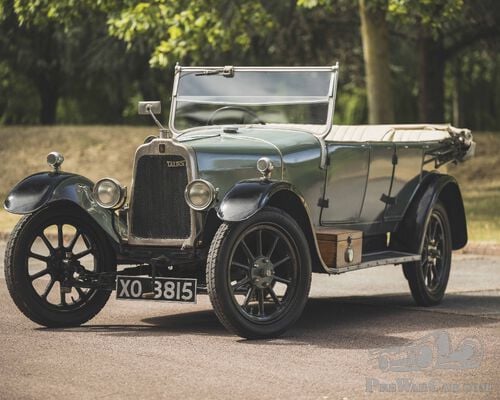
Rare RHD, low miles & great history file
This is an ONLINE-ONLY AUCTION at THE MARKET. The price shown here is the lower estimate. To see all the details, description, 250+ high-res photog..
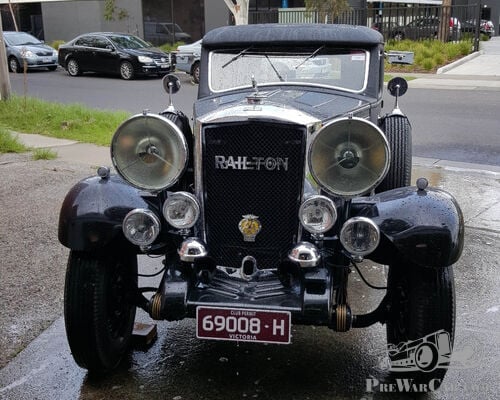
Railton straight 8 sports coupe for rallying REDUCED PRICE run with the bentleys at a fraction of the price
1934 Railton Sports CoupeBuilt for long distance rallyingRebuilt 2017built up at a cost of $160,000AUD, OFFERED FOR SALE AT A ..