The global magazine and marketplace for classic car enthusiasts, by enthusiasts.


Filter
Classic Albion, Pilain for sale - Albion, Pilain cars for sale
-

Société des Automobiles Pilain
The 1911 Pilain is the Type 4.0, equipped with a four-cylinder engine and a single Zenith carburetor. This car has undergone a comprehensive restoration over the past few years. Since the original body was too deteriorated to restore, it was decided to install an alternative body. The current elegant body is sourced from a Bianchi, which perfect.. -
1901 Albion A1 Dogcart 8HP Twin Cylinder - VCC Dated
1901 Albion Model A1 8HP Twin Cylinder Dog CartRegistration No. BS8677Chassis No. 45E Established in 1899 in Finnieston Street Glasgow by Dr Thomas Blackwood Murray and Norman Fulton, the Albion Motor Company were once the largest provider of commercial vehicles in the British Empire. Albion were famed for their relia..


Albion
GB, 1900 – 1913
Albion Motor Car Co Ltd, Scotstoun, Glasgow
Still active as a truck manufacturers within the Leyland Group, Albion was founded at the end of 1899 by T. Blackwood Murray and Norman Fulton, late of Arrol-Johnston and their early products were dogcarts with varnished-wood bodywork much in the Arrol-Johnston idiom, with 2-cylinder opposed-piston underfloor engines, low tension magneto ignition, and Murray’s patent governor. Wheel steering replaced the tiller in 1902, and a year later Albion began production of a 16hp vertical-twin which was made for many years, usually with solid tyres, and often with shooting-brake bodywork. ‘Cars for country houses’, especially Scottish ones, were a speciality of the house, though rather less rustic was a side-valve 5.6-litre chain-driven four introduced in 1906. This 24hp model had a seven-year production run. The last Albion passenger car was a 15hp Monobloc four with side valves in a T-head and worm drive, which sold for £475 in 1912. At the end of 1913 Albion elected to concentrade on commercial vehicles, though large shooting brakes using the 15hp engine continues to be made.
Source: Georgano, encyclopedia of motorcar; MCS
The information is written with the greatest of care. However, if you have any suggested amendments please contact us at office@prewarcar.com
Pilain
France, 1902 – 1920
SA des Automobiles Pilain, Lyons
François Pilain made his first Pilain cars, with 2- and 4-cylinder engines, in 1902, but had dropped the twin in his Pilain car by 1904. The drive of the Pilain car was independent of the rear axle, but two shafts to internally-toothed rings, with a dead axle beneath. The principle on the Pilain car was the same as that used by De Dion, the aim being to allow the axle to move in relation to the frame without recourse to chain drive. The engines of the Pilain car had side valves in a T-head, and there were 4 forward speeds. Round radiators and low-tension magneto ignition were featured, and 1906 Pilain cars came in 4.1-litre and 8.6-litre sizes, both with 4-cylinder engines. High-tension ignition and pressure lubrication followed on Pilain cars in 1908. There was a 1.9-litre Pilain car with monobloc engine in 1909, and a small 2.4-litre six in 1912. A wide 1913 range Pilain cars covered everything from a 1-litre lightweight up to 6.3-litres, including an ultra-long-stroke 4.2-litre (85x185mm) four. The Pilain car was an expensive if excellent machine that did not long outlive World War 1 in its original form. The Pilain car was then developed into the extraordinary S.L.I.M.
France, 1930 – 1935
E. Pilain, Levallois-Perret, Seine
Emile Pilain, who had been responsible for the original Rolland-Pillain, produced a light Pilain car on his own account in 1930 for the mass market. This Pilain car was a 919cc, watercooled sv four, with a 3-speed gearbox and Perrot brakes. It was rated at 5CV, and in 1932 there was also a 1.2-litre version Pilain car with free wheel.
Source: Georgano, encyclopedia of motorcar; TRN
The information is written with the greatest of care. However, if you have any suggested amendments please contact us at office@prewarcar.com


Featured
1929 Talbot K74 Limousine – Very comprehensive restoration project
For sale – 1929 Talbot K74 Limousine – Very comprehensive restoration projectAsking price: €19,950 A very rare 1929 Talbot K74..
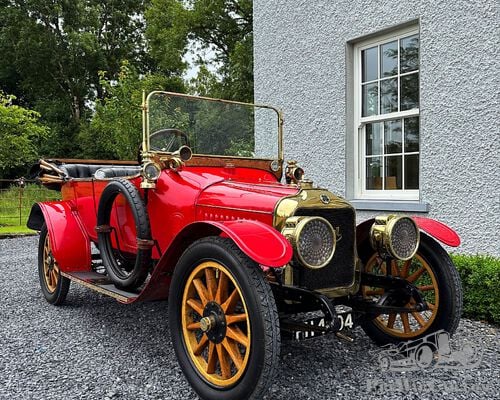
1914 Brasier
1914 Brasier Tourer 9ABrasier were a French manufacturer who were in business from 1901 until 1930, when the company became victim of the gr..
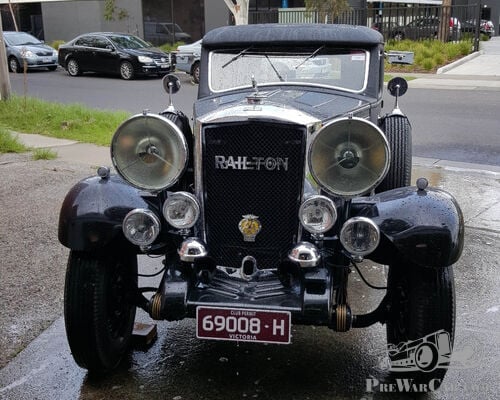
Railton straight 8 sports coupe for rallying REDUCED PRICE run with the bentleys at a fraction of the price
1934 Railton Sports CoupeBuilt for long distance rallyingRebuilt 2017built up at a cost of $160,000AUD, OFFERED FOR SALE AT A ..