The global magazine and marketplace for classic car enthusiasts, by enthusiasts.


Filter
Classic Alfa Romeo, Crossley for sale - Alfa Romeo, Crossley cars for sale
-

1929 Alfa Romeo 6C 1750 Super Sport
Created by legendary engineer Vittorio Jano, the Alfa Romeo 6C is rightly regarded as one of the greatest automobiles of all time. Launched in 1925 with an engine capacity of 1500cc the new model achieved many successes in top-flight motorsport. With the introduction of the 3rd Series in 1929 the engine was enlarged to 1750cc and the Super Sport.. -
Alfa Romeo RL Special Racer
Alfa Romeo RL Special, 6cylinders 2500ccm Jaguar SS100 Type engine, rolling chassis from the twenties, friction brakes.The chassis is not original. It is a period chassis adapted to the dimensions of an Alfa Romeo RL, similar to the front and rear axles.The bodywork is newly made from aluminium.The engine is a 1938 Jaguar SS.. -
1932 ALFA ROMEO 6c Supercharged GGTC by Cesare Sala
Year: 1932 Make: Alfa Romeo Model: 6c GTC Chassis: 101014925 Vintage & Prestige is proud to offer this incredible Alfa Romeo, coming to us in magnificient conditions troughout, with matching numbers all around. The car is located in Switzerland, from long ownersh.. -
1930 Alfa Romeo 6C 1750 GS Testa Fissa
1930 Alfa Romeo 6C 1750 GS Testa FissaChassis number: 8513089Engine Number: 8513089Registration Number: 102 hp, 1752 cc dual overhead cam six-cylinder engine with Memini supercharger, four-speed manual gearbox, semi-elliptic leaf spring suspension, and four-wheel mechanical drum brakes. Wheelbase: 2920 mm• The .. -
1933 Alfa Romeo 6C 1900 Gran Turismo Spider
William I'Anson Ltd are delighted to offer this 1933 Alfa Romeo 6c 1900 Gran Turismo Spider . This is a rare sixth-series Alfa Romeo 6C 1900 Gran Turismo, one of just 197 examples produced in 1933, retaining matching chassis, engine and gearbox numbers, and now presented in a supercharged specification. With a well do.. -
Alfa Romeo 6C 1750 GS Sixth Series Zagato Spider
Gorgeous 6th Series 6C 1750 Gran Sport Spider Matching numbers, not only engine but also rear axle, steering, gearbox etc.Only three owners in the past 70 yearsSold by myself 20 years agoSix times Mille Miglia participantFIVA passport A3Excellent condition throughoutServiced by ourselves for the most par.. -
1932 Alfa Romeo 8c Monza Tool Room Reconstruction.
Alfa Romeo 8c Monza Tool Room Reconstruction. Chassis Number: PS24110 Regsitration Number: Upon request for qualified buyers. PLEASE WATCH THE YOU TUBE VIDEO OF JAY LENO DRIVING IT This Alfa Romeo was first ordered & purchased by noted collector.. -
1930 Alfa Romeo 1750GT Bidée Spider
1930 Alfa Romeo 1750GT Bidée Spider Chassis Number: 8613270 Registration Number: 1OAU761 (Belgium). Built & exported to Belgium in 1930. In 1934 this Alfa suffered an accident & was then rebodied by Belgian coachbuilder Bidée into the stunniing little spider we find toda.. -
Alfa Romeo 8C 2300 Short-Chassis Zagato Toolroom Copy
Assembled over thirty years ago by the owner of a genuine Alfa Romeo 8C Short-Chassis Zagato as a toolroom copy of his own car. Sadly he passed away before the project was completed.The chassis is over 30 years old and is beautifully manufactured with holes in the correct places ready for spring hangers etc.Complete 8C Zagato-style.. -
1923 Alfa Romeo RL Sport
1923 Alfa Romeo RL SportVIN 7087, Engine 7087This car will be on the PreWarCar.com stand at Salon Retromobile 2026 - Pavillion 7.3, stand B011 Most probably the oldest Alfa Romeo RL in existence, Villa d ' Este entrant in 2024Period racing historyChassis shortened in period (192..


Alfa Romeo
Italy, 1910 to date
(1) A.L.F.A. (Anonima Lombardo Fabbrica Automobili), Milan, 1910 – 1914
(2) SA Italiana Ing. Nicola Romeo & C, Milan, 1914 – 1930
(3) SA Alfa Romeo, Milan, 1930 – 1942
(4) Alfa Romeo SpA, Milan, 1942 to date
(5) Alfa Romeo SpA, Pomigliano d’Arco, Naples, 1971 to date
A.L.F.A. (Anonima Lombardo Fabbrica Automobili) was founded in 1909 by Cav. Ugo Stella, formerly managing director of the Società Italiana Automobili Darracq, to manufacture a completely new range of Italian cars at Portello on the outskirts of Milan where, since 1906, small French Darracq cars had been assembled.
By 1910 the last Darracq had left the factory, and production commenced of a sturdy range of Alfa cars designed from scratch by Cav. Giuseppe Merosi, a native of Piacenza, who had been Chief Technician with Bianchi in Milan.
The first Alfas were a 24hp 4.1-litre car, later known as the 20/30hp, and a 12hp, 2.4-litre, which became the 15/20hp. Both were well made, with side-valve 4-cylinder monobloc engines and shaft drive. In 1913 the sports 6.1-litre 40/60hp appeared with push-rod overhead valves operated by two camshafts in the crankcase. A one-off 4½-litre Grand Prix car was built in 1914 with a 4-cylinder twin ohc engine, but it never ran in international races.
In 1915 the factory was taken over by the industrialist Nicola Romeo, and after World War 1 the pre-war models were marketed as Alfa Romeos. The 20/30 ES Sport of 1921-22 was successful in Italian races, as was a special racing 40/60 driven by Campari, which scored the firm’s first victory at Mugello in 1920. A 6-cylinder luxury side-valve car called the G1 was not a success, but Merosi’s best remembered designs followed it; the 3-litre 6-cylinder push-rod ohv touring, sports and racing RL series cars which first appeared in 1921 and went into production in 1922. A racing version won the 1923 Targa Florio. The similar 4-cylinder 2-litre type RM was marketed in 1923-26, but the pointed radiator sports 22/90hp RLSS and the touring 21/70hp RLT, which had a flat radiator, were sold until 1927.
In 1924 Alfa Romeo won the very first Grande Epreuve they ever entered, an unparalleled achievement, when Campari was victorious in the 1924 French Grand Prix at Lyons in the new straight-eight supercharged P2 car, designed by Vittorio Jano, who came from Fiat. In 1925 Alfa Romeo were declared World Champions.
Jano took over from Merosi in 1926 and his first touring and sports car designs soon became world famous, these having single and twin overhead camshaft 6-cylinder engines, first in 1.500cc and then in 1.750cc form. When supercharged, these cars won all the great sports car races in the period 1928-1930, with the exception of Le Mans.
The latter omission was rectified from 1931 to 1934 when victory at Le Mans each year went to Jano’s next sports car design, which had a 2.3-litre straight-eight supercharged engine with a central drive to the overhead camshafts. This engine also powered the successful Grand Prix Alfa Romeo of 1931, known as the Alfa Romeo‘Monza’ model and raced for the factory by Scuderia Ferrari. In 1932 this engine, in 2.65-litre form, powered the Alfa Romeo Type B P3 Monoposte G.P. car, which proved virtually unbeatable and bore affinities with the Alfa Romeo Type A racing car of 1931 powered by two 1.750cc engines side by side. In 1933 Alfa Romeo came under State ownership and the Alfa Romeo Monopostos were withdrawn from racing until right at the end of the season. Ferrari continued F.O. racing with Alfa Romeo Monzas enlarged to 2.6 litres.
The Alfa Romeo Monopostos in 2.9-litre form were not powerful enough against the Mercedes and Auto Unions, although Chiron won the 1934 French G.P. for Alfa Romeo, whilst Nuvolari quite unexpectedly won the 1935 German G.P. in an Alfa Romeo 3.8-litre Monoposto fitted with Dubonnet independent front suspension. From 1936 to 1939 Alfa Romeo fielded independently sprung straight-eight, V-12, and V-16 cars in G.P. racing, but against the German cars only isolated victories in smaller races were attained, usually through the skill of Nuvolari. In 1935 Ferrari built two big bi-motore racing cars, with one Alfa Romeo P3 engine under the bonnet and another in the tail.
Some 2.9 P3 engines were put into all-independently sprung chassis in 1937-1939 to make expensive but exceedingly fast prestige sports cars. In sportscar racing Alfa Romeos won every Mille Miglia from 1928 to 1938 inclusive, except in 1931.
In 1934 Jano’s unsupercharged 6-cylinder twin ohc 2.3-litre car replaced the 1750 and 8C 2300, and, developed by Bruno Treviso, it later became the 2500 of 1939 and the early post-war years. It was recplaced in 1950 by the 4-cylinder 1900. This marked an important change in Alfa Romeo policy. Previously the touring Alfas had been expensive and semi-bespoke machines, whereas the 1900 and its successors were unitary construction saloons whose production has risen to about 30.000 units per annum at the present time. In 1954 was introduced the famous 1300ccc Giuletta, designed by Orazio Satta. From it were derived the successful 1600 Giulia and the 6-cylinder 2600, introduces in 1962. For 1968 the 1600s were replaced by the 1750 series, actually 1.779cc, available as a saloon(Berlina), coupé (1750 GT Veloce) or open sports (1750 Spider Veloce).
The remarkable Colombo-designed supercharged 1½-litre 8-cylinder Monoposto known as the Alfa Romeo ‘158’ was introduces in 1938 for voiturette racing. After the war it was eligible for the Grand Prix formula, and by remaining unbeaten in Grandes Epreuves in 1946-1948 and 1950 until mid-1951, it set up a record unequalled by any other G.P. design. In 1946 Alfa Romeo took the first three places in the G.P. des Nations at Geneva, and repeated this finishing order in 1947 in the Italian G.P., the G.P. d’Europe at Spa and the Swiss G.P.. The most successful drivers during these years were Jean-Pierre Wimille, Achille Varzi and Count Felice Trossi, but the deaths of all three took place before the 1949 season and Alfa Romeo withdrew from racing as they had done in 1933. The Alfa Romeo 158s returned to the tracks in 1950 with Giuseppe Farina and Juan Manuel Fangio as their star drivers, and after victories in every race the cars ran in, Farina was declared World Champion. In 1951 Fangio was World Champion on the 400bhp Alfa Romeo Type 159, though the cars had to concede their first defeat, by and unblown 4½-litre Ferrari.
At the end of the season Alfa Romeo withdrew from G.P. racing, and although the works Disco Volante sports racing 2½- and 3-litre cars of 1952-1953 were generally unlucky in racing, the Alfa Romeo Giulias have had G.T. successes in recent years.
Competition activities were resumed in 1967 with the Alfa Romeo T33, a rear-engined 2-litre 4ohc V8 with hemispherical combustion chambers, fuel injection, alternator ignition, and a 6-speed all-synchromesh gearbox. Until 1969 a tubular trellis frame was used, replaced for 1970 by an orthodox platform, and the disc brakes were mounted inboard. This Alfa Romeo T33 was catalogued at 9.750.000 lire but was primarily used by the Autodelta racing team; later cars had 2½-litre and 3-litre engines. In 1971 Alfa Romeos won the BOAC 1.000 Kilometers, the Targa Florio and the Watkins Glen 6 hours, but in 1972 they were powerless against the all-conquering Ferraris. In the touring-car range, the six disappeared in 1969, and in 1970 the fuel-injected dry-sump 2.6-litre V8 engine was applied to a conventional front-engined coupé, the Alfa Romeo Montreal.
Other new 1972 models were the Alfa Romeo 2000, an updated 1750, and the 1.750cc Alfa Romeo Alfetta saloon with 122bhp engine, a 5-speed De Dion transaxle, double wishbone independent front suspension, and inboard disc brakes. It was the angular rear-end treatment of Alfa Romeo’s new economy saloon. The Alfasud, made in the Naples factory opened during 1971. This car had a 1.186cc flat-4 engine with cogged-belt drive for its twin overhead camshafts, hypoid bevel drive to the front wheel, all-disc brakes, and four forward speeds.
Source: Georgano, encyclopedia of motorcar; PMAH
The information is written with the greatest of care. However, if you have any suggested amendments please contact us at office@prewarcar.com
Crossley
GB, 1904 – 1937
(1) Crossley Brothers Ltd, Gorton, Manchester, 1904 – 1910
(2) Crossley Motors Ltd, Gorton, Manchester, 1910 – 1937
The name of Crossley was famous on engines before it was famous on cars; in fact the Crossley company was the first in Britain to make 4-stroke internal combustion engines on the Otto principle. Later, Daimler engines were made under licence. The first Crossley car for sale, a chain-driven 22hp 4-cylinder, appeared for the 1904 season. A Crossley 28hp and Crossley 40hp followed, all three cars being of normal design and foreign inspiration. Their designer was J.S. Critchley, formerly of Daimler. Shaft drive appeared in 1906, and late in 1909, some were fitted with Allen-Liveredge front-wheel brakes, but Crossley cars, though excellent machines, made little impression until after 1910. The 4-litre 20hp Crossley which then made its bow was a well-constructed, durable and very popular car. Designed by A.W. Reeves, it lived on in modified form until 1925. Crossley’s finest hour came in World War 1, when, as the Crossley 20/25hp it achieved fame as a staff car in the Royal Flying Corps, and as an ambulance and light truck. The Crossley model was extremely popular with the British Royal Family after the war in its 25/30hp version. In its early years, however, it was rivalled by the 15hp. The efficiency of the latter’s otherwise conventional engine, a side-valve four like the rest, gave this Crossley a better performance than most cars in its class and encouraged the makers to offer a special sporting variant, the Crossley Shelsley.
The Crossley Fifteen was discontinued after 1914, but a new Crossley arrived for 1921. This Crossley 19.6hp was a rather more modern design, having a detachable cylinder head, and it was cheaper and lighter on fuel than its 25/30hp companion. The performance was about the same. It was also made in sporting form as the Crossley 20/70hp, but this model was heavy, like the ’Crossley 19.6’ itself, and the brakes were not good enough for the 75mph that was available. Crossley did not make a serious attempt to invade the middle-class market until 1923, when the Crossley 12/14hp, later called the Crossley Fourteen, was introduced. Like its brothers, this was a simple side-valve four, in this case of 2.4 litres, but was more modern, with its unit construction of engine and gearbox and central gear-change. The Crossley Fourteen was a very successful model, being flexile and, thanks to its light weight, both roomy and economical. It survived until 1927. By this time the two bigger Crossley cars were giving way to a much more up-to-date car; the Crossley company’s first six and its first overhead-valve machine. This Crossley 18/50hp model was a spacious, heavy 2.6-litre car with good brakes but somewhat lacking in power. Its engine was enlarged to 3.2-litres and 20.9hp for 1928. At the same time a new small Crossley of similar design, the 2-litre Crossley 15.7hp was introduced, to which a sporting alternative reviving the Shelsley name was added in 1929. Lagonda’s 16/80 model used this engine later. The 6-cylinder Crossley 15.7hp continued until 1934 and the Crossley 20.9hp until 1937. Wilson pre-selector gearboxes were fitted from 1934.
In 1932, the Crossley company had introduced a light car, the Crossley Ten. This was an assembled vehicle powered by an 1100cc Coventry-Climax engine with overhead inlet valves. It was too heavy (a drawback compounded by the pre-selector gearbox), it was very low-geared and its brakes were mediocre. Another mistake was Crossley’s attempt to market the Burney rear-engined car with all-independent suspension. It was given a 15.7hp Crossley engine and a Wilson box, but it was too unconventional in appearance and handling. Very few were made. In 1935, Crossley introduced its new Regis range of small cars with handsome bodies styled by C.F. Beauvais. They consisted of the Crossley Ten and a new Crossley 1½-litre six of the same design also powered by Coventry-Climax, both with a new lowered frame. Both cars, together with the last Crossley 20.9s, disappeared after 1937.
Crossley assembled other people’s cars as well as making their own, beginning with the Willys-Overland Model 4 in 1920. The Gorton-produced Willys came to include more and more British-made parts, such as a Morris Oxford engine. A less likely diversion was an attempt of Crossley in 1921 to make the Type 22 Bugatti in England, but only a handful of these Crossley-Bugattis appeared. In 1922-1933 the Crossley factory made the AJS as well.
Source: Georgano, encyclopedia of motorcar; TRN
The information is written with the greatest of care. However, if you have any suggested amendments please contact us at office@prewarcar.com


Featured
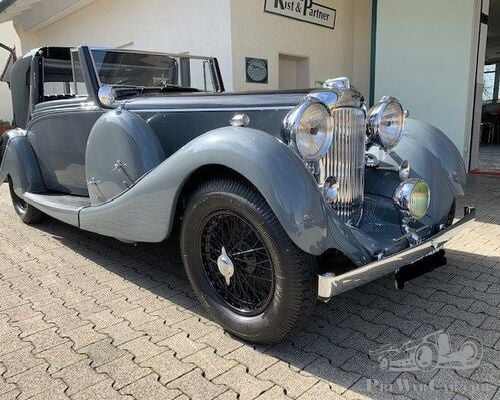
Lagonda LG 45 Coupe de Ville Sedanca by Mayfair
The successor to the M45, the LG45 was built around the same highly capable, competition-proven 4.5-litre Meadows inline-six engine, but featured r..
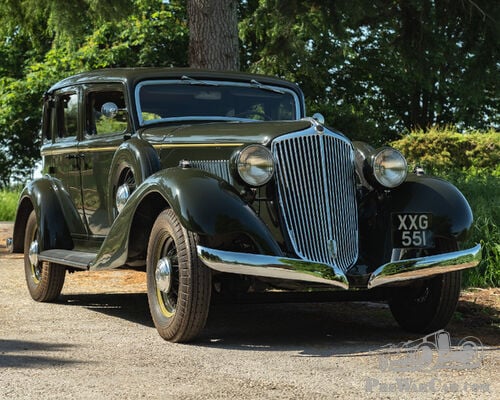
Graham Model 64 Standard Eight 'Blue Streak'
UK Registration No: XXG 551Chassis No: 1801069MOT: ExemptH&H ClassicsKelham Hall | Newark, Nottinghamshire

Lagonda LC Tourer 1934
The Lagonda story began in 1901 in Staines, a small town in the UK. The company enjoyed its greatest successes around 1935. During this period, the..