The global magazine and marketplace for classic car enthusiasts, by enthusiasts.


Filter
Classic Allard for sale - Allard cars for sale
-

Allard J2 FIA
Chassis No. 99J1557French classic car registration documentVehicle sold without an MOT“A genuine dragster eligible for the finest races on the calendar, including Monaco and Goodwood…” Like Enzo Ferrari and Carroll Shelby, Sydney Allard began his career as a racing driver before turning hi..

Allard
GB, 1899 – 1902
Allard and Co Ltd, Coventry, Warwickshire
The original Allard Cycle Co was formed in 1891. In 1899 they began to interest themselves in motors, building a De Dion-based tricycle and a Benz-derivative known as the Express. Their 2½hp and 3hp voiturettes, however, used single-cylinder 500cc engines clearly based on De Dion practice. Tubular frames and belt drive featured in the specification, and the cars could be had with electric or tube ignition. An oddity was a narrow little vis-à-vis for two people only. Late in 1900 the firm undertook to build the belt-driven Charette in series for International. In 1902 an entirely new 9hp single-cylinder Allard made its appearance. This had a flitch-plate frame and live axle. In June of that year Allard joined forces with the Birmingham Motor Manufacturing and Supply Co; the latter’s Birmingham factory was sold, and the Coventry firm changed its name to Rex. Mr Fred Allard, son of the head of the Coventry concern, was later chief designer of Armstrong-Siddeley Motors Ltd.
GB, 1937 – 1960
(1) Allards Motors Ltd, Putney, London S.W.15, 1937 – 1945
(2) Allard Motor Co Ltd, Clapham, London S.W.4, 1946 – 1960
The Allard stemmed from a ‘trials special’ evolved by Sydney Allard out of a 1934 Ford V8; this first car had a body from a G.P. Bugatti and divided-axle independent front suspension, and its excellent record on the ‘mud’ resulted in a demand for replicas. These were made in very small numbers, mostly with stark bodywork, up to World War 2. Some cars had the 4.4-litre 12-cylinder Lincoln Zephyr engine. In 1946 the Allard reappeared on the market with a lowered chassis, more civilized bodywork, and a striking radiator grill, still using the 3.6-litre sv Ford V8 engine; prices of the K (two-seater), L (four-seater), and M (drophead coupé) ranged from £1.125 up. Coil-spring independent front suspension and hydraulic brakes appeared in 1949, followed shorly afterward by the light and accelerative J2 two-seater with a De Dion rear axle; home-market models used the 3.9-litre ohv Ardun-Mercury conversion, but for cars sold in the USA power came from big V8s, such as the 5.4-litre Cadillac and Chrysler, and Oldsmobile’s Rocket. Sydney Allard won the 1952 Monte Carlo Rally on a P-type saloon in 1952, but Jaguar were already cutting hard into the specialist market, and the new 1953 models did not prosper; there were the big Monte Carlo saloon and Safari station wagon with V8 engines and De Dion axles, and a pair of smaller roadsters, the Palm Beach series with 1½-litre 4-cylinder and 2.3-litre 6-cylinder Dagenham Ford engines. Nor were American enthusiasts over-eager to buy the new Cadillac-engined JR sports-racer at $8.500. There was a brief flirtation with a 346cc 3-wheeler, the Clipper, in 1955, and in 1956 the old Ford V8 was at last dropped in favour of twin ohc Jaguar power units. Cars were now made to special order only, and the last design was a G.T. coupé introduced for 1958. Allard then made special modifications for Ford’s 105E-type Anglia
Source: Georgano, encyclopedia of motorcar; MCS
The information is written with the greatest of care. However, if you have any suggested amendments please contact us at office@prewarcar.com



Featured
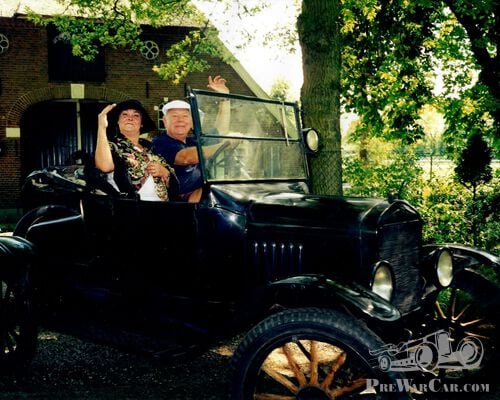
Zeer originele Ford Model T runabout
2 zits cabrio, motor is los, niet gerestaureerd, volledig orgineel, ingevoerd uit california in 1998, van de 2e eigenaar (m'n Oom) die hem van zn b..
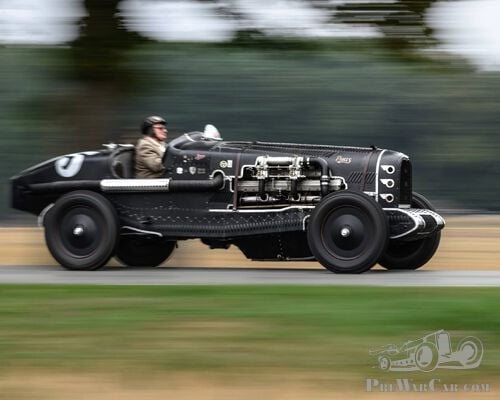
Delage DI, 1924, IL DRAGO RUGGENTE, one of few cars with an Aircraft engine and with war history.
A COLLECTOR'S OPPORTUNITY ONE-OFF. HAND-BUILT. UNREPEATABLE.A MACHINE WITH NO COMPARISONThere are special cars, there are racing cars..
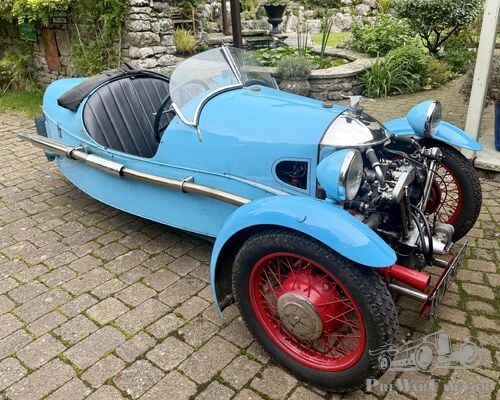
1933 Morgan Three-Wheeler Super Sports, Beetle Back • Show-Specification Car
First registered24 March 1933RegistrationXJ 6336 - original and transferableChassis numberD174Engine numberDTZE 94 H 31..