The global magazine and marketplace for classic car enthusiasts, by enthusiasts.


Filter
Classic Alvis, Cadillac for sale - Alvis, Cadillac cars for sale
-

1941 Cadillac Coupe
Cadillac really hit it with there design for 1941 , here a serie 62 coupe in a classic and eye-catching color combination. Designed by Harley Earl and Bill Mitchell and built at the Fleetwood plant, this serie 62 coupe is a full Classic (according to CCCA). The V8 engine with 150 hk make it a very powerful pre war car very usable on any ki.. -
1934 Alvis Speed 20SB Vanden Plas Tourer.
1934 Alvis Speed 20SB Vanden Plas Tourer. Chassis Number: 16197 Registration Number: AYN14 This alvis belongs to an octogenarian owner whom used it extensively until a few years ago maintaining it with out regard to cost with noted marque specialist Early Engineering. It i.. -
Cadillac 1934 Town Sedan serie 370D V12 Fleetwood Body
Cadillac 370D Town Sedan from Fleetwood with the V12 150HP engine and a wheelbase from 146" only 683 V12 where produced in 1934 by Cadillac This Impressive car has a weight from over 2500KG The Cadillac runs and drives well. Frank Kennis Phone: 00.31.622.420.766 or mail me: info@KennisCars.NL www.KennisCars.NL Classic Car Dealer for Europe Cad.. -
1932 Cadillac Series 452B V-16 All-Weather Phaeton by Fisher | The Quail Auction 2026
Engine No. 1400211 (See Text) Body No. 16 At a time when fours and sixes dominated the market and V8s were considered a luxury, Cadillac's decision to introduce a sixteen-cylinder engine in 1930 was as audacious as it was revolutionary. Designed as the halo example of the brand's "Standard of the World" reputation, the V-16 left compet.. -
1936 Cadillac Series 90 V-16 Five-Passenger Town Sedan | The Quail Auction 2026
Engine No. 5110221 Body No. 24 Fleetwood Style No. 5833-S 1936 marked the penultimate model year for Cadillac's celebrated overhead valve V-16, an engine that had redefined standards of power, smoothness, and underhood presentation since its 1930 debut. Whisper-quiet in operation, the 452-cubic-inch sixteen was perfectly suited t.. -
Cadillac V16 - Series 452 - 1930 - Imperial Sedan 4330
Offers invited a round € 200.000 - This ONE of 4 Survivors of Serie 4330 body style - book C.W. Cummings - 2014) ***excellent driving car, the V16 gives you a special experience, no other car has***https://www.prewarcar.com/a-stately-cadillac-v16-in-the-netherlandsBuilt; no 9 of 50 - Engine no. 700163Lengt.. -
Alvis Speed 25 Charlesworth, 1936
Alvis Speed 25 'Charlesworth' DHC, year 1936. Chassis number 13362SB, engine number 15149, body number 14128.12.36 (the original Charlesworth body). The body is finished in blue, combined with a blue leather interior and blue carpeting. Black mohair hood and cover. This beautiful Alvis Speed.. -
1928 Cadillac Model 7980 convertible coupe
Cadillac is one of the pristine cars in American history, here we have a 1928 model 7980 convertible coupewith all options as twin wooden spare wheels, trunk rack, pilot ray lights (who follow the direction of the front wheels) etc.The engine is a V8 with 5588cc on a 3560 wheelbase. At 2200kg it is not a lightweight.We parti.. -
1927 Cadillac V8 complete and restored rolling chassis
1927 Cadillac V8 complete and restored rolling chassis. With good radiator, beautiful original headlights, bonnet, cowling and dashboard. On restored wooden spoked wheels with the original hubcaps. Ideal car for racing and build your own body on ! We also have most of the dismantled original tourer body and the original fenders (guards) in good con.. -
1935 Alvis Speed 25 Sports Special - a lovely Special with the 3½-litre Speed 25 engine, which has just been rebuilt!
Some specials look better than others and this one looks just great! Built around 30 years ago for collector Dick van Dyck, it was acquired some 20 years ago by its current caretaker, the former chairman of the Dutch Vintage Sports Car Club (DVSCC). Built on a lightweight Silver Eagle chassis, it is fitted with the desirable 3½-..


Alvis
GB, 1920 -1967
(1) T.G. John Ltd, Coventry, Warwickshire, 1919 – 1937
(2) Alvis Car & Engineering Co Ltd, Coventry, Warwickshire, 1921 – 1937
(3) Alvis Ltd, Coventry, Warwickshire, 1937 – 1967
From its beginning, the name of Alvis has connoted high quality, long life and better-than-average performance. The first production Alvis set the trend. Those responsible for it were T.G. John, formerly of Siddeley-Deasy, and G.P.H. de Freville, who had worked for D.F.P. and had designed aluminium pistons bearing the name of Alvis for them. Their 10/30hp light car, current until 1922, used an extremely efficient 4-cylinder sv engine of 1.460cc made by Alvis, a 4-speed gearbox and attractive aluminium bodies by Morgan or Charlesworth. It was available in two-seater, four-seater or Super Sports form. The last-named as the first Alvis to have the famous ‘duck’s back’ body. Though noisy and expensive, the aLVIS ‘10/30’ was immensely popular among sporting motorists. In 1921, 322 examples were sold and by the following year the Alvis company employed 350 people. At the end of 1919, the new-born company had undertaken to deliver 1.000 cars, but the moulders’ strike which a brief spell during this period, the company made the Buckingham cyclecar.
In 1922, an engine of 1.598cc with a bigger bore and rated at 12/40hp was introduced in Alvis cars designed more for touring. Captain G.T. Smith-Clarke became chief engineer in 1923. He was responsible for the push-rod ohv 12/50hp engine, which was quieter and more powerful than its predecessors and at the same time extremely strong and long-lasting. It was first seen, in modified form, in the Alvis that won the Brooklands 200-Mile Race of 1923. The touring Alvis models were provided with 1.598cc engines, but the Alvis Super Sports had a shorter stroke giving 1.496cc and was more highly-tuned. The former were usually capable of about 60-65mph, but the latter would exceed 70mph comfortably. Handling qualities of all Alvis models were excellent, while bodies were by Cross & Ellis. During 1924 all Alvis cars went over to the new engine. At first, the Alvis firm’s survival was doubtful. Although 963 units of the older Alvis models had been sold in 1923, a receiver had to be appointed in the following year, because of lack of the capital needed for production on a scale to meet demand. More money was forthcoming, however, and the new Alvis 12/50hp restored the company’s fortunes. Prices were reduced for 1926, and all Alvis models were given front-wheel brakes. The chassis was stiffened by doing away with the separate subframe that had carried the engine and gearbox, and the engine was rubber-mounted. The downward-sloping ‘beetle-back’ tail was now the Super Sports style. By 1928, 6000 Alvises were on the road, and production was running at about 900 chassis per annum.
In that year, Alvis introduced a new type that was also to be a great success. Following fashion, it was a small six of 1.870cc. Similar in design to the old four, this Alvis was smoother, more flexible and quieter. Bodies were roomier and gearing was lower. This Alvis 14.75hp was superseded by the Alvis Silver Eagle in 1929, a car with a bigger bore that gave a mistake. They put into production a Alvis sports machine that had front-wheel-drive (Alvis FWD) – the first instance of this type of drive in a catalogued car – and independent suspension by four quarter-elliptic springs at the front and swing axles with quarter-elliptics at the rear. The 4-cylinder, 1.482cc, single ohc engine utilized many Alvis 12/50 parts, and could be had with a Roots-type supercharger. Helped by a low centre of gravity, the roadholding was very fine, and so were the brakes. During 1928 this Alvis model finished 6th and 9th at Le Mans, and 2nd in the Ulster Tourist Trophy race. In the following year an 8-cylinder version, still of 1½-litres was added. Unfortunately, the Alvis fwd had a very specialized, limited appeal, being complicated, unconventional, temperamental and hard to work on. However, Alvis were so confident in them and in the new six that they announced suspension of the production of the Alvis 12/50 in 1929. It was hurriedly reinstated when the six, popular though it was, proved insufficient to keep the Alvis company going alone. It was for sale until 1932, alongside a new sporting variant, the Alvis 12/60hp.
This was the Alvis company’s last out and out sports car, but its reputation for high-performance vehicles was sustained by the introduction of another new line for sale in 1932. The Alvis Speed Twenty was an exceptionally low-built, handsome fast tourer of modern appearance that combined the refinement of a medium-sized (2.511cc) six with speed, excellent roadholding and brakes, stamina and a reasonable sales-price. The car, and the types which succeeded it were a great success. The engine was a slightly tuned version of the largest option available in the Alvis Silver Eagle, and the chassis, too, was basically similar to that of the earlier Alvis model, which was retained. The power output was about 87bhp, permitting the better examples of the Vanden Plas open tourer to attain 90mph, in spite of the car’s weight, which was an equally traditional Alvis feature. The bodies were all coachbuilt.
With the introduction of this Alvis, the character of Alvis policy in the 1930s was set: the Alvis Speed Twenty and its developments provided the glamour, while an assortment of ‘bread-and-butter’ fours and sixes backed it up. All had push-rod ohv engines. The old Alvis ‘12/50’ and Alvis ‘12/60’ were replaced for 1933 by the sale of the heavier Alvis Firefly in the 1½-litre, 4-cylinder range. Much of the extra weight was added by the optional Wilson pre-selector gearbox, which could also be had on its development, the Alvis Firebird of 1935. This car, however, had an 1.842cc engine, in an attempt to cope with the avoirdupois. The Alvis Silver Eagle was joined early in 1933 by the 2.511cc Alvis Crested Eagle, which also had a Wilson gearbox. This was a chassis intended to carry heavier boddies, and was important because it was the first Alvis touring car to have independent front suspension, which was by a single transverse leaf. This feature, together with an all-synchromesh gearbox, was seen on the 1934 Alvis Speed Twenty. The latter model for sale, which was also growing heavier with increasing public demand for comfort rather than sporting pretensions, was given a bigger engine of 2.762cc in 1935 by lengthening the stroke.
For the same reason, the Alvis 3½-litre also made its bow. It was basically similar to the Alvis Speed Twenty, which it supplemented, but had a smoother, quieter engine with a bigger bore, providing 3.571cc and was designed to accommodate more comfortable, less sporting bodies. The Alvis 3½-litre was, however, a more powerful car than the Alvis Speed Twenty, with 110bhp. It was a short and logical step to replace the Alvis Speed Twenty with a new car for sale for 1936 that combined the virtues of both models. This was the fine Alvis Speed Twenty-five, which used the 3.571cc engine. Capable of a smooth and silent 95mph in saloon form, it was what many people still regard as the best Alvis ever built. At the same time, a car that was originally envisaged as a replacement for the short-lived Alvis 3½-litre was announced. This Alvis 4.3-litre had the same engine, bored out to a capacity of 4.387cc and providing 123bhp. With the introduction of the short-chassis sports tourer version for 1938, the Alvis 4.3-litre became the most exciting Alvis in the range, for it could easily exceed 100mph, with acceleration to match. Some consider that it was not quite as good-looking as the Alvis Speed Twenty-five, nor equally refined.
A new four for sale to replace the Alvis Firebird was listed for 1938. This was the Alvis 12/70hp, a George Lanchester design, with an 80mph performance in spite of its weight. The engine size was unaltered. The Alvis Silver Eagle had been dropped in 1936, but the Alvis Crested Eagle became for sale in a number of versions with the 2.762cc and 3.571cc engines as they appeared, in less highly-tuned forms. The Alvis Silver Crest, another Alvis car in which George Lanchester had a hand, was also brought in for sale in 1938 alongside the 12/70hp. It was intented to carry bodies of the more formal sort, and was powered by the 2.762cc engine, among others. It, too, had independent front suspension.
An aero engine works had been opened as early as 1937. The Alvis car factory at Holyhead Road, Coventry was completely destroyed by bombing in 1940, but the company continued to make aero engines – Rolls-Royce Merlins – at eighteen shadow factories. After World War 2, Alvis made their own Leonides unit and Alvis car production was restarted in 1946. A one-model policy, tailored to meet conditions of austerity, was adopted. Quality was still the main characteristic of the new Alvis TA14 for sale, which, in Alvis tradition, used a 4-cylinder push-rod ohv engine, now of 1.892cc.This Alvis TA14 car was the direct descendant of the 12/70hp. An ugly sporting model appeared briefly for sale in 1948. The Alvis TA14 was dropped during 1950 and the Alvis TA21, a big six, substituted. This was the first entirely new post-war Alvis. Its 2.993cc engine developed 90bhp, and this Alvis car – though not its sports roadster variant the Alvis TB21 – was as slower car than the Alvis Speed Twenty-five. Not so its development, the Alvis TC21/100, for sale in 1954 and 1955. This, after attention from Alec Issigonis, had a tuned engine providing 100bhp and a higher axle ratio, and carried a 100mph guarantee. The Alvis TC21/100 did not last long, for in 1955 there appeared one of the handsomest cars Alvis ever made, the Graber-designed Alvis saloon on what was virtually the Alvis TC21/100 chassis. Few were built until 1959, when this car was given a modified engine delivering 120bhp and renamed the Alvis TD21. It acquired disc brakes as standard fittings on all four wheels for 1962. For 1964, it was replaced by Alvis TE21, with 130bhp and five forward speeds. Automatic transmission was optional. In 1965 Rover acquired a controlling interest in the firm; production of private ceased in the summer of 1967.
Source: Georgano, encyclopedia of motorcar; TRN
The information is written with the greatest of care. However, if you have any suggested amendments please contact us at office@prewarcar.com
Cadillac
US, 1903 to date
(1) Cadillac Automobile Co, Detroit, Mich., 1903 – 1905
(2) Cadillac Motor Car Co, Detroit, Mich., 1905 to date
The ‘Standard of the World’ started humbly as a single-cylinder car selling for $750. Henry M. Leland, its creator, had been associated with Henry Ford and has also built engines for Oldsmobile. The Model-A Cadillac was markedly similar to the early Fords in having a horizontal underfloor engine, 2-speed planetary transmission and central chain drive via a spur-type differential, but Cadillac’s 1½-litre inlet over exhaust power unit had one cylinder where Ford used two. There was no bonnet on the early Cadillac models. This very successful design remained in production until 1908, later improvements including rack-and-pinion steering, transverse front suspension and a dummy bonnet. The Cadillac marque was introduced to Britain by F.S. Bennett, who in 1908 conducted a ‘standardization test’ at Brooklands. Three single-cylinder Cadillac cars were dismantled and the parts mixed up – they were then reassembled and the vehicles run on the track. The R.A.C. awarded Cadillac the Dewar Trophy for this achievement.
A 30hp 4-cylinder Cadillac car with separate cylinders and copper jackets was announced for 1906 and 75.000 of this type Cadillac were sold before it was discontinued in 1914. The original planetary transmission gave way first to a conventional 3-speed box, and finally in 1914 to a 3-speed box with 2-speed back axle. Cadillac was one of the firms organized into the General Motors group in 1909 by W.C. Durant, and in 1910, when a 4-cylinder Cadillac tourer could be bought for $1600, the company was claiming that tolerance on 112 parts of the car were accurate to one-thousandth of an inch. 1912 saw a most important Cadillac innovation: the standardization of the Delco system of electric lighting and starting on the Cadillac, now of 5½-litres capacity and capable of 60mph. The first left-hand drive Cadillac of 1915 was also the first of the company’s V8s, to become as much a hallmark of the breed as were Buick’s overhead valves. Inspired by the De Dion Bouton of 1910 it had 5.1-litre engine and sold for $2700. 13.000 V8 Cadillac cars were sold in the first year of production and the model was widely used by the U.S. Army in World War 1. Cylinder heads were detachable from 1917 on, and 1924 Cadillac versions had Duco cellulose finish and front wheel brakes.
In 1927, when 47.000 Cadillac cars were sold, a less expensive companion make, La Salle appeared, and the cars were restyled in 1928. The synchromesh gearbox made its world debut with the 1929 Cadillac models, which also featured chromium plating and safety glass, with a price range from $3.295 to $5.995. 1930 saw the advent of the ohv Cadillac V16 of 7.4-litres, which gave 185bhp and had a wheelbase of 12ft 4in. This sold at an average rate of 500 Cadillac cars a year for eight seasons in the $6.000-$9.000 price backet. It was joined in 1931 by an equally impressive ohv 6-litre V12 Cadillac for sale. Improvements over the next few years included power brakes (1931), ride control (1932), no-draught ventilation (1933), Dubonnet type independent front suspension (1934) and ‘turret-top’ all-steel bodies (for sale in 1935). 1938 Cadillac models had column change as standard, a year ahead of other GM products, while the V12 and V16 were dropped in favour of a side-valve short-stroke Cadillac 16-cylinder model which was made until 1940. Another new model for Cadillac in 1938, the 8-cylinder Cadillac Sixty Special, anticipated GM’s 1940 styling with its absence of running boards and 4-light sedan bodywork. 5.7-litre side-valve V8s in three wheelbase lengths made up the 1941 Cadillac range, on which Hydramatic transmission was optional for the first time.
The post-war era was to see Cadillac outstrip all its competitors in the top-price class and become an international symbol of wealth. Sales climbed from 66.000 cars in 1941 to 103.857 Cadillac cars in 1950, and to a new record of 165.959 Cadillac cars in 1964. Tail fins made their first appearance on Cadillac’s 1948 fastback coupé, and in 1949 Cadillac, along with Oldsmobile, adopted overhead valves and oversquare cylinder dimensions, their new 5.4-litre engine developing 160bhp. Cadillacs were raced at Le Mans in 1950 by Briggs Cunningham and the Cadillac engine was also used in export editions of Britain’s J2. Allard. Power output increased steadily: 190bhp in 1952 (by which time manual transmission was no longer offered), 210bhp in 1953 (when a 12-volt electric system was standardized), and 230bhp in 1954, the year when panoramic wrap-around windscreens and power-assisted steering became standard on the Cadillac for sale.
The expensive Cadillac Eldorado Brougham of 1957 (it cost over $13.000) was the first car to have air suspension (dropped after a few seasons) as standard equipment, while Cadillac, along with Lincoln, started the fashion for four headlamps, that later became universal in the USA. 1966 Cadillac cars featured GM’s perimeter-type chassis frame, a 340bhp 7-litre engine, variable-rate power steering, full air conditioning, electric door locks and seat controls, a time switch for the headlamps and a six-position steering wheel. Prices started at $4.650. In 1967 Cadillac set a new sales record of 213.161 cars, bettered in 1969 with 266.798/ They introduced a fwd car on Oldsmobile Toronado lines, the Fleetwood Cadillac Eldorado with torsion-bar ifs, self-levelling suspension, and front disc brakes, these last being applied to the more expensive Cadillac Fleetwoods with conventional drive, and to all the 1969 Cadillac range. Capacity of the Cadillac V8 engine was increased – to 7.735cc in 1968 and to 8.2 litres in 1970, but otherwise there were no major changes. In 1973 Cadillac were one of the few firms offering a nine-seater limousine: the Cadillac 75 with a wheelbase of 12ft 7½in and an overall length of 20ft 8in.
Source: Georgano, encyclopedia of motorcar; MCS
The information is written with the greatest of care. However, if you have any suggested amendments please contact us at office@prewarcar.com


Featured
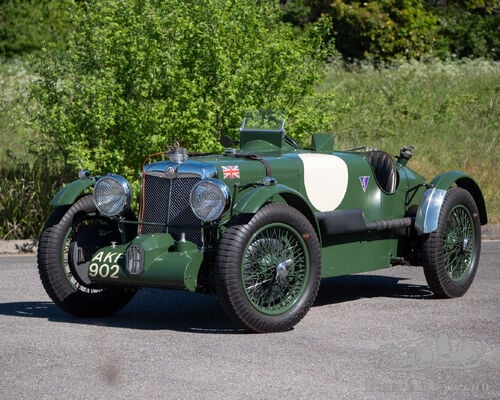
K3 Replica on KN Chassis
"The K3 Magnette must rank in the history books as the most famous and successful of all the record breaking MGs. With only 33 examples produced durin..
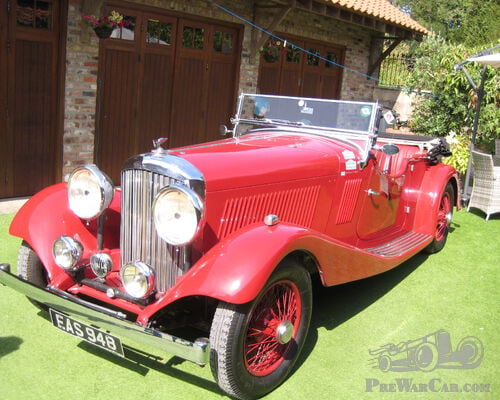
1935 Bentley 3.5 ltr. VDP 4str. Tourer
Chassis B 123 CW was first registered 14th March 1935, and in the late eighties underwent a " body-off" restoration and fitted with VANDEN PLAS
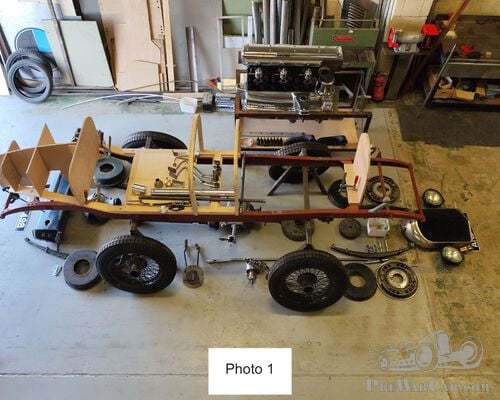
Bentley 3/6 litre sports racing car kit with V5C
I am a specialist vintage and classic car restorer with decades of hands-on experience. For some time I have been collecting parts for a special pr..