The global magazine and marketplace for classic car enthusiasts, by enthusiasts.


Filter
Classic Amilcar, American Austin (Bantam) for sale - Amilcar, American Austin (Bantam) cars for sale
-

1914 American Underslung Model 642 Roadster | RM Sotheby's | The Monterey Auction
To Be OFFERED AT AUCTION at RM Sothebys' The Monterey Auction event, 13 - 15 August 2026. $600,000 - $800,000 USD The sole known surviving Model 642 roadster, American’s sportiest creationA robust machine with a 60-hp T-head six and four-speed transmissionBuilt on the innovative Underslung chassis, one of the best-engin.. -
AMILCAR CS SKIFF
AMILCAR CS Pointe skiff en boisRestauration ancienneFreins sur les 4 rouesA parcouru de nombreux rallyesA remettre en routeCarte Grise FrançaiseL'Amilcar CS (Cyclecar Sport) est l'un des exemples les plus emblématiques de l'âge d'or des cyclecars français. Lancé en 1922 et produit jusqu'en 1925, le modèl..


Amilcar
France, 1921 – 1939
(1) Sté Nouvelle pour l’Automobile Amilcar, St Denis, 1921 – 1937
(2) Sté Financière pour l’Automobile, Boulogne-sur-Seine, 1937 – 1939
Of all the sporting voiturettes that proliferated in France after World War 1, the Amilcar was the most famous and successful. Its name(Amilcar) was an anagram of those of its proagonists, Messrs Lamy, who had been concerned with the design of the Le Zèbre before the war, and Akar, who financed the Amilcar. The Amilcar’s designer was Edmond Moyet. The Amilcar Type CC and its developments the Amilcar CS and Amilcar C4 all had 4-cylinder sv engines of about 1-litre capacity, three forward speeds and quarter-elliptic springing. They differed little, therefore, from hosts of their competitors. The Amilcar CGS or Grand Sport of 1924 was a different and more serious proposition. It had a 1.074cc engine with full pressure-lubcrication, front-wheel brakes and front half-elliptic springs. It was developed into the more powerful, lowered Amilcar CGSS (Surbaisse) model in 1926. Various touring cars of between one and two litres were also made, all with four cylinders and side valves, but it was the Amilcar CGS and Amilcar CGSS that made the company’s reputation throughout the world.
Even so, the Amilcar C6 Course, one of the very few pure racing cars ever to be put into production, was still more exciting. Introduced in 1926, it dominated the 1100cc voiturette racing class. Its twin overhead camshaft, 6-cylinder engine developed 83hp and used roller bearings in works form. These Amilcars were capable of 118mph. A small touring straight-8 joined the range in 1928, as was the fashion then. This low-built Amilcar C8 was another excellent machine, with good roadholding and a creditable maximum speed of almost 80mph in spite of its considerable weight. The 2-litre engine had a single overhead camshaft.
By 1930, the Amilcar company was concentrating on touring cars; sports cars in France, as elsewhere with the onset of the Depression, were in decline. The Amilcar C8 was there, enlarged to two litres. The 1¼-litre Amilcar Type M, a sedate small four which had arrived in 1928, survived until 1935 as the Amilcar M2, Amilcar M3 and Amilcar M4; latterly with a 1.7-litre engine. Meanwhile, 1933 had brought Moyet’s new 5CV, the Type C, current until 1935 in various forms, and the disappearance of the C8. From 1934 to 1937 the Amilcar 12CV N7 was offered, which used a Delahaye engine, and there was also the Amilcar 14CV G36. The last Amilcars, made by Hotchkiss, were far more interesting. These ‘Compounds’ of 1938-1939 had independent suspension front and rear, front-wheel drive on J.A. Grégoire Tracta patents, and the Alpax unit construction of body and chassis that incorporated much aluminum. The engine was an 1.185cc four.
Source: Georgano, encyclopedia of motorcar; TRN
The information is written with the greatest of care. However, if you have any suggested amendments please contact us at office@prewarcar.com
American Austin (Bantam)
US, 1930 – 1941
(1) American Austin Co Inc, Butler, Pa. 1930 – 1934
(2) American Bantam Car Co, Butler, Pa. 1935 – 1941
This was a license-produced Austin Seven with mirror-image engine. Chevrolet-like styling, and fixed disc wheels with detachable rims, selling in sedan form at $445. Unfortunately Americans have never been keen on sub-compacts, and rumoured orders for 180.000 American Austin cars boiled down to a trickle of sales. The make’s first year was its best, and even then only 8.558 American Austin cars were sold. There were receiverships in 1932 and 1934, and no car at all were produced in 1935 or 1936. In 1937 the American Austin was renamed the Bantam, with styling by Alexis de Sakhnoffski, a new horizontal-barred grille, pressure lubrication, mechanical pump feed, and synchromesh. The 1940 Bantam models had enlarged 800cc engines with 3-bearing crankshafts, and the range now included a four-seater convertible as well as roadsters, tourings, station wagons and light commercials, but few found buyers. In the same year the Bantam company produced the first successful Jeep prototype with 4-cylinder Continental engine for the US Army. Though the big contracts went to Willys and Ford, Bantam not only rescued themselves but abandoned car manufacture for good.
Source: Georgano, encyclopedia of motorcar; MCS
The information is written with the greatest of care. However, if you have any suggested amendments please contact us at office@prewarcar.com


Featured
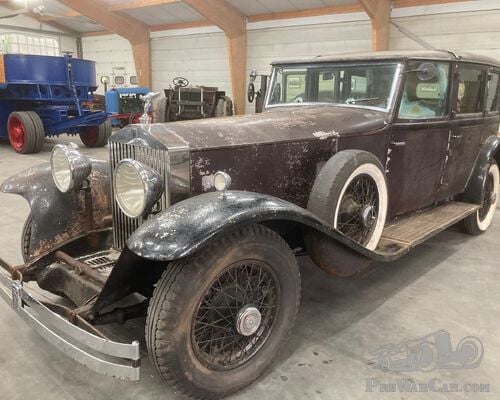
Rolls-Royce
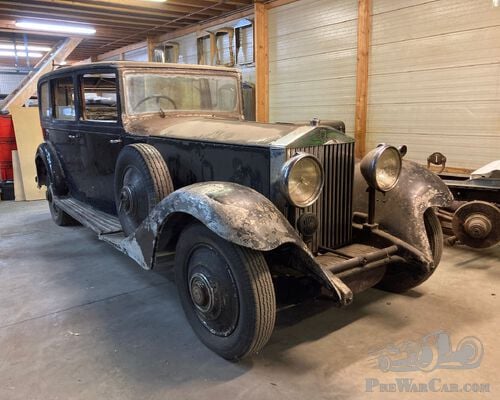
Rolls-Royce Phantom ll chassisnummer 287 AJS. bouwjaar 1932, Links gestuurd, Brewster Keswick Sedance Towncar
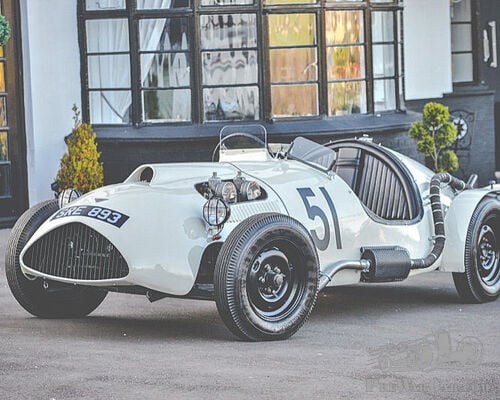
1933 Alvis 3.0 Special - One-Off Alloy Body | Period Competition Car | Featured in “Alvis – A Century of Drivers”
1933 Alvis 3. 0 Special - One-Off Alloy-Body | Period Competition Car | Featured in “Alvis – A Century of Drivers”