The global magazine and marketplace for classic car enthusiasts, by enthusiasts.


Filter
Classic Case, American Austin (Bantam) for sale - Case, American Austin (Bantam) cars for sale
-

1914 American Underslung Model 642 Roadster | RM Sotheby's | The Monterey Auction
To Be OFFERED AT AUCTION at RM Sothebys' The Monterey Auction event, 13 - 15 August 2026. $600,000 - $800,000 USD The sole known surviving Model 642 roadster, American’s sportiest creationA robust machine with a 60-hp T-head six and four-speed transmissionBuilt on the innovative Underslung chassis, one of the best-engin.. -
Case tractionengine for sale
Case 45, year 1909, probably one of the the best case worldwide. Restored from scratch, one hundred percent original. The tractor was restored in 2000 and the boiler was rebuilt by specialist Mc Ewen in England. An authentic water and coal trailer was built.This case has boiler test from England and Austrian TÜV, all papers are therefor. If you ..


Case
CDN, 1907
Lethbridge Motor Car Co, Lethbridge, Alt.
The Case Model A had a 20/24hp 4-cylinder air-cooled engine, friction drive, and what were describes as ‘Fawkes airless tyres’. The price for the Canadian Case was $2.000.
US, 1910 – 1927
The J.I. Case Threshing Machine Co, Racine, Wisc.
The American Case was a conventional car made by one of America’s best-known makers of threshing machines, steam traction engines and agricultural tractors. The Case cars were mainly sold through the farm equipment dealers. At first 4-cylinder Case cars only were made, the 1914 range consisting of a ‘Case 25’, ‘Case 35’, and powerful ‘Case 40’, but a Continental-engined Case six was offered for 1918. This was available in three body styles, a touring, a sedan, and a ‘sport’, which was a close-coupled open four-seater. The engine was rated at 29.4hp (3.9-litres), and this was gradually increased to 31.5hp (5.3-litres) by 1923. These 6-cylinder engines were all by Continental, and usually only one size was offered each year, although in some years (such as 1923) an overlap between Case models made two sizes available. From 1924 a smaller Case six of 4-litres was made, but in decreasing quantities, and in 1927 Case car production ceased. The Case company is still active and well-known in the field of agricultural tractors and other farm equipment. These, like the Case cars, carry the eagle emblem modelled on ‘Old Abe’, the famous mascot of the 8th Wisconsin Regiment from 1861 to 1881.
Source: Georgano, encyclopedia of motorcar; GNG
The information is written with the greatest of care. However, if you have any suggested amendments please contact us at office@prewarcar.com
American Austin (Bantam)
US, 1930 – 1941
(1) American Austin Co Inc, Butler, Pa. 1930 – 1934
(2) American Bantam Car Co, Butler, Pa. 1935 – 1941
This was a license-produced Austin Seven with mirror-image engine. Chevrolet-like styling, and fixed disc wheels with detachable rims, selling in sedan form at $445. Unfortunately Americans have never been keen on sub-compacts, and rumoured orders for 180.000 American Austin cars boiled down to a trickle of sales. The make’s first year was its best, and even then only 8.558 American Austin cars were sold. There were receiverships in 1932 and 1934, and no car at all were produced in 1935 or 1936. In 1937 the American Austin was renamed the Bantam, with styling by Alexis de Sakhnoffski, a new horizontal-barred grille, pressure lubrication, mechanical pump feed, and synchromesh. The 1940 Bantam models had enlarged 800cc engines with 3-bearing crankshafts, and the range now included a four-seater convertible as well as roadsters, tourings, station wagons and light commercials, but few found buyers. In the same year the Bantam company produced the first successful Jeep prototype with 4-cylinder Continental engine for the US Army. Though the big contracts went to Willys and Ford, Bantam not only rescued themselves but abandoned car manufacture for good.
Source: Georgano, encyclopedia of motorcar; MCS
The information is written with the greatest of care. However, if you have any suggested amendments please contact us at office@prewarcar.com


Featured
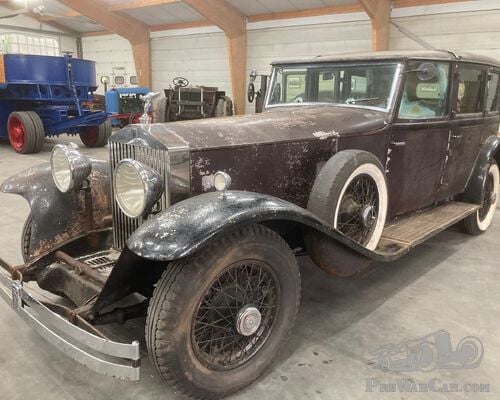
Rolls-Royce
Rolls-Royce Phantom ll chassisnummer 287 AJS. bouwjaar 1932, Links gestuurd, Brewster Keswick Sedance Towncar