The global magazine and marketplace for classic car enthusiasts, by enthusiasts.


Filter
Classic Cord, American Austin (Bantam) for sale - Cord, American Austin (Bantam) cars for sale
-

1937 Cord 812 Supercharged Cabriolet | RM Sotheby's | The Monterey Auction
To Be OFFERED AT AUCTION at RM Sothebys' The Monterey Auction event, 13 - 15 August 2026. $175,000 - $250,000 USD The iconic Cord in its most desirable and sought-after formA much-enjoyed part of the Mann Collection for 33 yearsAttractive older restoration, mellowed through years of touring pleasureIdeal for CC.. -
1914 American Underslung Model 642 Roadster | RM Sotheby's | The Monterey Auction
To Be OFFERED AT AUCTION at RM Sothebys' The Monterey Auction event, 13 - 15 August 2026. $600,000 - $800,000 USD The sole known surviving Model 642 roadster, American’s sportiest creationA robust machine with a 60-hp T-head six and four-speed transmissionBuilt on the innovative Underslung chassis, one of the best-engin.. -
1937 Cord 812 "Sportsman" Cabriolet
Vehicle Highlights Chassis No. 1268FEngine No. FB1707Auburn Cord Duesenberg (ACD) Club Certified Category 1 (C-277)Ideal for Auburn Cord Duesenberg Club and CCCA events Vehicle DescriptionThis is a 1937 Model 812 Cord Cabriolet “Sportsman”. A beautifully restored exa..


Cord
US, 1929 – 1937
Auburn Automobile Co, Auburn, Ind., 1929 -1937
The first American front-wheel-drive car to win popular approval, the Cord was one of a trio of distinctive cars (the others being the Auburn and the Duesenburg) that made up Erret Lobban Cord’s empire. The first Cord for sale was the Cord Model L-29, powered by a 4.934cc straight 8 engine made by Lycoming, another Cord subsidiary. The Cord L-29 was much lower than most contemporary American cars and was made in open and closed models, as well as being given special coachwork by such firms as Murphy, Hayes, and in England, Freestone & Webb. However, the price of over $3.300 was against the car in the Depression years, and production ended in 1932 after some 4400 Cord cars had been sold.
The Cord name re-emerged later in 1935 with the strikingly modernistic Cord Model 810. Designed by Gordon Buehrig, this car had originally been intended as a small model of Duesenberg. Like the Cord L-29 the new car was front-driven and Lycoming-powered, although by a slightly smaller V8 engine of 4.730cc. The body was of a very advanced design, and featured retractable headlamps and a wrap-around grille. Body styles were the Westchester and Beverly sedans (identical except for upholstery pattern), two-seater Sportsman and four-seater Phaeton convertibles. In 1937 the Cord Model 812 series was introduced, featuring a long-wheelbase Custom berline with chauffeur division, while an optional supercharger boosted power to 195bhp. Prices ranged from $1.995 for the early models to $3.575 for the 1937 Cord Supercharged Custom berline, and this drastically restricted sales. Only 2320 examples of the Cord 810 and Cord 812 were made.
Source: Georgano, encyclopedia of motorcar; KM
The information is written with the greatest of care. However, if you have any suggested amendments please contact us at office@prewarcar.com
American Austin (Bantam)
US, 1930 – 1941
(1) American Austin Co Inc, Butler, Pa. 1930 – 1934
(2) American Bantam Car Co, Butler, Pa. 1935 – 1941
This was a license-produced Austin Seven with mirror-image engine. Chevrolet-like styling, and fixed disc wheels with detachable rims, selling in sedan form at $445. Unfortunately Americans have never been keen on sub-compacts, and rumoured orders for 180.000 American Austin cars boiled down to a trickle of sales. The make’s first year was its best, and even then only 8.558 American Austin cars were sold. There were receiverships in 1932 and 1934, and no car at all were produced in 1935 or 1936. In 1937 the American Austin was renamed the Bantam, with styling by Alexis de Sakhnoffski, a new horizontal-barred grille, pressure lubrication, mechanical pump feed, and synchromesh. The 1940 Bantam models had enlarged 800cc engines with 3-bearing crankshafts, and the range now included a four-seater convertible as well as roadsters, tourings, station wagons and light commercials, but few found buyers. In the same year the Bantam company produced the first successful Jeep prototype with 4-cylinder Continental engine for the US Army. Though the big contracts went to Willys and Ford, Bantam not only rescued themselves but abandoned car manufacture for good.
Source: Georgano, encyclopedia of motorcar; MCS
The information is written with the greatest of care. However, if you have any suggested amendments please contact us at office@prewarcar.com


Featured
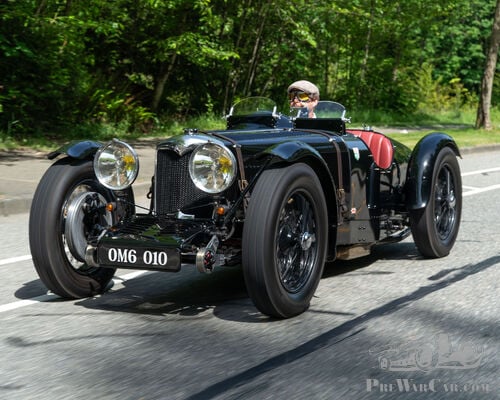
Riley 14/6 Special 1933
The ExperienceStep into the golden age of British motoring. This 1933 Riley 14/6 Special is a masterclass in pre-w..
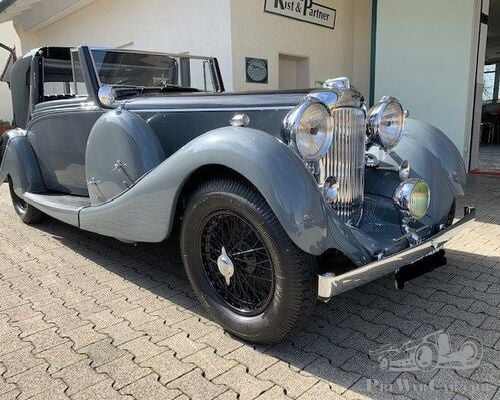
Lagonda LG 45 Coupe de Ville Sedanca by Mayfair
The successor to the M45, the LG45 was built around the same highly capable, competition-proven 4.5-litre Meadows inline-six engine, but featured r..

Daimler Flat six 15 Saloon - Fluid Flywheel / pre-selector
The E20 was manufactured between 1935 and 1939. It offered the choice of a coachbuilt saloon, Sports Saloon, Fixedhead Coupé and Drophead Coupé bod..