The global magazine and marketplace for classic car enthusiasts, by enthusiasts.


Filter
Classic DFP - Doriot-Flandrin-Parant, American Austin (Bantam) for sale - DFP - Doriot-Flandrin-Parant, American Austin (Bantam) cars for sale
-

C1926 DFP open
Rare DFP from c1926Mechanical complet, Missing interior and hood topno documents,can see in LisbonCan help with transportchassis # 40 273 -
1934 American Austin Roadster | RM Sotheby's | The Hershey Auction
Sold | $33,600 USD One of the first microcars produced for the American marketEquipped with a 747-cc inline four-cylinder engine producing approximately 13 hpRides on a 75-in. wheelbase with reported fuel economy of up to 40 mpgCoachwork by renowned designer Count Alexis de Sakhnoffsky, finished in an attractive..


D.F.P.
France, 1906 – 1926
Doriot, Flandrin et Parant, Courbevoie, Seine
Doriot and Flandrin had worked for Clément-Bayard and Peugeot, and their first products were straightforward shaft-driven single-cylinder voiturettes with transverse rear suspension, sold as Doriot-Flandrins until Parant arrived to complete the triumvirate. The singles DFP cars were still being marketed with 1100cc engines as late as 1910, but the 1908 DFP car range already included two 4-cylinder cars with sv Chapuis-Dornier engines of 2.4-litres and 2.8-litres capacity. By 1910 there was a small DFP four, the very successful DFP 10/12hp of 1.6-litres, with L-head Monobloc engine, magneto ignition, thermos-syphon cooling, cone clutch and 3-speed gearbox. There was also a DFP 25/30hp 6-cylinder car in 1911. In 1912 DFP started to make their own engines the ‘DFP 10/12’ being joined by an excellent 2-litre ‘DFP 12/15’ with pressure lubcrication, 3-bearing crankshaft and 4-speed gearbox, capable of 2500rpm and 55mph. Further, the British concession was acquired by the brothers W.O. and H.M. Bentley, who ran the ‘12/15’ in competitions; by the end of 1913 a specially prepared example of the DFP car had been timed of the half-mile at 89.70mph. Nothing, however, could be done with the DFP 16/22hp, a 2.8-litre (later 3-litre) machine with pair-cast cylinders and poor performance. In 1914 came the sporting DFP 12/40hp with V-radiator and electrics: for this model the Bentleys persuaded D.F.P. to fit aluminium pistons, as a consequence of which a 65mph performance was available for only £320. W.O. Bentley finished 6th in that year’s T.T., an excellent effort for a 2-litre car competing against specialized 3.3-litre machines.
DFP never recovered fully from World War 1 and Bentley’s decision to set up as a manufacturer in his own right meant that the DFP car company lost its best export market. A DFP 12/15hp chassis now cost £675 as against £290 in 1914. Failing finances forced the DFP company to use proprietary engines, Altos for the 2-litre models, and a Sergant in the ‘10/12’, which went American in 1922 with central change and coil ignition, but reverted to a magneto in 1923. 1922 ‘DFP 12/40s’ had 4-wheel brakes, and a year later this model was supplanted by an ohv 4-speed ‘13/50’, once again with a DFP-built engine. At the same time the DFP company marketed the little D.F.Petite, a sporting machine in the Amilcar idiom, with an ohv 1100cc engine, 3-speed gearbox, quarter-elliptic springing all round and a back axle without differential. This DFP car had front-wheel brakes by 1925, but a year later production had ceased, the DFP car factory being acquired by the Lafitte concern.
Source: Georgano, encyclopedia of motorcar; MCS
The information is written with the greatest of care. However, if you have any suggested amendments please contact us at office@prewarcar.com
American Austin (Bantam)
US, 1930 – 1941
(1) American Austin Co Inc, Butler, Pa. 1930 – 1934
(2) American Bantam Car Co, Butler, Pa. 1935 – 1941
This was a license-produced Austin Seven with mirror-image engine. Chevrolet-like styling, and fixed disc wheels with detachable rims, selling in sedan form at $445. Unfortunately Americans have never been keen on sub-compacts, and rumoured orders for 180.000 American Austin cars boiled down to a trickle of sales. The make’s first year was its best, and even then only 8.558 American Austin cars were sold. There were receiverships in 1932 and 1934, and no car at all were produced in 1935 or 1936. In 1937 the American Austin was renamed the Bantam, with styling by Alexis de Sakhnoffski, a new horizontal-barred grille, pressure lubrication, mechanical pump feed, and synchromesh. The 1940 Bantam models had enlarged 800cc engines with 3-bearing crankshafts, and the range now included a four-seater convertible as well as roadsters, tourings, station wagons and light commercials, but few found buyers. In the same year the Bantam company produced the first successful Jeep prototype with 4-cylinder Continental engine for the US Army. Though the big contracts went to Willys and Ford, Bantam not only rescued themselves but abandoned car manufacture for good.
Source: Georgano, encyclopedia of motorcar; MCS
The information is written with the greatest of care. However, if you have any suggested amendments please contact us at office@prewarcar.com



Featured
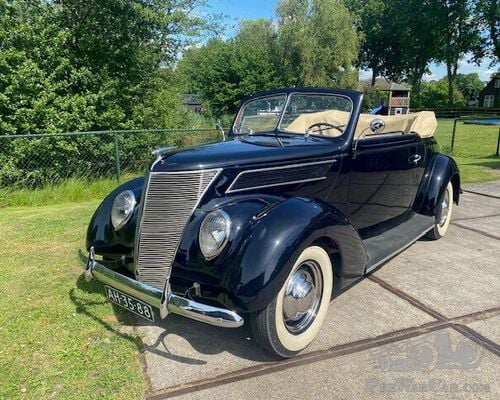
Ford v8 Club cabriolet 1937
Very nice Ford v8 Club cabriolet. In excellent condition. Runs and drives very well.Top condition.Shipping possible.
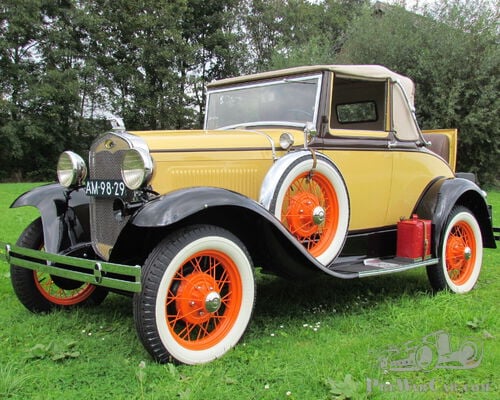
A Ford 68C Cabriolet
A fully restored Ford Model A, finished in its original factory colours and in very good condition. The car recently completed a 2,500-kilometre to..
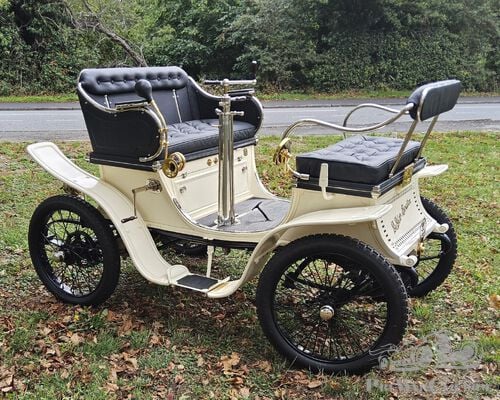
1902 De Dion Bouton Vis-a Vis 4.5 H.P. Reg No. Y123 V.C.C. Cert No. 1649
1902 De Dion Bouton Vis-à-vis 4.5 H.P.Reg. No. Y132 V.C.C. Cert No. 1649Beautifully presented and completely restored following an ex..