The global magazine and marketplace for classic car enthusiasts, by enthusiasts.


Filter
Classic Flint, American Austin (Bantam) for sale - Flint, American Austin (Bantam) cars for sale
-

Flint 1925/26 touring-car
Was on the road 8 month ago , but now it stands not running. It need total restoration . Top is very bad.It has Danish registration document . Lots of documentations goes with car.There are some extra parts with the car : trunk , extra rim , cyl.head , trunk-rag , and more. -
1914 American Underslung Model 642 Roadster | RM Sotheby's | The Monterey Auction
To Be OFFERED AT AUCTION at RM Sothebys' The Monterey Auction event, 13 - 15 August 2026. $600,000 - $800,000 USD The sole known surviving Model 642 roadster, American’s sportiest creationA robust machine with a 60-hp T-head six and four-speed transmissionBuilt on the innovative Underslung chassis, one of the best-engin..


Flint
US, 1902 – 1904
Flint Automobile Co, Flint, Mich.
The Flint was a light two-seater runabout with a rear-mounted single-cylinder engine and no mudguards. The Flint was designed by A.B.C. Hardy who was later general manager of Marquette and then Chevrolet. Flint is sometimes erroneously called the Hardy after the designer.
US, 1923 – 1927
Flint Division, Locomobile Co of America, Long Island City, N.Y., 1923 – 1924, Elizabeth, N.J., 1924 – 1927, Flint, Mich., 1924 – 1926
Fitted with a 7-bearing crankshaft and a steel tube for added reinforcement, the Flint occupied an important niche in William C. Durant’s car empire. With its 6-cylinder Continental engine and a price of less than $2.000 for the closed models, Flint was popular in its class and as many as 3.000 Flint cars were sold in a year. Lockheed hydraulic 4-wheel brakes came with the 1925 Flint model, and during the company’s last two years there were two big sixes of 3.8-litres and 4½-litres, as well as the 2.8-litre ‘Flint Junior’. A compact six Flint with rear wheel brakes only.
Source: Georgano, encyclopedia of motorcar; GNG, KM
The information is written with the greatest of care. However, if you have any suggested amendments please contact us at office@prewarcar.com
American Austin (Bantam)
US, 1930 – 1941
(1) American Austin Co Inc, Butler, Pa. 1930 – 1934
(2) American Bantam Car Co, Butler, Pa. 1935 – 1941
This was a license-produced Austin Seven with mirror-image engine. Chevrolet-like styling, and fixed disc wheels with detachable rims, selling in sedan form at $445. Unfortunately Americans have never been keen on sub-compacts, and rumoured orders for 180.000 American Austin cars boiled down to a trickle of sales. The make’s first year was its best, and even then only 8.558 American Austin cars were sold. There were receiverships in 1932 and 1934, and no car at all were produced in 1935 or 1936. In 1937 the American Austin was renamed the Bantam, with styling by Alexis de Sakhnoffski, a new horizontal-barred grille, pressure lubrication, mechanical pump feed, and synchromesh. The 1940 Bantam models had enlarged 800cc engines with 3-bearing crankshafts, and the range now included a four-seater convertible as well as roadsters, tourings, station wagons and light commercials, but few found buyers. In the same year the Bantam company produced the first successful Jeep prototype with 4-cylinder Continental engine for the US Army. Though the big contracts went to Willys and Ford, Bantam not only rescued themselves but abandoned car manufacture for good.
Source: Georgano, encyclopedia of motorcar; MCS
The information is written with the greatest of care. However, if you have any suggested amendments please contact us at office@prewarcar.com


Featured
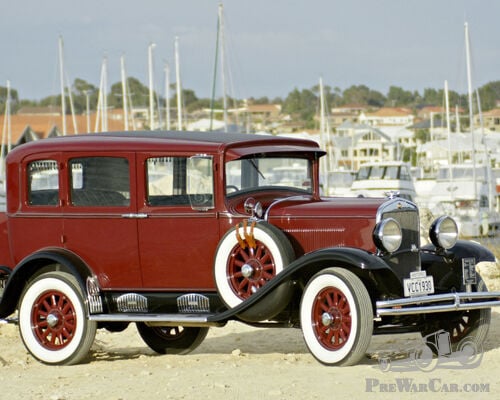
1930 Chrysler 66 Six-Wheel Equipped Royal Sedan
An exceptionally well restored and highly awarded Chrysler 66 Royal Sedan, with only two owners in nearly 97 years.The present owner ..
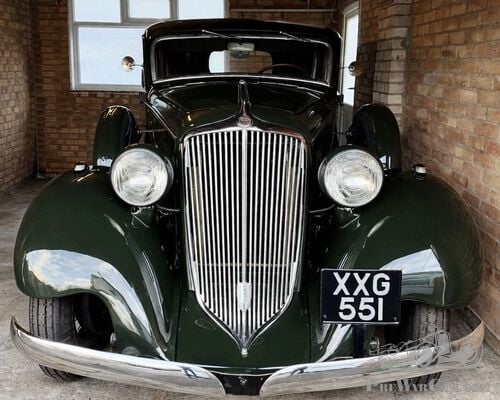
Graham Model 64 Standard Eight 'Blue Streak'
‘The most imitated car on the road’ One of the most significant pre-war American cars ever built. One of 23 known to exist glob..
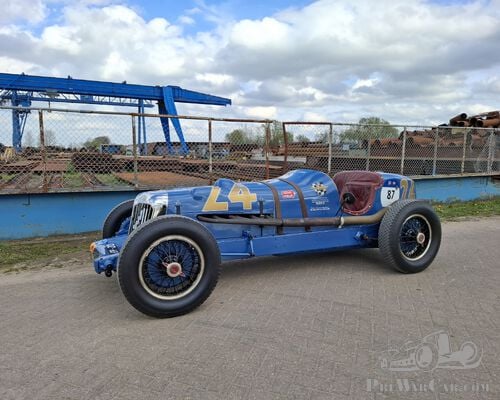
1932 - Graham " Lucenti " Indianapolis
Original participant of the 1932, 1934 and 1935 Indy 500. Best result: finishing 10th overall in the 1934 Indy 500 with driver “Herb” Ardinger...