The global magazine and marketplace for classic car enthusiasts, by enthusiasts.


Filter
Classic Marmon, American Austin (Bantam) for sale - Marmon, American Austin (Bantam) cars for sale
-

1914 American Underslung Model 642 Roadster | RM Sotheby's | The Monterey Auction
To Be OFFERED AT AUCTION at RM Sothebys' The Monterey Auction event, 13 - 15 August 2026. $600,000 - $800,000 USD The sole known surviving Model 642 roadster, American’s sportiest creationA robust machine with a 60-hp T-head six and four-speed transmissionBuilt on the innovative Underslung chassis, one of the best-engin.. -
Marmon Type 70 Sedan 1930 for sale
Marmon-Roosevelt straight eight sedan. Model 97, Type 70. The body was built by Hayes Corp. Roosevelt is the companion make to Marmon, nevertheless the Marmon label is featured on the car. The car makes a striking impression with it's six wire wheels and handsome headlights. It runs and drives but it requires work. The restoration is older and .. -
1931 Marmon Sedan 88
MARMON - SEDAN 88 Year 1931GasolineHistorical, 8 cylinders, very good condition.


Marmon
US, 1902 – 1933
(1) Nordyke and Marmon Co, Indianapolis, Ind., 1902 – 1925
(2) Marmon Motor Car Co, Indianapolis, Inc., 1926 – 1933
Howard Marmon’s first cars were advanced machines, featuring air-cooled V4 engines of oversquare dimensions, with mechanically-operated overhead valves and pressure lubrication. Something approaching independent front suspension was achieved on Marmon cars by the use of double-three-point suspension, with a separate sub-frame for engine and transmission. Only the 2-speed gearbox of planetary type conformed on the Marmon cars to American practice of the period. These Marmon cars persisted until 1908, though 1907 brought the introduction of selective sliding-type gearboxes on the Marmon car and a short-lived 60hp V8. In 1908 buyers of Marmon cars had the choice of air or water cooling and cylinder heads were detachable. The following year Marmon went over to conventional T-head in-line fours rated at 40/45hp and 50/60hp, and two years later only the 5.2-litre Model 32 Marmon car with rear-axle gearbox was listed. Marmon cars did well in contemporary competition, with 54 1st places logged with a Marmon car between 1909 and 1912; Ray Harroun won the first Indianapolis 500 in 1911 with a specially-built 6-cylinder Marmon car, the well-known Marmon Wasp. An enormous 9.3-litre six rated at 48hp was available in 1914.
In 1916 the advanced ohv 6-cylinder Marmon 34 with aluminium cylinder block, body, bonnet and radiator shell, and double transverse rear suspension was introduced. The engine capacity of this Marmon car was 5½-litres, and its output 74bhp; developments of this Marmon car were still listed as late as 1927, acquiring Delco coil ignition in 1920, and the option of a Marmon car with front wheel brakes in 1923. The Marmon cars were expensive: $5.000 was asked for a touring car in 1921. A not very successful 3.1-litre ohv straight-8 in the Marmon car appeared in 1927, but the following season only Marmon cars with eights were made, the cheapest sv Marmon 68 selling for $1.395. In 1928 Marmon also entered some front-wheel-drive Marmon cars at Indianapolis, but they were in fact only revamped Millers. The Marmon car company sold 22.300 Marmon cars in 1929, thanks to a cheap new straight-8 at under $1.000, the Marmon Roosevelt. This brandname, however, did not last, for the Marmon car appeared in the 1930 programme as the Marmon R, along with three other eights, the sv 69, and two big ohv Marmon cars with 4-speed gearboxes and capacities of the 4.9- and 5.2-litres respectively.
Marmon cars swansong was the magnificent 9.1-litre 200bhp 16-cylinder model of 1931. This Marmon car was beautifully proportioned, and had an alloy engine. The list price of the Marmon car was $4.925; there was a companion Marmon 8-125 in 1932, but only the Marmon Sixteen was listed for 1933. At the very end Marmon was testing a Marmon car with a 150bhp V12 with independent front suspension, De Dion rear axle, and tubular backbone frame, but this never saw production.
Source: Georgano, encyclopedia of motorcar; MCS
The information is written with the greatest of care. However, if you have any suggested amendments please contact us at office@prewarcar.com
American Austin (Bantam)
US, 1930 – 1941
(1) American Austin Co Inc, Butler, Pa. 1930 – 1934
(2) American Bantam Car Co, Butler, Pa. 1935 – 1941
This was a license-produced Austin Seven with mirror-image engine. Chevrolet-like styling, and fixed disc wheels with detachable rims, selling in sedan form at $445. Unfortunately Americans have never been keen on sub-compacts, and rumoured orders for 180.000 American Austin cars boiled down to a trickle of sales. The make’s first year was its best, and even then only 8.558 American Austin cars were sold. There were receiverships in 1932 and 1934, and no car at all were produced in 1935 or 1936. In 1937 the American Austin was renamed the Bantam, with styling by Alexis de Sakhnoffski, a new horizontal-barred grille, pressure lubrication, mechanical pump feed, and synchromesh. The 1940 Bantam models had enlarged 800cc engines with 3-bearing crankshafts, and the range now included a four-seater convertible as well as roadsters, tourings, station wagons and light commercials, but few found buyers. In the same year the Bantam company produced the first successful Jeep prototype with 4-cylinder Continental engine for the US Army. Though the big contracts went to Willys and Ford, Bantam not only rescued themselves but abandoned car manufacture for good.
Source: Georgano, encyclopedia of motorcar; MCS
The information is written with the greatest of care. However, if you have any suggested amendments please contact us at office@prewarcar.com


Featured
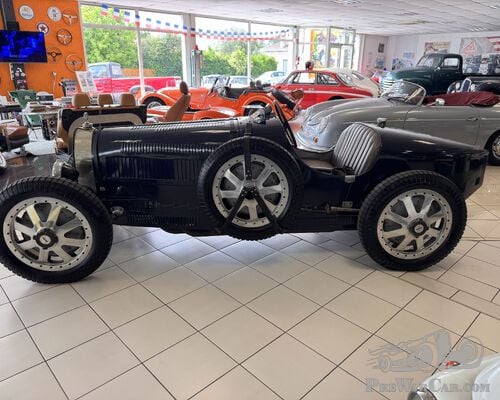
Bugatti 35 B Pur Sang
Bugatti 35 B Pur Sang,importée par un membre délégué de la FFVE il y’a une quinzaine d années.Participation à de nombreux Rallyes Bug..
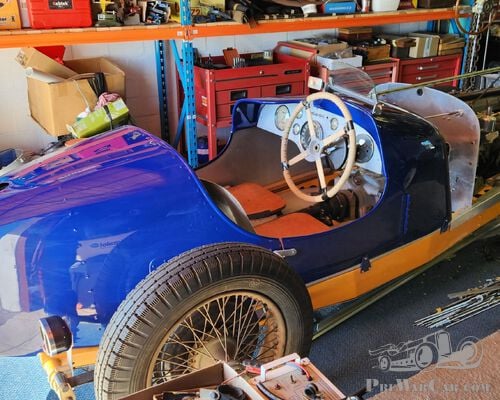
Riley TT Sprite
1935 6-cylinder TT Sprite replica. Chassis # 46A2722. Engine # 6A2722. Original Ulster Imp body. Restoration nearing completion. Engine, G..