The global magazine and marketplace for classic car enthusiasts, by enthusiasts.


Filter
Classic Regal, American Austin (Bantam) for sale - Regal, American Austin (Bantam) cars for sale
-

Regal Underslung Model T 1913
The Regal Motor Company was founded in 1908 in Detroit, USA, and became known for its conventional chassis concept, the “Underslung,” an extra-low concept with the axles mounted above the chassis. This resulted in a lower top dead center and greater stability; advertisements also stated that the car could not tip over.This Regal Model T w.. -
1914 American Underslung Model 642 Roadster | RM Sotheby's | The Monterey Auction
To Be OFFERED AT AUCTION at RM Sothebys' The Monterey Auction event, 13 - 15 August 2026. $600,000 - $800,000 USD The sole known surviving Model 642 roadster, American’s sportiest creationA robust machine with a 60-hp T-head six and four-speed transmissionBuilt on the innovative Underslung chassis, one of the best-engin..


Regal
France, 1903
O.C. Selbach, Paris
Regal cars was one of the names under which Lacoste et Battmann cars were sold. Originally the Regal car was a light two-seater with a 6hp De Dion engine, later Régal cars were powered by 2- and 4-cylinder engines by Aster and Mutel.
US, 1907 – 1920
Regal Motor Car Co, Detroit, Mich.
In 1907 Regal made 50 of their 20hp 4-cylinder Regal cars, but the following year the Regal car company took them all back, and gave the owners a new 1908 model Regal cars free. Apparently this generosity by the Regal car company was not repeated in following years, and they settled down to making a range of conventional 4-cylinder Regal cars. The best-known Regal car was the 3.2-litre 18/20hp ‘underslung’ model, which, like the American Underslung, had frame members which passed underneath the axles. The Underslung Regal car was made in open two-seater, and closed coupé form. Other Regal car models were the 20/30hp and 40hp which had normal chassis design. Regal cars were imported into England by Seabrook of Great Eastern Street, and from 1911 to 1915 the Regal cars sold in England were known as RMCs or Seabrook-RMCs. In 1915 a 10/15hp four of 2.1-litres with unit construction of engine and gearbox was introduced on a Regal car, together with a short-lived V8. At the 1919 Olympia Show Seabrooks showed a large RMC tourer powered by a 3.8-litre 6-cylinder engine, but shortly afterwards American production of Regal cars ceased, and Seabrooks began to make their own light cars.
CDN, 1910
This Regal car was a 30hp car made as a touring car or runabout at Walkerville, Ont. The Regal car had no connection with the better known Regal cars.
CDN, 1914 – 1917
Canadian Regal Motor Car Co, Berlin, Ont.
The Regal car was a light-weight touring car which resembled the Detroit model Regal car bearing the same name. The Regal car was available with a Lycoming 4-cylinder engine at $875 or a V8 at $1.350, it had a radiator filler concealed under the bonnet. The Regal car company was under the direction of Henry Nyberg, who had built the US Nyberg car before going to Canada. In 1917 the Regal car company moved to a new plant and started producing Dominion trucks. About 200 Canadian Regal cars were built.
Source: Georgano, encyclopedia of motorcar; GNG, GB
The information is written with the greatest of care. However, if you have any suggested amendments please contact us at office@prewarcar.com
American Austin (Bantam)
US, 1930 – 1941
(1) American Austin Co Inc, Butler, Pa. 1930 – 1934
(2) American Bantam Car Co, Butler, Pa. 1935 – 1941
This was a license-produced Austin Seven with mirror-image engine. Chevrolet-like styling, and fixed disc wheels with detachable rims, selling in sedan form at $445. Unfortunately Americans have never been keen on sub-compacts, and rumoured orders for 180.000 American Austin cars boiled down to a trickle of sales. The make’s first year was its best, and even then only 8.558 American Austin cars were sold. There were receiverships in 1932 and 1934, and no car at all were produced in 1935 or 1936. In 1937 the American Austin was renamed the Bantam, with styling by Alexis de Sakhnoffski, a new horizontal-barred grille, pressure lubrication, mechanical pump feed, and synchromesh. The 1940 Bantam models had enlarged 800cc engines with 3-bearing crankshafts, and the range now included a four-seater convertible as well as roadsters, tourings, station wagons and light commercials, but few found buyers. In the same year the Bantam company produced the first successful Jeep prototype with 4-cylinder Continental engine for the US Army. Though the big contracts went to Willys and Ford, Bantam not only rescued themselves but abandoned car manufacture for good.
Source: Georgano, encyclopedia of motorcar; MCS
The information is written with the greatest of care. However, if you have any suggested amendments please contact us at office@prewarcar.com


Featured

Lagonda LC Tourer 1934
The Lagonda story began in 1901 in Staines, a small town in the UK. The company enjoyed its greatest successes around 1935. During this period, the..

1915 Rolls-Royce Silver Ghost Barker Tourer
⁃ An exceptionally rare original bodied pre-war Silver Ghost⁃ Desirable Barker tourer in exciting barn find condition⁃ ..
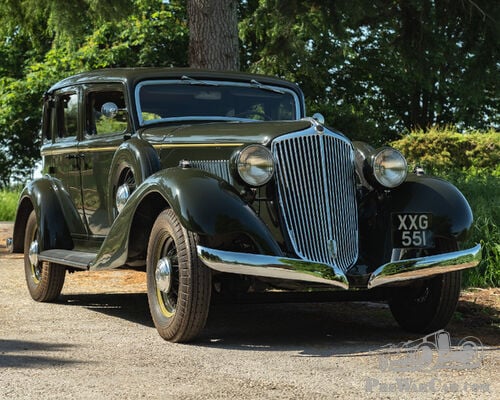
Graham Model 64 Standard Eight 'Blue Streak'
UK Registration No: XXG 551Chassis No: 1801069MOT: ExemptH&H ClassicsKelham Hall | Newark, Nottinghamshire