The global magazine and marketplace for classic car enthusiasts, by enthusiasts.


Filter
Classic American LaFrance, Orient for sale - American LaFrance, Orient cars for sale
-

1905/6 Orient Buckboard
Build by Waltham , mass. Usa . very original and unrestored , except the engine which is restored and running .Known history back to before ww2 . Last ovner found it in 1950.Eur 25.800

American LaFrance
US, 1907 – 2014
LaFrance Manufacturing Company
American LaFrance (ALF) was an American vehicle manufacturer which focused primarily on the production of fire engines, fire aerials, and emergency apparatus such as ambulance and rescue vehicles. The company was located in Summerville, South Carolina. It was announced Friday, January 17, 2014, they would cease operations.
The American LaFrance Fire Engine Company was one of the oldest fire apparatus manufacturers in the United States. With roots that go back to approximately 1832, the companies that went on to become American LaFrance built hand-drawn, horse-drawn, and steam-powered fire engines. Founded in 1873 by Truxton Slocum LaFrance and his partners, including Alexander S. Diven as the LaFrance Manufacturing Company selling hand powered equipment. The International Fire Engine Company, corporate predecessor of American LaFrance, built some steam power fire engines between 1903 and 1907. Apparatus built by International included horse drawn steamers, hose wagons, and hook & ladders to chemical engines, water towers and combinations. The American LaFrance Fire Engine Company was formed in 1903. Its corporate offices and manufacturing plant were in Elmira, New York. It also operated a Canadian plant in Toronto, Ontario, where it sold apparatus under the name Lafrance-Foamite, until 1971. American LaFrance (ALF) delivered its first motorized fire engine in 1907. Over the years, American LaFrance built thousands of fire trucks including chemical engines, combination pumpers, aerial ladder trucks, Aero Chief snorkel trucks, and airport crash trucks. The classical style of the American LaFrance apparatus is easily recognized. Some of the company's innovations led to changes in the industry, most notably the cab forward style cab.
In 1995, the company was bought by Freightliner LLC, which is a subsidiary of Daimler AG. Freightliner continued to utilize American LaFrance's original nameplates and designations including the Eagle custom chassis
Historic vehicles
- Type 1 1903-1904 Steam-powered Combination Hose & ChemicaL Wagon
- Type 3 1906-1906 Packard "N" Two-Tank ChemicaL Car - only 1 built
- Type 4 1909-1912 Simplex based chassis - 2 built (see also Technisches Museum Sinsheim site )
- Type 5 1910-1911 First complete ALF motor fire apparatus - 4 cyl.
- Type 6 1910-1914 LaFrance Commercial truck
- Type 8 1908-1910 ALF roadster type passenger car
- Type 10 1911-1920 Improved larger version of Type 5
- Type 12 1911-1925 6 cyl. 800, 900 & 1000 GPM pumper (see also in Riga Motor Museum)
- Type 14 1912-1926 City service ladder truck
- Type 15 1913-1925 1400 GPM Pump and hose car
- Type 16 1912-1916 Front drive aerial ladder truck
- Type 17 1913-1926 Tractor drawn - aerial, water tower, ladder
- Type 18 1913-1913 2-wheel front-drive steam fire engine tractor
- Type 19 1915-1928 1000 GPM Pump and hose car, 6 cyl.
- Type 25 1914-1914 Front drive, straight frame aerial ladder
- Type 28 1915-1915 Front drive service ladder truck
- Type 30 1914-1914 Front drive, bevel-gear drive water tower
- Type 31 1915-1929 2-wheel front-drive tractor
- Type 32 1915-1927 LaFrance/Model "T" Ford, Alf "F" series
- Type 33 1917-1926 Front drive straight frame service ladder truck
- Type 34 1916-1916 Centrifugal pumper
- Type 52 1922-1927 "Village Queen" Model "T" Ford trailer pump
- Type 65 19??-19?? 400 GPM Junior pumper
- Type 75 1915-1927 750 GPM 6 cyl Pumper - large number built
- Type 91 1927-1927 500 GPM Pumper - Buda-6 cycl. engine
- Type 92 1927-1927 600 GPM Pumper - Buda-6 cycl. engine
- Type 94 19??-19?? Service ladder truck, Buda-6 cycl.
- Type 96 19??-19?? Same as Type 94 but configured as a Quad
- Type 99 1927-1932 GMC Cosmopolitan, Buick 6-cyl. - see 100 series
- Type 500 1941-1946 Narrow cab and body design
- Type 600 1941-1946 Narrow cab and body design
- 100 Series 1926-1929 Metropolitan
- 200 Series 1929-1931 Master
- 300 Series 1931-1935 V-12 powered, 312A
- 400 Series 1933-1938 Junior 450/600/475 GPM
- 400 Series 1935-1940 Senior1000/1250/1500 pump-in-cowl design
- 500 Series 1938-1941 New enclosed streamlined design
- 600 Series 1941-1946 Improved 500 Series
- JO/JOX Series 1938-1946 mid-mount aerial ladder - Cab-ahead
- 700 Series 1947-1959 Cab-ahead-of-engine design
- 800 Series 1956-1958 Updated 700 Series (Pumpers only)
- 900 Series 1958-1974 New wide-cab design
- Pioneer I, II & III 1964-1978 Also Sparton I TCM flat-panel cab
- Pacemaker 1973-1976 TCM canopy cab-forward
- 1000 Series 1970-1974 Premium version of 900 Series
- Century Series 1974-1985 New wider cab
- Century 2000 1986-1994 Redesign by Kersey/ALF
- Patriot 1992-1994
- ALF Eagle 1996–2014 All-new custom chassis
- ALF Metropolitan 1999–2014 Entry-level custom chassis
- Freightliner Business Class, M2 2002–2014 Commercial chassis
Source: Wikipedia
The information is written with the greatest of care. However, if you have any suggested amendments please contact us at office@prewarcar.com
Orient
US, 1898 – 1908
Waltham Mfg Co, Waltham, Mass.
The Orient car company made an experimental electric runabout in 1898, but did not put this Orient car into production. Their first petrol-engined Orient cars were motor cycles, tricycles and light runabouts powered by De Dion engines. In 1902 they introduced the Orient Buckboard, a very simple Orient car consisting of two seats on a wooden platform, with a 4hp air-cooled engine geared to the rear axle, and, originally, only one speed. There were no springs on this Orient car, as the wooden platform was said to have enough resilience. The weight was 350lb and the price $375.
Although the simple Buckboard was continued, more sophisticated Orient cars were gradually introduced, including a four-seater version Orient car which in turn became a side-entrance tonneau. Wheel steering and small bonnets to cover the driver’s feet appeared in 1904, although the engine of the Orient car was still at the back, and the Buckboard ancestry remained obvious.
In 1905 a completely new Orient car appeared, known as the Waltham Orient. This Orient car had a 4-cylinder air-cooled 18/20hp engine mounted in front in the conventional manner, friction transmission and shaft drive. A slightly smaller 16hp Orient car model was also made. In 1908 Waltham merged with the C.H. Metz Company, and for the following year the cars were known as Metz.
Source: Georgano, encyclopedia of motorcar; GNG
The information is written with the greatest of care. However, if you have any suggested amendments please contact us at office@prewarcar.com


Featured
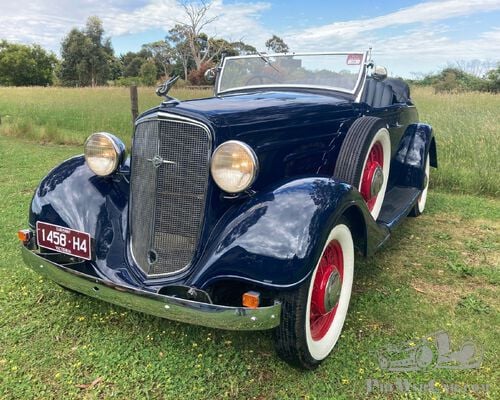
1934 Chevrolet Standard Roadster
1934 Chevrolet Standard Roadster This vehicle was delivered to Australia from Chevrolet and the body was manufactured by Holden Body Works w..
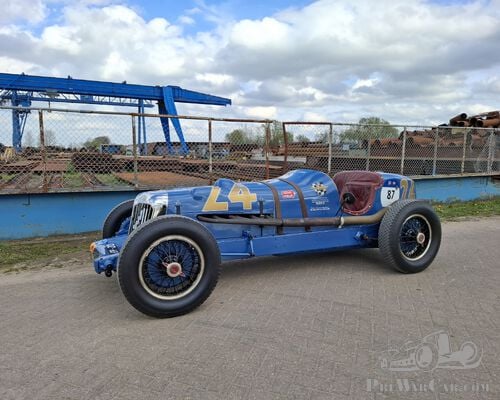
1932 - Graham " Lucenti " Indianapolis
Original participant of the 1932, 1934 and 1935 Indy 500. Best result: finishing 10th overall in the 1934 Indy 500 with driver “Herb” Ardinger...
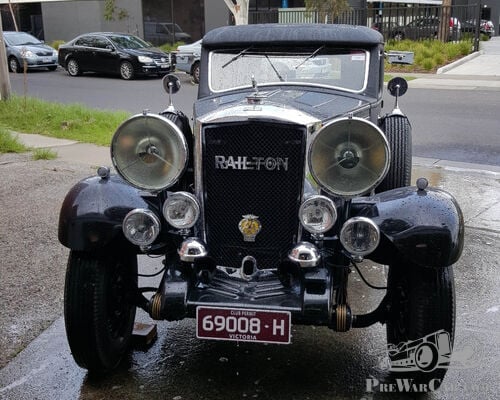
Railton straight 8 sports coupe for rallying REDUCED PRICE run with the bentleys at a fraction of the price
1934 Railton Sports CoupeBuilt for long distance rallyingRebuilt 2017built up at a cost of $160,000AUD, OFFERED FOR SALE AT A ..