The global magazine and marketplace for classic car enthusiasts, by enthusiasts.


Filter
Classic Amilcar, Chalmers for sale - Amilcar, Chalmers cars for sale
-

1927 Amilcar CGS
Paris-based manufacturer Amilcar was founded by Andre Morel and engineer Edmond Moyet to build high-performance cyclecars and voiturettes. Amilcar's first model, the CC, entered production in 1921 and featured the company’s own four-cylinder 904cc side-valve engine. The CC was replaced in 1924 with the CGS which became the company’s most ..

Amilcar
France, 1921 – 1939
(1) Sté Nouvelle pour l’Automobile Amilcar, St Denis, 1921 – 1937
(2) Sté Financière pour l’Automobile, Boulogne-sur-Seine, 1937 – 1939
Of all the sporting voiturettes that proliferated in France after World War 1, the Amilcar was the most famous and successful. Its name(Amilcar) was an anagram of those of its proagonists, Messrs Lamy, who had been concerned with the design of the Le Zèbre before the war, and Akar, who financed the Amilcar. The Amilcar’s designer was Edmond Moyet. The Amilcar Type CC and its developments the Amilcar CS and Amilcar C4 all had 4-cylinder sv engines of about 1-litre capacity, three forward speeds and quarter-elliptic springing. They differed little, therefore, from hosts of their competitors. The Amilcar CGS or Grand Sport of 1924 was a different and more serious proposition. It had a 1.074cc engine with full pressure-lubcrication, front-wheel brakes and front half-elliptic springs. It was developed into the more powerful, lowered Amilcar CGSS (Surbaisse) model in 1926. Various touring cars of between one and two litres were also made, all with four cylinders and side valves, but it was the Amilcar CGS and Amilcar CGSS that made the company’s reputation throughout the world.
Even so, the Amilcar C6 Course, one of the very few pure racing cars ever to be put into production, was still more exciting. Introduced in 1926, it dominated the 1100cc voiturette racing class. Its twin overhead camshaft, 6-cylinder engine developed 83hp and used roller bearings in works form. These Amilcars were capable of 118mph. A small touring straight-8 joined the range in 1928, as was the fashion then. This low-built Amilcar C8 was another excellent machine, with good roadholding and a creditable maximum speed of almost 80mph in spite of its considerable weight. The 2-litre engine had a single overhead camshaft.
By 1930, the Amilcar company was concentrating on touring cars; sports cars in France, as elsewhere with the onset of the Depression, were in decline. The Amilcar C8 was there, enlarged to two litres. The 1¼-litre Amilcar Type M, a sedate small four which had arrived in 1928, survived until 1935 as the Amilcar M2, Amilcar M3 and Amilcar M4; latterly with a 1.7-litre engine. Meanwhile, 1933 had brought Moyet’s new 5CV, the Type C, current until 1935 in various forms, and the disappearance of the C8. From 1934 to 1937 the Amilcar 12CV N7 was offered, which used a Delahaye engine, and there was also the Amilcar 14CV G36. The last Amilcars, made by Hotchkiss, were far more interesting. These ‘Compounds’ of 1938-1939 had independent suspension front and rear, front-wheel drive on J.A. Grégoire Tracta patents, and the Alpax unit construction of body and chassis that incorporated much aluminum. The engine was an 1.185cc four.
Source: Georgano, encyclopedia of motorcar; TRN
The information is written with the greatest of care. However, if you have any suggested amendments please contact us at office@prewarcar.com
Chalmers / Chalmers-Detroit
US, 1908 – 1924
Chalmers Motor Car Co, Detroit, Mich.
The Chalmers was one of the most popular automobiles made in the United States for more than a decade. The Chalmers was the successor to the Thomas-Detroit which was built by a company which had been founded in 1906 by E.R. Thomas (builder of the Thomas car in Buffalo, N.Y.), Roy D. Chapin and Howard Earle Coffin; the two latter had previously served at Oldsmobile. The Thomas-Detroit of which some 500 were sold during the first year of production, was marketed through the parent firm in Buffalo which manufactured a larger line of cars under the Thomas emblem. The Thomas-Detroit was a medium priced four-cylinder car which had been designed by Coffin. In 1907, Hugh Chalmers, vice president of the National Cash Register Co and a noted salesman, entered the firm. Shortly after, he bought a half of E.R. Thomas’ stock and became president of the company which became the Chalmers-Detroit Motor Company. The Thomas-Detroit became the Chalmers-Detroit in 1908 and in 1910, the Chalmers. Open and closed Chalmers models in two lines comprised the Chalmers four-cylinder cars, with self-starters appearing in 1912. Chalmers (as Chalmers-Detroit) had distinguished itself in road races as early as 1908 when W.R. Burns won the Motor Parkway Sweekstakes at Jericho, N.Y., averaging 48.7mph in the six-lap 140.76 mile run.
In 1913, the Chalmers brought out its first 6-cylinder model, as well as the four and apart from small mechanical and design changes, continued both until 1914. The Chalmers four was dropped from the 1915 line, however, and sixes were to be used exclusively in Chalmers until the ending of manufacture. By 1915, some 20.000 Chalmers cars per year were coming off the Chalmers production line and would even exceed that figure before the advent of World War 1. In 1917, an L-head motor replaced the earlier overhead-valve type and on August 4th, Chalmers again headed racing news when Joe Dawson won the 24-hour stock Car Endurance Run at Sheepshead Bay, N.Y. Sales flagged following the end of the war and Hugh Chalmers, always the salesman, and with the realization that a competitor, Maxwell, wasn’t faring well either, arranged to lease his Chalmers plants to Maxwell, using his salesmanship to promote the two concerns and getting the benefit of Maxwell tooling and manufacturing equipment. By the early 1920s, however, many makes of cars were in financial difficulties due to over-expansion and recession, and Walter P. Chrysler was called in to try and reorganize Maxwell. Chrysler was at this time planning his own corporation and in 1922 Chalmers was taken over by Maxwell which had become a Chrysler subsidiary. The last Chalmer cars for sale were equipped with Lockheed hydraulic brakes but 1923 was the last year of Chalmers production with some 9000 units leaving the factories. The Maxwell survived until 1925 when it became the Chrysler Four.
Source: Georgano, encyclopedia of motorcar; KM
The information is written with the greatest of care. However, if you have any suggested amendments please contact us at office@prewarcar.com


Featured

HORCH 930 V
For SaleHorch 930 VManufacturer: HorchModel and Variant: 930 VBody Type: 4-door sedanChassis Number: ..

Alfa 6C1750 Spider
Alfa 6C1750 Spider with complete history from delivery in 1930 to first owner in Firenze till today with copy Libretto/license plate all the years
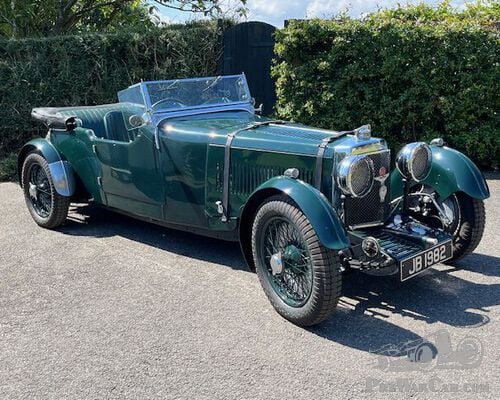
1933 Aston Martin Le Mans
Exceptional 1933 Astron Martin Le MansOriginally bodied as a Standard (Chassis No. L2/222), this unique vehicle was thoughtfully re-bodied i..