The global magazine and marketplace for classic car enthusiasts, by enthusiasts.


Filter
Classic Amilcar, DeSoto for sale - Amilcar, DeSoto cars for sale
-

zu verkaufen Amilcar CGSs original und vollständig restauriert
Zum Verkauf steht ein außergewöhnlicher Amilcar CGss, der in Frankreich in weitgehend originalem, jedoch stark verbrauchtem Zustand aufgefunden wurde. Das Fahrzeug war vollständig und bot damit eine hervorragende Grundlage für eine umfassende und sorgfältige Restaurierung. Aufgrund des über Jahrzehnte entstandenen Verschleißes war eine we.. -
Amilcar 5CV Type C5 Aerodynamic
Amilcar 5CV Type C5 AerodynamicI am selling it because I no longer drive it. I have two invoices for engine and carburettor servicing costing over €10,000. I also have body parts for an Amilcar 5CV Type C5 to be restored and some mechanical parts to go with the car, such as a gearbox, etc., as well as a chassis with two front wings for a .. -
1927 Amilcar Series E Special
The Amilcar marque is one that is associated with sporting prewars, and often times small, low, short chassis race cars. While this is true, the series E is a larger model, with a relatively long chassis and propelled by a larger four cylinder engine mated to a four speed gearbox. The history of this particular series E was outli..


Amilcar
France, 1921 – 1939
(1) Sté Nouvelle pour l’Automobile Amilcar, St Denis, 1921 – 1937
(2) Sté Financière pour l’Automobile, Boulogne-sur-Seine, 1937 – 1939
Of all the sporting voiturettes that proliferated in France after World War 1, the Amilcar was the most famous and successful. Its name(Amilcar) was an anagram of those of its proagonists, Messrs Lamy, who had been concerned with the design of the Le Zèbre before the war, and Akar, who financed the Amilcar. The Amilcar’s designer was Edmond Moyet. The Amilcar Type CC and its developments the Amilcar CS and Amilcar C4 all had 4-cylinder sv engines of about 1-litre capacity, three forward speeds and quarter-elliptic springing. They differed little, therefore, from hosts of their competitors. The Amilcar CGS or Grand Sport of 1924 was a different and more serious proposition. It had a 1.074cc engine with full pressure-lubcrication, front-wheel brakes and front half-elliptic springs. It was developed into the more powerful, lowered Amilcar CGSS (Surbaisse) model in 1926. Various touring cars of between one and two litres were also made, all with four cylinders and side valves, but it was the Amilcar CGS and Amilcar CGSS that made the company’s reputation throughout the world.
Even so, the Amilcar C6 Course, one of the very few pure racing cars ever to be put into production, was still more exciting. Introduced in 1926, it dominated the 1100cc voiturette racing class. Its twin overhead camshaft, 6-cylinder engine developed 83hp and used roller bearings in works form. These Amilcars were capable of 118mph. A small touring straight-8 joined the range in 1928, as was the fashion then. This low-built Amilcar C8 was another excellent machine, with good roadholding and a creditable maximum speed of almost 80mph in spite of its considerable weight. The 2-litre engine had a single overhead camshaft.
By 1930, the Amilcar company was concentrating on touring cars; sports cars in France, as elsewhere with the onset of the Depression, were in decline. The Amilcar C8 was there, enlarged to two litres. The 1¼-litre Amilcar Type M, a sedate small four which had arrived in 1928, survived until 1935 as the Amilcar M2, Amilcar M3 and Amilcar M4; latterly with a 1.7-litre engine. Meanwhile, 1933 had brought Moyet’s new 5CV, the Type C, current until 1935 in various forms, and the disappearance of the C8. From 1934 to 1937 the Amilcar 12CV N7 was offered, which used a Delahaye engine, and there was also the Amilcar 14CV G36. The last Amilcars, made by Hotchkiss, were far more interesting. These ‘Compounds’ of 1938-1939 had independent suspension front and rear, front-wheel drive on J.A. Grégoire Tracta patents, and the Alpax unit construction of body and chassis that incorporated much aluminum. The engine was an 1.185cc four.
Source: Georgano, encyclopedia of motorcar; TRN
The information is written with the greatest of care. However, if you have any suggested amendments please contact us at office@prewarcar.com
DeSoto
US, 1913 – 1916
DeSoto Motro Car Co, Auburn, Ind.
The DeSoto appears to have succeeded the Zimmerman. This was a large car with a 55hp, 6-cylinder engine, which was furnished with a compressed-air starter. The DeSoto model Six-55 five-seater touring car sold for $2185.
US, 1928 – 1960
Chrysler Motors Corp, Detroit, Mich.
The DeSoto was launched in 1928 as a 3.2-litre side valve six to compete with Oldsmobile, Pontiac and the cheaper Nashes. Styling and general design of the DeSoto were in line with the 1929 Chryslers, and at $885 for a DeSoto sedan 90.000 were sold in the first twelve months. A 3.4-litre straight-8 DeSoto on a 9ft 6in wheelbase was announced for 1930 as the world’s cheapest 8-cylinder car. However, DeSoto suffered badly in the Depression, and in 1932, when flexible rubber engine mountings and free wheels were made available, sales dropped to 26.000 DeSoto cars.
The DeSoto disappeared from the British market about this time, though certain ‘Chrysler’ models listed in England (the Mortlake, Croydon, and some of the Richmonds) were in fact DeSoto cars in all but name. A 6-cylinder version of Chrysler’s advanced unitary-construction Airflow, the SE-type with a 4-litre engine, was brought out in 1934, but was an unsuccessful as its bigger sister. Later DeSotos followed regular Chrysler lines closely though in later years there was a tendency for DeSoto to move into a higher price class than Dodge; by 1952 DeSotos started $300 higher than the companion make.
By 1939 the DeSoto cars for sale were being made with independent front suspension, hypoid back axles and column change. There was a choice at DeSoto of two 6-cylinder engines and three wheelbase lengths, the longest of these being reserved for seven-seater bodywork – DeSoto continued to offer a really roomy family car right up to 1954. A 4-speed semi-automatic Vacumatic transmission became an option in 1941, but DeSoto’s big post-war change of models did not take place until 1952, when the division followed Chrysler’s lead in adopting the oversquare ohv V8; the DeSoto version was of 4½-litre capcity and developed 16-bhp. With the advent of Chrysler’s ‘flight sweep’ styling in 1955, the side-valve sixes were dropped and the standard engine in a DeSoto was now a 4.8-litre eight, giving 185bhp in Firedome guise, and 200bhp in Fireflite form. Though this redesigning saved Chrysler sales generally, the slump in the medium-price class had an adverse effect on DeSoto and in 1959 the DeSoto division was merged with Plymouth. Last of the DeSotos were the 1961 models, unitary-construction cars with a choice of three engines: Plymouth’s 145bhp ohv ‘slant six’ as used in the Valiant, and V8s of 230 and 265bhp, the two former only in Canadian DeSotos. Production of DeSoto cars ceased in November 1960 after only a few had been delivered.
Source: Georgano, encyclopedia of motorcar; MCS
The information is written with the greatest of care. However, if you have any suggested amendments please contact us at office@prewarcar.com


Featured
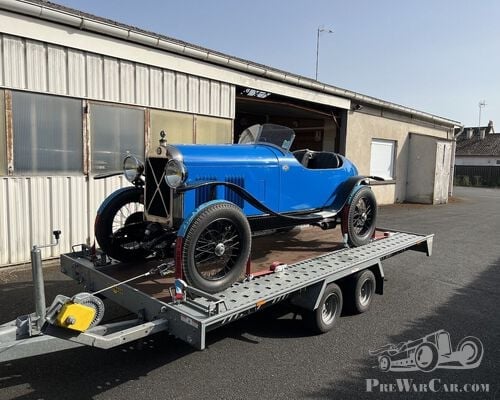
Salmson VAL 3 Séries 7
1927 Salmson VAL3 Series 7. Completely restored a few years ago, in very good overall condition, both bodywork and mechanics. Bordino-style bodywor..
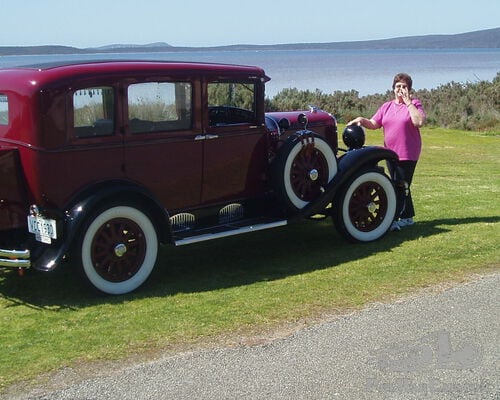
1930 Chrysler 66 Six-Wheel Equipped Royal Sedan
An exceptionally well restored and highly awarded Chrysler 66 Royal Sedan, with only two owners in nearly 97 years.The present owner ..
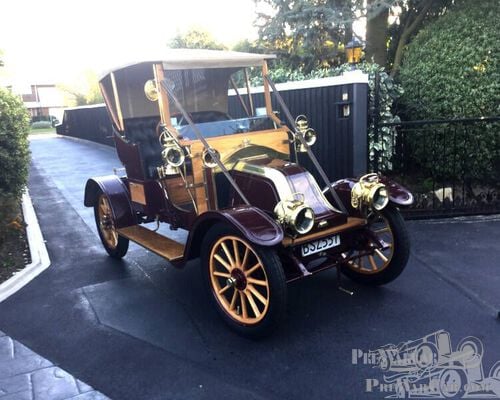
Renault /AX 1913 - named Gigi
Purchased fully renovated from New Zealand and imported to the UK. We have owned her for over10 years. Gigi is currently living in France where she..