The global magazine and marketplace for classic car enthusiasts, by enthusiasts.


Filter
Classic Amilcar, Du Pont for sale - Amilcar, Du Pont cars for sale
-

1929 Du Pont Model G Two-Passenger Speedster by Merrimac | RM Sotheby's | The Monterey Auction
To Be OFFERED AT AUCTION at RM Sothebys' The Monterey Auction event, 13 - 15 August 2026. $800,000 - $1,200,000 USD One of the most beautiful American automobiles of its generationThe 1929 New York International Automobile Show display carOne of three two-passenger “taper tail” models with an external spareOne .. -
AMILCAR CS SKIFF
AMILCAR CS Pointe skiff en boisRestauration ancienneFreins sur les 4 rouesA parcouru de nombreux rallyesA remettre en routeCarte Grise FrançaiseL'Amilcar CS (Cyclecar Sport) est l'un des exemples les plus emblématiques de l'âge d'or des cyclecars français. Lancé en 1922 et produit jusqu'en 1925, le modèl..


Amilcar
France, 1921 – 1939
(1) Sté Nouvelle pour l’Automobile Amilcar, St Denis, 1921 – 1937
(2) Sté Financière pour l’Automobile, Boulogne-sur-Seine, 1937 – 1939
Of all the sporting voiturettes that proliferated in France after World War 1, the Amilcar was the most famous and successful. Its name(Amilcar) was an anagram of those of its proagonists, Messrs Lamy, who had been concerned with the design of the Le Zèbre before the war, and Akar, who financed the Amilcar. The Amilcar’s designer was Edmond Moyet. The Amilcar Type CC and its developments the Amilcar CS and Amilcar C4 all had 4-cylinder sv engines of about 1-litre capacity, three forward speeds and quarter-elliptic springing. They differed little, therefore, from hosts of their competitors. The Amilcar CGS or Grand Sport of 1924 was a different and more serious proposition. It had a 1.074cc engine with full pressure-lubcrication, front-wheel brakes and front half-elliptic springs. It was developed into the more powerful, lowered Amilcar CGSS (Surbaisse) model in 1926. Various touring cars of between one and two litres were also made, all with four cylinders and side valves, but it was the Amilcar CGS and Amilcar CGSS that made the company’s reputation throughout the world.
Even so, the Amilcar C6 Course, one of the very few pure racing cars ever to be put into production, was still more exciting. Introduced in 1926, it dominated the 1100cc voiturette racing class. Its twin overhead camshaft, 6-cylinder engine developed 83hp and used roller bearings in works form. These Amilcars were capable of 118mph. A small touring straight-8 joined the range in 1928, as was the fashion then. This low-built Amilcar C8 was another excellent machine, with good roadholding and a creditable maximum speed of almost 80mph in spite of its considerable weight. The 2-litre engine had a single overhead camshaft.
By 1930, the Amilcar company was concentrating on touring cars; sports cars in France, as elsewhere with the onset of the Depression, were in decline. The Amilcar C8 was there, enlarged to two litres. The 1¼-litre Amilcar Type M, a sedate small four which had arrived in 1928, survived until 1935 as the Amilcar M2, Amilcar M3 and Amilcar M4; latterly with a 1.7-litre engine. Meanwhile, 1933 had brought Moyet’s new 5CV, the Type C, current until 1935 in various forms, and the disappearance of the C8. From 1934 to 1937 the Amilcar 12CV N7 was offered, which used a Delahaye engine, and there was also the Amilcar 14CV G36. The last Amilcars, made by Hotchkiss, were far more interesting. These ‘Compounds’ of 1938-1939 had independent suspension front and rear, front-wheel drive on J.A. Grégoire Tracta patents, and the Alpax unit construction of body and chassis that incorporated much aluminum. The engine was an 1.185cc four.
Source: Georgano, encyclopedia of motorcar; TRN
The information is written with the greatest of care. However, if you have any suggested amendments please contact us at office@prewarcar.com
Du Pont
US, 1920 – 1932
(1) Du Pont Motors Inc, Wilmington, Del., 1920 – 1923
(2) Du Pont Motors Inc, Moore, Pa., 1923 – 1932
E. Paul du Pont’s company built quality cars in limited numbers, total production being 537 vehicles of all Du Pont types. First of the line was a Du Pont 4.1-litre sv four with their own engine, selling for $2.600, but this gave way to proprietary-engined sixes, initially powered by Herschell-Spillman. The 1925 Du Pont Model D had a 6-cylinder 5-litre Wisconsin engine with overhead valves that developed 75bhp, a constant-mesh gearbox, and Lockheed hydraulic brakes to all four wheels. Its successor, the Du Pont Model E, could be had with a supercharger, but the best-known, and best, Du Pont was the Du Pont Model G speedster introduced in 1928. With its narrow straight wings copied from the Amilcar, Woodlite headlamps and grille concealing the radiator, the last a pioneering feature, the Du Pont Model G was not a good-looking car, but it was a very effective one. Like all the DuPont speedsters it had four forward speeds. The 5.3-litre, sv straight-8 engine, by Continental, gave 114bhp at 3600rpm with catalogued modifications. With the latter, 100mph was guaranteed. In the 1929 Le Mans 24 Hours race the Du Pont Model G proved itself faster than the other American entries, Stutz and Chrysler. Touring bodywork was, of course, available on the Du Pont car, and in 1931 came the long wheelbase (12ft 2 in) Du Pont Model H, built in a Stearns Knight frame. The later Du Pont cars were assembled in the Indian motorcycle factory at Springfield, after E. Paul du Pont had acquired this concern.
Source: Georgano, encyclopedia of motorcar; TRN
The information is written with the greatest of care. However, if you have any suggested amendments please contact us at office@prewarcar.com


Featured
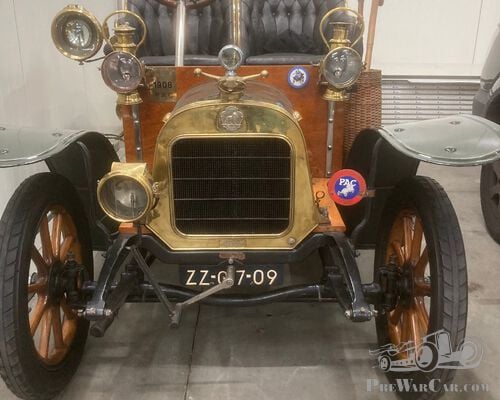

Lagonda LC Tourer 1934
The Lagonda story began in 1901 in Staines, a small town in the UK. The company enjoyed its greatest successes around 1935. During this period, the..
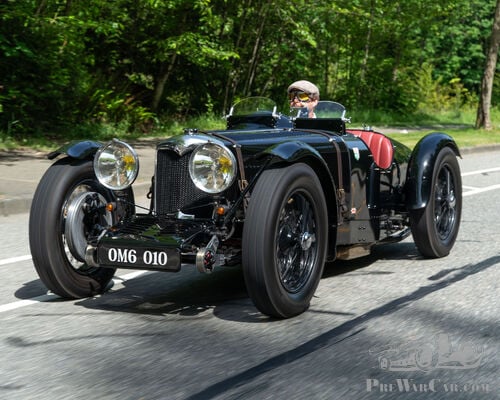
Riley 14/6 Special 1933
The ExperienceStep into the golden age of British motoring. This 1933 Riley 14/6 Special is a masterclass in pre-w..