The global magazine and marketplace for classic car enthusiasts, by enthusiasts.


Filter
Classic Ansaldo, Du Pont for sale - Ansaldo, Du Pont cars for sale
-

1929 Du Pont Model G Two-Passenger Speedster by Merrimac | RM Sotheby's | The Monterey Auction
To Be OFFERED AT AUCTION at RM Sothebys' The Monterey Auction event, 13 - 15 August 2026. $800,000 - $1,200,000 USD One of the most beautiful American automobiles of its generationThe 1929 New York International Automobile Show display carOne of three two-passenger “taper tail” models with an external spareOne .. -
1921 Ansaldo type 4C rolling chassis
1921 Ansaldo type 4C rolling chassis. Complete engine and gearbox no 17634 and chassis no 1763. All components are in excellent condition including the 5 original wirespoked wheels and three of the beaded edge tyres. Good radiator. Suitable project to build a Special from. OHC engine. € 18500 negotiable. ..


Ansaldo
Italy, 1919 – 1936
(1) SA Ansaldo Automobili, Turin, 1919 – 1932
(2) Construzione e Vendita Automobili Ansaldo, Turin, 1932 – 1934
(3) Ansaldo – Ceva SA, Turin, 1934 – 1936
One of Italy’s biggest engineering groups, Ansaldo turned their idle aero-engine works over to Ansaldo car manufacture in 1919, their Soria-designed range being intended for volume production in competition with FIAT. The advanced 4-cylinder ohc engines contrasted with the 3-speed gearboxes, central change, wooden wheels, and austere, Chevrolet-like tourer bodywork, but even the basic 1.847cc Ansaldo 4A car was capable of 55mph, and by 1922 it had been joined by the 2-litre Ansaldo 4CS car for sale that managed 70mph on an output of 48bhp. FIAT, however, were making five times as many cars. In 1923 there came both four-wheel brakes and a six, the 2-litre Ansaldo 6A car with coil ignition. In 1926 there was even a cheap Ansaldo car for sale with 1½-litre, the Ansaldo 10 car with transverse front suspension. The 1927 Ansaldo sixes had 2.2-litre engines and four forward speeds; the latter, long with coil ignition, were found on the bigger fours by 1928. Unfortunately Soria’s resignation in 1927 left Ansaldo with no new ideas, though his final efforts reached the market in 1929 and were the company’s staples after 1930. The Ansaldo 18 for sale was merely an enlarged 2.8-litre six, but the Ansaldo 22 car for sale, was a large and luxurious 3½-litre pushrod straight-8 on an 11ft 2in wheelbase, distinguished by its disc wheels with quick-detachable rims. These were a product of Ruotificio Italiano, an Ansaldo subsidiary. In 1932 the CEVA concern was organized to take over the stock of 400 unsold Ansaldo 18 and Ansaldo 22 chassis, and these were still available, with restyled body work, as late as 1936.
Source: Georgano, encyclopedia of motorcar; MCS
The information is written with the greatest of care. However, if you have any suggested amendments please contact us at office@prewarcar.com
Du Pont
US, 1920 – 1932
(1) Du Pont Motors Inc, Wilmington, Del., 1920 – 1923
(2) Du Pont Motors Inc, Moore, Pa., 1923 – 1932
E. Paul du Pont’s company built quality cars in limited numbers, total production being 537 vehicles of all Du Pont types. First of the line was a Du Pont 4.1-litre sv four with their own engine, selling for $2.600, but this gave way to proprietary-engined sixes, initially powered by Herschell-Spillman. The 1925 Du Pont Model D had a 6-cylinder 5-litre Wisconsin engine with overhead valves that developed 75bhp, a constant-mesh gearbox, and Lockheed hydraulic brakes to all four wheels. Its successor, the Du Pont Model E, could be had with a supercharger, but the best-known, and best, Du Pont was the Du Pont Model G speedster introduced in 1928. With its narrow straight wings copied from the Amilcar, Woodlite headlamps and grille concealing the radiator, the last a pioneering feature, the Du Pont Model G was not a good-looking car, but it was a very effective one. Like all the DuPont speedsters it had four forward speeds. The 5.3-litre, sv straight-8 engine, by Continental, gave 114bhp at 3600rpm with catalogued modifications. With the latter, 100mph was guaranteed. In the 1929 Le Mans 24 Hours race the Du Pont Model G proved itself faster than the other American entries, Stutz and Chrysler. Touring bodywork was, of course, available on the Du Pont car, and in 1931 came the long wheelbase (12ft 2 in) Du Pont Model H, built in a Stearns Knight frame. The later Du Pont cars were assembled in the Indian motorcycle factory at Springfield, after E. Paul du Pont had acquired this concern.
Source: Georgano, encyclopedia of motorcar; TRN
The information is written with the greatest of care. However, if you have any suggested amendments please contact us at office@prewarcar.com


Featured

K3 Replica on KN Chassis
"The K3 Magnette must rank in the history books as the most famous and successful of all the record breaking MGs. With only 33 examples produced durin..
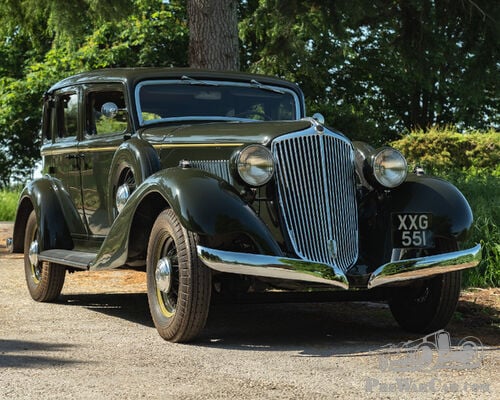
Graham Model 64 Standard Eight 'Blue Streak'
UK Registration No: XXG 551Chassis No: 1801069MOT: ExemptH&H ClassicsKelham Hall | Newark, Nottinghamshire