The global magazine and marketplace for classic car enthusiasts, by enthusiasts.


Filter
Classic Ansaldo, Stoewer for sale - Ansaldo, Stoewer cars for sale
-

1921 Ansaldo type 4C rolling chassis
1921 Ansaldo type 4C rolling chassis. Complete engine and gearbox no 17634 and chassis no 1763. All components are in excellent condition including the 5 original wirespoked wheels and three of the beaded edge tyres. Good radiator. Suitable project to build a Special from. OHC engine. € 18500 negotiable. .. -
1924 Stoewer type D3 roadster
Rare opportunity to buy a vintage 1924 Stoewer type D3 roadster in fully restored condition. More than € 50K were spent in 2018 and 2019 on its restoration . Detailed work invoices come with the car. A video can be sent on request . Price € 64000 ex Eibergen Netherlands imported EEC.


Ansaldo
Italy, 1919 – 1936
(1) SA Ansaldo Automobili, Turin, 1919 – 1932
(2) Construzione e Vendita Automobili Ansaldo, Turin, 1932 – 1934
(3) Ansaldo – Ceva SA, Turin, 1934 – 1936
One of Italy’s biggest engineering groups, Ansaldo turned their idle aero-engine works over to Ansaldo car manufacture in 1919, their Soria-designed range being intended for volume production in competition with FIAT. The advanced 4-cylinder ohc engines contrasted with the 3-speed gearboxes, central change, wooden wheels, and austere, Chevrolet-like tourer bodywork, but even the basic 1.847cc Ansaldo 4A car was capable of 55mph, and by 1922 it had been joined by the 2-litre Ansaldo 4CS car for sale that managed 70mph on an output of 48bhp. FIAT, however, were making five times as many cars. In 1923 there came both four-wheel brakes and a six, the 2-litre Ansaldo 6A car with coil ignition. In 1926 there was even a cheap Ansaldo car for sale with 1½-litre, the Ansaldo 10 car with transverse front suspension. The 1927 Ansaldo sixes had 2.2-litre engines and four forward speeds; the latter, long with coil ignition, were found on the bigger fours by 1928. Unfortunately Soria’s resignation in 1927 left Ansaldo with no new ideas, though his final efforts reached the market in 1929 and were the company’s staples after 1930. The Ansaldo 18 for sale was merely an enlarged 2.8-litre six, but the Ansaldo 22 car for sale, was a large and luxurious 3½-litre pushrod straight-8 on an 11ft 2in wheelbase, distinguished by its disc wheels with quick-detachable rims. These were a product of Ruotificio Italiano, an Ansaldo subsidiary. In 1932 the CEVA concern was organized to take over the stock of 400 unsold Ansaldo 18 and Ansaldo 22 chassis, and these were still available, with restyled body work, as late as 1936.
Source: Georgano, encyclopedia of motorcar; MCS
The information is written with the greatest of care. However, if you have any suggested amendments please contact us at office@prewarcar.com
Stoewer
D, 1899 – 1939
(1) Gebrüder Stoewer, Fabrik für Motorfahrzeuge, Stettin, 1899 – 1916
(2) Stoewer-Werke AG vorm. Gebr. Stoewer, Stettin, 1916 – 1939
The Stoewer car factory developed out of the Stoewer ironworks and was among the pioneers of the German car industry. After manufacturing motor cycles, tricycles and quadricycles for two years, Stoewer turned to cars in 1899. The first Stoewer car had a rear-mounted 2-cylinder engine. 4-cylinder Stoewer cars followed in 1901, and electric Stoewer cars were also produced. Best known were the 2-cylinder Type T Stoewer car (2.280cc and 3/12PS), the 4-cylinder Stoewer P4 (3.052cc and 11/22PS), the Stoewer G4 (1.500cc and 6/12PS) and the 6-cylinder Stoewer P6 (8.820cc and 34/60PS), evolved in the 1905-1907 period all Stoewer cars with shaft-drive. The Stoewer B1 of 6/16PS and the Stoewer B6 of 9/22PS which appeared in 1910 were also built by Mathis under licence. The G4 Stoewer car was the basis for the Stoewer B5, which Stoewer car in 1912 became famous by setting up a record at Brooklands with 67.7mph. The new range of Stoewer cars which appeared in 1913 was also based on successful earlier cars. They were the Stoewer C1 (6/18PS), Stoewer C2 (10/28PS) and C3 Stoewer car (6-cylinder and 19/45PS). Shortly before the outbreak of World War 1 the Stoewer car range was headed by the F4 Stoewer car with a 4-cylinder, 8.8-litre 33/100PS ohc engine. After the war an enormous Stoewer car appeared, the Stoewer D7, using a 6-cylinder 11.2-litre 42/120PS aero engine, as well as some conservative sv 4- and 6-cylinder Stoewer cars with rear wheel and transmission brakes. Front wheel brakes appeared on Stoewer cars in 1925. Stoewer introduced 8-cylinder Stoewer cars in 1928. These were the Stoewer Superior, Stoewer Marschall, Stoewer Gigant and Stoewer Repräsentant with engines ranging from 2-litres and 45bhp to 4.9-litres and 100bhp. The Stoewer car firm re-entered the economy class in 1931 with the V5, a front-driven Stoewer car with a V4 1.188cc engine, followed by the front-drive models R140 (1.369cc), R150 (1.488cc) and R180 (1.769cc). Another 8-cylinder was the front wheel drive Greif V8 with a 2.488cc engine, which was replaced by the conventional 6-cylinder 3.609cc Arcona Stoewer car in 1938. In 1934 the 1½-litre 4-cylinder Stoewer car and 2½-litre V8 Stoewer car were shown at the Brussels Salon by Monsieur Dewaet under the name D.S. (Dewaet-Stoewer). The Greif Junior was built under Tatra licence with an opposed 4-cylinder 1.474cc engine. It succeeded the Röhr Junior. In the middle of the range was the Stoewer Sedina with a 4-cylinder engine of 2.4-litres.
Production of private Stoewer cars was given up at the outbreak of World War 2 in 1939. The Stoewer car factory was destroyed during the war and production of Stoewer cars was not resumed.
Source: Georgano, encyclopedia of motorcar; HON
The information is written with the greatest of care. However, if you have any suggested amendments please contact us at office@prewarcar.com


Featured
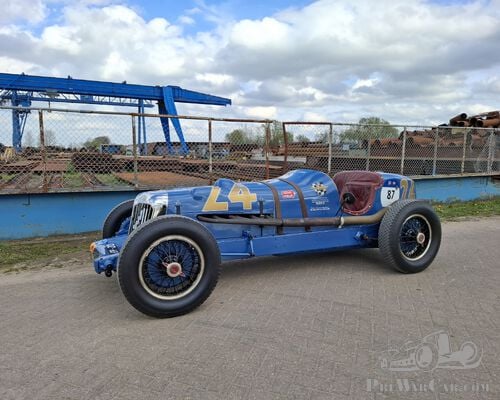
1932 - Graham " Lucenti " Indianapolis
Original participant of the 1932, 1934 and 1935 Indy 500. Best result: finishing 10th overall in the 1934 Indy 500 with driver “Herb” Ardinger...
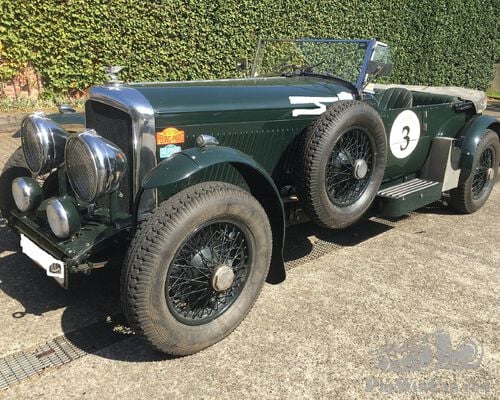
Bentley Derby Special Open Rally Car
This Bentley Derby, manufactured in 1935, has been rebuilt into a short and long-distance rally car. Full rebuilt engine in 2021, Since 2021 low mi..
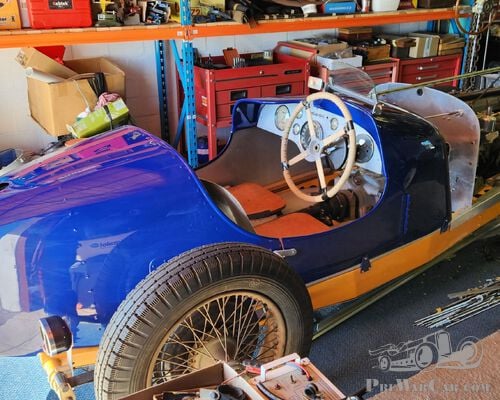
Riley TT Sprite
1935 6-cylinder TT Sprite replica. Chassis # 46A2722. Engine # 6A2722. Original Ulster Imp body. Restoration nearing completion. Engine, G..