The global magazine and marketplace for classic car enthusiasts, by enthusiasts.


Filter
Classic Arrol-Johnston for sale - Arrol-Johnston cars for sale
-

Te koop, Renault NN Torpedo Commercial 1926
Deze Renault betreft een restauratie object voorzien van Franse papieren Carte Grise plus Certificat de Cession D'un Véhicle gedateerd 2003. Tevens een Renault NN rollend chassis voor eventuele onderdelen eveneens met Franse papieren. Te bezichtigen in Bemmel (Nederland). Vraagprijs voor beiden voertuigen € 6000,= dus voor beide auto's die in éé.. -
Rolland Pilain
I am selling a 1913 Rolland Pilain RP 10HP in very good condition. It has a standard registration document in my name, and the MOT will be carried out prior to the sale. -
The famous white Riley 12/4 from 1936 with Race History ex New Zealand
The famous white Riley of racing driver Mrs. Ivy Stephenson , Riley 12/4 Kestrel Special from 1936A car which was built as a race car and still can be successfully raced today!- A known car with racing history in New Zealand -Restored in excellent state and condition-Comprehensively files and documentation .. -
1933 Rolls Royce 20/25 Sedanca by Thrupp & Maberly
1933 Rolls Royce 20/25 Sedanca by Thrupp & Maberly Chassis Number: GRW27 Registration Number: VTK777 Simply the best we have ever seen. This car won prizes in class at the recent RREC national rally at Burghley house. A massive nut & bolt re.. -
1934 Rolls-Royce 20/25 Gurney Nutting Owen 3 position drop head
1934 Rolls-Royce 20/25 Gurney Nutting Owen 3 position drop headChassis number: GLZ75Registration number: ALW565Chassis number GLZ 75 was off test 10th July 1933 for supply to HR Owen as a ‘stock’ car. The chassis was delivered to Gurney Nutting & Co Ltd. on The Kings Road for Owen Sedanca Coupe Coachwork which the car st.. -
1913 Wolseley 24/30HP Two-Seater
1913 Wolseley 24/30HP Two-Seater Chassis no. 20034Registration no. J1296Engine no. 34/1134 1913 Wolseley 24/30HP Two-Seater for sale: A large and imposing Edwardian two seat tourer, this 24/30hp model sports Wolseleys large 5 litre six cylinder engine giving ample power and easy modern day cruising spe.. -
a real Speedster
A real Speedster with hot cams, big vales, big bores, etc. Will go 100 kmh. Technical absolute top. comes with some spare parts and fresh MOT. -
Alvis Speed 25 Charlesworth, 1936
Alvis Speed 25 'Charlesworth' DHC, year 1936. Chassis number 13362SB, engine number 15149, body number 14128.12.36 (the original Charlesworth body). The body is finished in blue, combined with a blue leather interior and blue carpeting. Black mohair hood and cover. This beautiful Alvis Speed.. -
1923 Bentley 3 Litre
Bentley 3-Litre, built in 1923. Chassis number 110, engine number 104. License plate KLY 3, nickname “Wilfred”. This Bentley was delivered new on June 4, 1923. The first dated work order reads: “Stripped for racing”. This Bentley 3-Litre won a race at Brooklands in the hands of Captain Cecil Wingfield Tw.. -
MG PB Mille Miglia
The surviving Triple-M Register record is particularly useful: it confirms PB0464, registration AVF50, engine 731 APB, matching chassis, engine and bonnet, and records an unusually long period of ownership from 1964. The car is also documented in the 1000 Miglia entry records, including the 2024 event.1935 MG PB Midget – Chassis PB0464 – ..



Arroll-Johnston (Arrol-Aster)
GB, 1897 – 1931
(1) The Mo-Car Syndicate Ltd, Bluevale, Camlachie, Glasgow, 1897 – 1906
(2) The New Arrol-Johnston Car Co Ltd, Paisley, Renfrewshire, 1906 – 1913
(3) Arrol-Johnston & Aster Heathhall, Dumfries, 1913 – 1927
Arrol-Johnston was one of the famous makes of Scotland. It was born when George Johnston, Sir William Arrol (the civil engineer) and others, produced their first Arrol-Johnston Dogcart, a strong reliable vehicle with an underfloor flat-twin, opposed-piston engine and chain drive. Its high-wheeled, solid-tyred, horse-carriage type of body was retained well into the 1900s, a more modern 12hp machine was introduced alongside the Arrol-Johnston Dogcart for sale in 1905, with a front-mounted 3-cylinder engine and unit construction of engine and gearbox, but even the Dogcart outlived this one. The Arrol-Johnston make received a new lease of life, however, with the arrival of J.S. Napier as chief engineer and the formation of a new company under Sir William beardmore. Napier won the first Tourist Trophy Race in 1905 with an 18hp car of his own design. By 1908 it was making conventional cars only – three 4-cylinder models. T.C. Pullinger became general manager in 1909 and the company’s most popular pre-war model, the 2 ½-litre 1 Arrol-Johnston 5.9hp appeared. It, too, was normal, except for its dashboard radiator and Allen-Liversidge front-wheel brakes. The latter were unsatisfactory, and lasted only until 1912. By that year, there were also a smaller four Arrol-Johnston for sale and a big six in the range. Experiments were made with an electric car, the Arrol-Johnston-Edison.
Arrol-Johnston planned to impress the post-war market with their advanced Arrol-Johnston Victory model, designed by G.W.A. Brown. The single ohc engine, developed 40bhp from 2.6 litres. However, the car was too expensive and insufficiently developed. It broke down when on a Royal tour of the West of England, so that the publicity attending its début was not of the kind it needed. Hurriedly Arrol-Johnston resuscitated the old Arrol-Johnston 15.9hp. It was cheaper, but this was at the cost of such unpopular American cost-cutting expedients as a black-painted radiator and fixed ignition. All the same, it saved the Arrol-Johnston company for the time being, and a more modern version, the Arrol-Johnston 20hp, was introduced alongside the Arrol-Johnston 15.9hp in 1922. It had a Monobloc engine with an detachable head. In 1926 overhead valves and front-wheel brakes were added.
In 1927 Arrol-Johnston were merged with Aster and complication set in. The Arrol-Johnston 15.9hp was retained. So were the two current Asters. Both the latter were given Burt-McCollum single sleeve-valve engines in the interests of silence, but the 21/60hp Aster was also available in its original ohv form, renamed the Arrol-Aster. Another completely new Arrol-Aster for sale was the 2½-litre 6-cylinder 17/50hp with sleeve valves. The 21/60hp Arrol-Aster and the 15.9hp Arrol-Johnston were dropped for 1929, and a straight-8 Arrol-Aster substituted. It had a 3.3-litre sleeve valve engine consisting of the 17/50 unit with two extra cylinders and was available in supercharged form. This was a fast car intented as a sports mdoel, but unlike the French sleeve-valve designs it could not produce high outputs as revolutions were limited.
Source: Georgano, encyclopedia of motorcar; TRN
The information is written with the greatest of care. However, if you have any suggested amendments please contact us at office@prewarcar.com


Featured
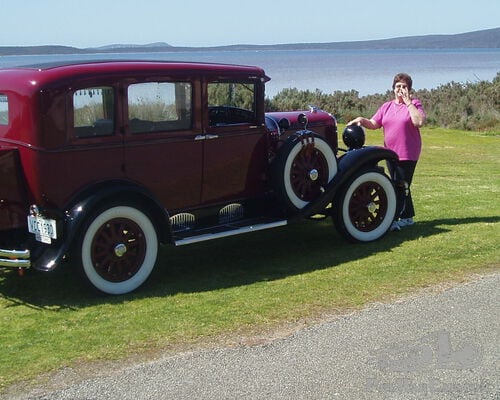
1930 Chrysler 66 Six-Wheel Equipped Royal Sedan
An exceptionally well restored and highly awarded Chrysler 66 Royal Sedan, with only two owners in nearly 97 years.The present owner ..
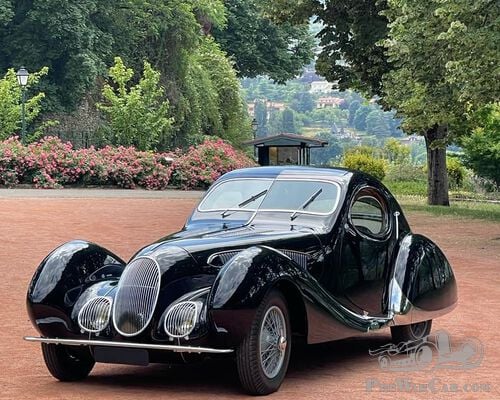
1939 Talbot-Lago T150C “Goutte d’Eau” — Iconic French Coachbuilt Masterpiece
Talbot-Lago T150C ‘Teardrop’ — An Icon of French Automotive Art There are motor cars that define an era. And then there are those tha..
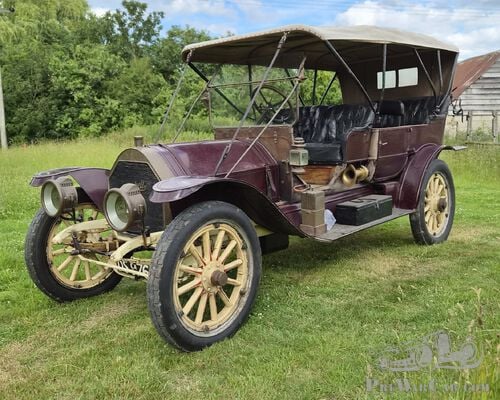
1910 Mitchell Model S - 50HP Six Cylinder
Based in Racine, Wisconsin and being the largest wagon manufacturer in the USA, Mitchell-Lewis produced their first motor car in 1903. Sales grew ..