The global magazine and marketplace for classic car enthusiasts, by enthusiasts.


Filter
Classic Rolland-Pilain, Aston Martin for sale - Rolland-Pilain, Aston Martin cars for sale
-

Rolland Pilain
I am selling a 1913 Rolland Pilain RP 10HP in very good condition. It has a standard registration document in my name, and the MOT will be carried out prior to the sale. -
1934 Aston Martin Mk II (long chassis)
This 1934 Aston Martin MkII long chassis tourer is a stunning example of vintage Aston Martin craftsmanship. Originally delivered new to Mr King of Norwich in December 1934, the car remained in the King family until 1952. It was enjoyed next by Mr Briggs of Berkshire and remained in the UK until 1986 when it travelled to New York until 2002,.. -
1935 Aston Martin MkII Long Chassis Tourer
This 1935 Mark II long chassis four-seater is chassis number B5/ 547/ L and has a well-documented ownership record from new that has taken it from Britain to California and Germany and home again, by way of a class win at the Pebble Beach Concours d’Elegance. Cared for by Ecurie Bertelli since 2001 and running on its original but strengthened re.. -
1933 Aston Martin Le Mans aka The 'Green Monster'
Chassis H3/ 300/ S is a car with a remarkable history. Built as a ‘Le Mans’ 2/ 4-seater, first registered BPA 889 in November 1933 and finished in green throughout. It was supplied through Winter Garden Garages and Coombs of Guildford to its first owner, AH Boyd, who had previously enlisted in the Royal Navy and was advancing through his officer.. -
1935 Aston Martin MkII Sports Saloon
This is a truly rare and handsome machine: a matching-numbers Mk II Sports Saloon - one of only 21 ever built. Few survive and this example, chassis J4/ 505/ L, has an astonishingly comprehensive and continuous history file, running from 1939 and its second owner. Its first owner, Miss D Evans, was active in motorsport and features.. -
1934 Aston Martin Mk II (short chassis)
Brand new Ecurie Bertelli engine built around a new cylinder block, only test miles completed since. The original cylinder block comes with the car. The Mk II model was introduced in 1934, as Aston-Martin’s replacement for the Le Mans. It sported a new, stronger chassis and an improved engine with counter-balanced crankshaft. Or.. -
1924 Aston Martin Side Valve 3-seater tourer
One of the earliest Aston Martins with a superb and engaging history. Only four owners from new. Bamford & Martin's chassis numbering for production cars began at '1916', making this side valve-engined chassis number '1941', one the oldest surviving production Aston-Martins and one of only a handful of cars remaining from before 1926.. -
1931 Aston Martin 1 1/2 litre International Le Mans.
1932 Aston Martin 1 1/2 litre International Le Mans.Chassis number: A1/97Engine number: A1/97Registration Number: GN8254 Very Rare & sought after with just 7 or so cars built. Created during the crossover period between two models, this car has features of both the International and later Le .. -
Aston Martin International
3rd July 1930 Chassis # S48Engine # S48Aston Martin International S48 is now offered for sale after 37 years in continuous family ownership. This important example of Aston Martin’s celebrated pre-war sports car combines strong provenance, proven road use and specialist care, making it a compelling opportunity for enthusiasts of t.. -
1938 Aston Martin 15/98
This delightful 1938 Aston Martin 15/98 short chassis was originally supplied new to Mr Brookes in 1938. Between 1997 and 2000, it underwent a meticulous rebuild by renowned 2-litre pre-war Aston Martin specialist, David Taylor, who fitted it with a new body. Following its restoration, the car has remained in the Taylor family ever since and ha..


Rolland-Pilain
France, 1906 – 1931
SA des Etablissements Rolland-Pilain, Tours
Unusual among French marques of its period, Rolland Pilain cars made their greatest impact after World War 1. Their first product was a 20hp 4-cylinder model Rolland Pilain cars with a monobloc engine, though smaller 2.2-litre shaft-driven Rolland Pilain cars were available in 1909 and a 3-speed 1½-litre Rolland Pilain 8/10CV in 1910, in which year the Rolland Pilain car company was also experimenting with ‘valveless’ engines and 4-wheel brakes. Though racing was in the doldrums, the Rolland Pilain car company went to the trouble of building a big chain-driven Rolland Pilain car for the 1911 Grand Prix de France, and a complex 1912 range started with a Rolland Pilain 9CV of 1.7-litres and went up to a chain-driven 4-cylinder 60 Rolland Pilain car of 130x270mm. The 6-cylinder Rolland Pilain 18CV had a ‘valveless’ engine, and even in 1913 chain drive was still optional on the biggest fours of 20CV and 24CV Rolland Pilain cars. Only 1.9-litre and 4-litre 4-cylinder Rolland Pilain cars with sv monobloc engines and unit gearboxes were listed in 1914.
These basic types of Rolland Pilain cars, still with pedal-operated transmission brakes, were available again after World War 1, but far more advanced was the 2.2-litre Rolland Pilain 14/16 of 1921, which boasted not only overhead valves and a detachable head, but also front-wheel brakes (hydraulic at the front and mechanical at the rear). This Rolland Pilain car was still catalogued in 1926. Even more ambitious was the 2-litre twin ohc straight-8 GP Rolland Pilain car of 1922, with desmodromic valves, ball-bearing crankshafts and 4-wheel hydraulic brakes. A victory of a Rolland Pilain car at San Sebastian in 1923 was the limit of the success of Rolland Pilain cars on the circuits, but the type found its way into the catalogue as the Type A22 Rolland Pilain car at 90.000fr, and one of the racers also ran with a 2-litre, 6-cylinder cuff-valve Schmid engine. In 1925 came a 2-litre ohv 4-cylinder Rolland Pilain car with 4-wheel mechanical brakes, selling for £725 in England, while a 1½-litre development, the Rolland Pilain D26, was introduced for 1927. In 1929 Rolland-Pilain car, along with several other French firms, tried a Franco-American theme by introducing a range of big luxury chassis with sv Continental engines. Both the 6-cylinder, 3-litre, and the 4-litre straight-8 Rolland Pilain cars had centralized chassis lubrication, though the elegant bodywork of the Rolland Pilain car was marred by the use of artillery wheels. At the 1930 Paris Salon the Rolland Pilain car company shared a stand with the BNC (also going through a Franco-American phase), but this was the end, though the Rolland Pilain car firm’s Paris depot was still advertising spare parts for Bignan as well as Rolland Pilain cars in 1934.
Source: Georgano, encyclopedia of motorcar; MCS
The information is written with the greatest of care. However, if you have any suggested amendments please contact us at office@prewarcar.com
Aston Martin
GB, 1922 to date
(1) Bamford and Martin Ltd, London, W.8, 1922 – 1925
(2) Aston Martin Motors Ltd, Feltham, Middlesex, 1926 – 1929
(3) Aston Martin Ltd, Feltham, Middlesex, 1929 – 1957
(4) Aston Martin Lagonda Ltd, Newport Pagnell, Bucks, 1958 to date
The Aston Martin’s reputation has always far transcended its small-scale production. The first prototype was evolved by Lionel Martin and Robert Bamford in 1914, the Aston part of the name deriving from the Aston Clinton hill-climb. It used a 1.4-litre side-valve Coventry-Simplex engine in an Isotta-Fraschini voiturette chassis, and was followed by a second Aston Martin prototype in 1919. Aston Martin production started in 1922 with a larger 1½-litre side-valve engine in a chassis with 4-speed gearbox and semi-elliptic springs all round. A complete Aston Martin car for sale cost £850, and about 60 were made up to 1925. Successes included 2nd place in the 1922 200-Mile Race at Brooklands, and the collection of a number of world records in the same year. Front-wheel brakes were standard from 1923, and several overhead-camshaft engines were evolved for racing, initially of single-cam type, but later in 16-valve (1922) and 8-valve (1924) twin-cam forms, the former developing 54bhp. These Aston Martin cars were generally less successful than the production side-valves. The Aston Martin company exhibited at Olympia in 1925, but was wound up a few weeks later.
A comeback was staged in 1926, the new Aston Martin machine being an ohc 1½-litre designed by A.C. Bertelli. This was tested in an Enfield-Allday racing chassis and went into production at Feltham in 1927 in 50bhp form, with 4-speed separate gearbox, dash-mounted steering box, and David Brown worm final drive. Bodies were the work of Bertelli’s brother Enrico, and early Aston Martin sports models weighed only 2.128lb complete. A 63bhp dry-sump competition engine was made in 1928, and two dozen Aston Martin cars had been delivered by 1929. The dry-sump engine was standardized in 1930 and the Aston Martin 1½-litre model had a long and distinguished competition history: 6th in the ‘Double-12’ at Brooklands in 1931, the award of the Biennial Cup at Le Mans in 1932, 5th at Le Mans in 1933 and 3rd in 1935, in which year a class win was recorded in the Mille Miglia. In 1938, two years later the Aston Martin 1½-litre had gone out of production, Polledry took 2nd place in the Bol d’Or 24-Hour Race, and a similar car was actually 5th as late as 1951.
Finance was always a problem; there was a brief marketing link with Frazer Nash in 1931 and in 1933 the Aston Martin firm came under the direction of R.G. Sutherland, who retained control until after World War 2. In 1932 the Aston Martin 1½-litre acquired bevel drive and a unit gearbox of Moss make, being sold in 55bhp touring and 70 bhp sports versions, while the handsome Aston Martin MkII of 1934-1936, though it now weighed 2.576lb, was capable of 85mph and sold for £610. Aston Martin’s best sales year was 1933 with 105 cars delivered. The 80bhp Aston Martin Ulster model of 1935 could exceed 100mph. An Aston Martin 2-litre model, still with ohc was prepared for the cancelled 1936 Le Mans race and replaced the 1½-litre the following season, with wet-sump lubrication, synchromesh gearbox and Girling brakes at £575; a dry-sump Aston Martin Speed Model version was still available for £200 more. Prices were slashed to £495 in 1939, in which year the Aston Martin Speed Model was sold with aerodynamic bodywork and the Cross rotary-valve engine was tried, but not adopted. There were also wartime experiments with the Atom saloon with tubular chassis-body structure and Cotal gearbox, but the first post-war Aston Martin for sale, a Claude Hill design, featured a short-stroke pushrod 2-litre engine, independent front suspension, a hypoid back axle, hydraulic brakes and, for the first time, coil ignition. One of these Aston Martin cars won at Spa in 1948, but very few were made, even after the acquisition of the company by David Brown group in 1947.
In 1949 the 2.6-litre twin ohc 6-cylinder engine designed by W.O. Bentley for Lagonda (also part of the David Brown empire) was installed in an aerodynamic Aston Martin coupé using a space-frame with square-section tubes. It ran at Le Mans, reaching production status in 1950 as the Aston Martin DB2 available in 107bhp and 123bhp Aston Martin Vantage forms at a price of £1.915. These cars did well at Le Mans in 1950 and 1951, as well as winning their class in the 1951 Mille Miglia; they led to some out-and-out sports-racing machines, the Aston Martin DB3 (for sale in 1952), with Eberhorst-designed structure and 5-speed gearbox, and the 2.9-litre Aston Martin DB3S (for sale in 1953), which developed 210bhp and reverted to four forward speeds. Three wins in the Goodwood 9-Hour Sports-Car Race, and place at Sebring and 5th in the Mille Miglia in 1953, and twosuccessive 2nd places at Le Mans (1955 and 1956) made the David Brown Astons a powerful force in international racing. The touring Aston Martin DB2 acquired rather occasional rear seats in 1954 and a 140bhp 2.9-litre engine in 1955.
1956 saw the first of two unsuccessful forays into Formula I (the second was in 1959), and the début of the Aston Martin DBR series of sports-racers with space frames and De Dion rear axles, the first Aston Martins to have disc brakes. These were raced in 2.5-, 2.9-, and 3.7-litre forms and scored three successive wins in the Nürburgring 1000-Kilometre race, a win at Spa in 1957, a 1-2-3 victory in the 1958 T.T., and finished 1st and 2nd at Le Mans in 1959. Also in 1959 Aston Martin became the first and only British makers to win the Sports Car Constructors’ Championship. The MkIII version of the Aston Martin DB2/4 (for sale in 1957) had front disc brakes, and could be had with overdrive or automatic gearbox – factory options which are found on all later Aston Martins. Manufacture was transferred to the former Tickford body works (which had made the N.P. car in the 1920s) at Newport Pagnell in 1958. 1959 saw a detuned 240bhp version of the 3.7-litre DBR engine installed in the Aston Martin DB4, an Italian-styled sports saloon with platform frame, trailing-link and coil rear suspension and all-round disc brakes. A 302bhp short-chassis GT version capable of 170mph followed in 1960. A 255bhp Vantage engine was an option on the standard chassis in 1962, and the 4-litre Aston Martin DB5 for sale in 1964 had alternator ignition, a diaphragm clutch and the new transmission option of five forward speeds. The 5-speed box was standard in the 282bhp Aston Martin DB6 which sold in 1966 for £5.084. A 325bhp Vantage version was also available. An additional 1967 Aston Martin model had coupé bodywork by Superleggera Touring of Italy – a return to two-seaters after a lapse of several years. In December 1966 it was announced that the Aston Martin company was developing a 5-litre V8 racing engine to be installed in a Lola chassis. New for 1968 was the Aston Martin DBS coupé with four headlamps and De Dion rear axle, and in 1970 Mk2 versions of the Aston Martin DB6 had power steering as standard and fuel injection as a regular option. A new Aston Martin DBS was powered by Aston Martin’s V8, a 4ohc 5.4-litre unit developing 375bhp; transmission options were a 5-speed ZF gearbox or Chrysler Torqueflite automatic. In 1972 Ogle produced their Karen-styled version of this car with 22 rear lamps, Sundym glass and headlamp washers. Aston Martin changed hands in April of that year, and the 6-cylinder cars were discontinued.
Source: Georgano, encyclopedia of motorcar; MCS
The information is written with the greatest of care. However, if you have any suggested amendments please contact us at office@prewarcar.com



Featured
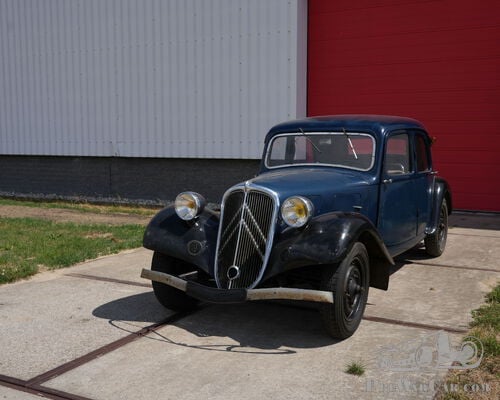
1935 Citroën Traction Avant
Early-production Traction AvantExceptionally original, unrestored conditionRecently part of a major museum collection
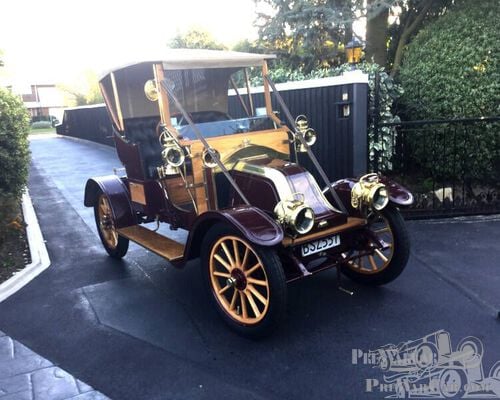
Renault /AX 1913 - named
Purchased fully renovated from New Zealand and imported to the UK. We have owned her for over10 years. Gigi is currently living in France where she..
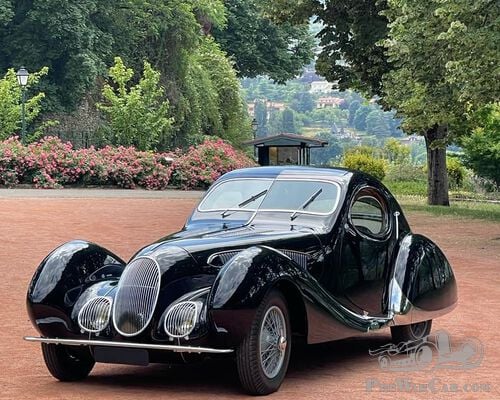
1939 Talbot-Lago T150C “Goutte d’Eau” — Iconic French Coachbuilt Masterpiece
Talbot-Lago T150C ‘Teardrop’ — An Icon of French Automotive Art There are motor cars that define an era. And then there are those tha..