The global magazine and marketplace for classic car enthusiasts, by enthusiasts.


Filter
Classic Auburn, Crossley for sale - Auburn, Crossley cars for sale
-

Auburn 851 Phaeton Sedan 1935
A very well-driving Auburn with a powerful engine, excellent brakes, and light steering.This five-seat open convertible features a rebuilt engine and a well-functioning dual-ratio rear axle, ideal for relaxed cruising at around 90 km/h (56 mph). An older restoration, it's in remarkably good condition, with a new convertible top.NL .. -
1936 Auburn 852 SC Cabriolet
Presented in striking Auburn Onyx Black with a rich slate gray leather interior, this 1936 Auburn 852 Convertible Cabriolet is a true jewel of prewar American motoring. The car underwent a comprehensive, nut-and-bolt, frame-off restoration by renowned Auburn authority James Milligan and owner of Auburn West, a respected purveyor of Auburn new-ol.. -
1935 Auburn 851SC Speedster
Vehicle Highlights Chassis No. 32741EEngine No. GH537 Vehicle DescriptionThis vehicle was first sold to Mr. Schilling (A. Schilling & Company founded in 1881). After some degree of use by Mr. Schilling, he directed his mechanic to mount the Auburn Speedster body on a Lincoln V12 chassis...


Auburn
US, 1900 – 1937
Auburn Automobile Co, Auburn, Ind.
One of the most famous of all American cars, the Auburn first appeared in 1900 when Frank and Morris Eckhart of the Eckhart Carriage Co, in Auburn, Ind., began experimenting with hand-built cars, selling them in and around Auburn. The first production Auburn car for sale appeared in 1903 as a single-cylinder chain-driven runabout with the engine under the body and the fuel tank under the bonnet. A touring Auburn model was added in 1904 and in 1905, 2-cylinder Auburn cars were introduced and continued until 1910, in which year a 4-cylinder type with a Mercedes-shaped radiator and a Rutenber engine was introduced. Both open and closed bodies were available on this larger chassis. In 1911 Auburn bought the Zimmerman Manufacturing Co, which had been producing high wheelers under that name, and continued to manufacture them. Auburn introduced a 6-cylinder car with electric lights as standard equipment in 1912. Right- or left-hand steering was optional in 1914 on Auburn cars for sale, and from 1914 to 1919, 4- and 6-cylinder Auburn cars were available with Teetor, Rutenber and Continental engines. In 1919, the company introduced its Auburn Beauty Six model featuring streamlined bodies with beveled edges on the sides. In 1921 this became the Auburn 6-51 sports model with cycle-type mudguards, step-plates instead of running-boards, disc wheels and a small luggage compartment behind the front bumper. Nickel trim was also featured, as well as leather upholstery and an abundance of bright colour schemes. The Auburn for sale in 1923 were powered by a Continental engine for the 6-43 or a Weidely ohv six for the larger model Auburn 6-63, or Auburn Supreme. In 1924, balloon low-pressure tyres were available on Auburn at extra cost. Up to now production figures had seldom exceeded 4000 units per year.
In 1924 E.L. Cord bought the Auburn company and from that point on, the Auburn took a leading position in the American automobile business. Cord had the entire range redesigned by J.M. Crawford, and the 1925 Auburn line consisted of 4-, 6- and 8-cylinder models. The new car had two-tone colour schemes and a novel belt moulding which extended at the cowl over the top of the bonnet with its apex at the radiator cap. The Auburn cars for sale were handsome and well built, although some of the larger models had ugly 6-spokes iron wheels more suited to truck design. These were soon discontinued and normal spoke or wire wheels became standard. The basic lines of the 1925 Auburn model were so advanced that the design remained practically the same until 1930. The 4-cylinder Auburn for sale was dropped in 1927 and sales climbed steadily. The 1931 Auburn was perhaps the sleekest car in the company’s history and sales reached a peak of 28.103 Auburn cars that year. The 1931 Auburn Straight-Eight was augmented in 1932 with a new 6.4-litre V12, both cars being equipped with a Columbia dual-ratio rear axle. This Auburn V12 was the first 12-cylinder car to sell under $1.000, and probably the only one, too. These lines were continued in 1933. In 1934 a new design replaced the basic 1931 type and a six was added to the range. In 1935 a new and handsome sports design was announced and a supercharged line of Auburns augmented the Auburn 653 six for sale and Auburn 851 eight for sale. The pointed-tail 150bhp Auburn speedster models were guaranteed to have been test driven at more than 100mph. The cars remained unchanged for 1936 and although a new range of Auburns had been planned for 1937, no cars were produced.
Source: Georgano, encyclopedia of motorcar; KM, GNG
The information is written with the greatest of care. However, if you have any suggested amendments please contact us at office@prewarcar.com
Crossley
GB, 1904 – 1937
(1) Crossley Brothers Ltd, Gorton, Manchester, 1904 – 1910
(2) Crossley Motors Ltd, Gorton, Manchester, 1910 – 1937
The name of Crossley was famous on engines before it was famous on cars; in fact the Crossley company was the first in Britain to make 4-stroke internal combustion engines on the Otto principle. Later, Daimler engines were made under licence. The first Crossley car for sale, a chain-driven 22hp 4-cylinder, appeared for the 1904 season. A Crossley 28hp and Crossley 40hp followed, all three cars being of normal design and foreign inspiration. Their designer was J.S. Critchley, formerly of Daimler. Shaft drive appeared in 1906, and late in 1909, some were fitted with Allen-Liveredge front-wheel brakes, but Crossley cars, though excellent machines, made little impression until after 1910. The 4-litre 20hp Crossley which then made its bow was a well-constructed, durable and very popular car. Designed by A.W. Reeves, it lived on in modified form until 1925. Crossley’s finest hour came in World War 1, when, as the Crossley 20/25hp it achieved fame as a staff car in the Royal Flying Corps, and as an ambulance and light truck. The Crossley model was extremely popular with the British Royal Family after the war in its 25/30hp version. In its early years, however, it was rivalled by the 15hp. The efficiency of the latter’s otherwise conventional engine, a side-valve four like the rest, gave this Crossley a better performance than most cars in its class and encouraged the makers to offer a special sporting variant, the Crossley Shelsley.
The Crossley Fifteen was discontinued after 1914, but a new Crossley arrived for 1921. This Crossley 19.6hp was a rather more modern design, having a detachable cylinder head, and it was cheaper and lighter on fuel than its 25/30hp companion. The performance was about the same. It was also made in sporting form as the Crossley 20/70hp, but this model was heavy, like the ’Crossley 19.6’ itself, and the brakes were not good enough for the 75mph that was available. Crossley did not make a serious attempt to invade the middle-class market until 1923, when the Crossley 12/14hp, later called the Crossley Fourteen, was introduced. Like its brothers, this was a simple side-valve four, in this case of 2.4 litres, but was more modern, with its unit construction of engine and gearbox and central gear-change. The Crossley Fourteen was a very successful model, being flexile and, thanks to its light weight, both roomy and economical. It survived until 1927. By this time the two bigger Crossley cars were giving way to a much more up-to-date car; the Crossley company’s first six and its first overhead-valve machine. This Crossley 18/50hp model was a spacious, heavy 2.6-litre car with good brakes but somewhat lacking in power. Its engine was enlarged to 3.2-litres and 20.9hp for 1928. At the same time a new small Crossley of similar design, the 2-litre Crossley 15.7hp was introduced, to which a sporting alternative reviving the Shelsley name was added in 1929. Lagonda’s 16/80 model used this engine later. The 6-cylinder Crossley 15.7hp continued until 1934 and the Crossley 20.9hp until 1937. Wilson pre-selector gearboxes were fitted from 1934.
In 1932, the Crossley company had introduced a light car, the Crossley Ten. This was an assembled vehicle powered by an 1100cc Coventry-Climax engine with overhead inlet valves. It was too heavy (a drawback compounded by the pre-selector gearbox), it was very low-geared and its brakes were mediocre. Another mistake was Crossley’s attempt to market the Burney rear-engined car with all-independent suspension. It was given a 15.7hp Crossley engine and a Wilson box, but it was too unconventional in appearance and handling. Very few were made. In 1935, Crossley introduced its new Regis range of small cars with handsome bodies styled by C.F. Beauvais. They consisted of the Crossley Ten and a new Crossley 1½-litre six of the same design also powered by Coventry-Climax, both with a new lowered frame. Both cars, together with the last Crossley 20.9s, disappeared after 1937.
Crossley assembled other people’s cars as well as making their own, beginning with the Willys-Overland Model 4 in 1920. The Gorton-produced Willys came to include more and more British-made parts, such as a Morris Oxford engine. A less likely diversion was an attempt of Crossley in 1921 to make the Type 22 Bugatti in England, but only a handful of these Crossley-Bugattis appeared. In 1922-1933 the Crossley factory made the AJS as well.
Source: Georgano, encyclopedia of motorcar; TRN
The information is written with the greatest of care. However, if you have any suggested amendments please contact us at office@prewarcar.com


Featured

Lagonda LC Tourer 1934
The Lagonda story began in 1901 in Staines, a small town in the UK. The company enjoyed its greatest successes around 1935. During this period, the..
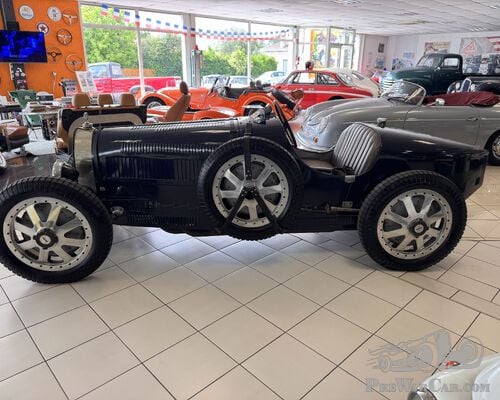
Bugatti 35 B Pur Sang
Bugatti 35 B Pur Sang,importée par un membre délégué de la FFVE il y’a une quinzaine d années.Participation à de nombreux Rallyes Bug..