The global magazine and marketplace for classic car enthusiasts, by enthusiasts.


Filter
Classic Auburn, Du Pont for sale - Auburn, Du Pont cars for sale
-

1929 Du Pont Model G Two-Passenger Speedster by Merrimac | RM Sotheby's | The Monterey Auction
To Be OFFERED AT AUCTION at RM Sothebys' The Monterey Auction event, 13 - 15 August 2026. $800,000 - $1,200,000 USD One of the most beautiful American automobiles of its generationThe 1929 New York International Automobile Show display carOne of three two-passenger “taper tail” models with an external spareOne .. -
1936 Auburn 852 SC Cabriolet
Presented in striking Auburn Onyx Black with a rich slate gray leather interior, this 1936 Auburn 852 Convertible Cabriolet is a true jewel of prewar American motoring. The car underwent a comprehensive, nut-and-bolt, frame-off restoration by renowned Auburn authority James Milligan and owner of Auburn West, a respected purveyor of Auburn new-ol.. -
1935 Auburn 851SC Speedster
Vehicle Highlights Chassis No. 32741EEngine No. GH537 Vehicle DescriptionThis vehicle was first sold to Mr. Schilling (A. Schilling & Company founded in 1881). After some degree of use by Mr. Schilling, he directed his mechanic to mount the Auburn Speedster body on a Lincoln V12 chassis... -
Auburn 851 Phaeton Sedan 1935
A very well-driving Auburn with a powerful engine, excellent brakes, and light steering. This five-seat open convertible features a rebuilt engine and a well-functioning dual-ratio rear axle, ideal for relaxed cruising at around 90 km/h (56 mph). An older restoration, it's in remarkably good condition, with a new convertible top.NL Docume..


Auburn
US, 1900 – 1937
Auburn Automobile Co, Auburn, Ind.
One of the most famous of all American cars, the Auburn first appeared in 1900 when Frank and Morris Eckhart of the Eckhart Carriage Co, in Auburn, Ind., began experimenting with hand-built cars, selling them in and around Auburn. The first production Auburn car for sale appeared in 1903 as a single-cylinder chain-driven runabout with the engine under the body and the fuel tank under the bonnet. A touring Auburn model was added in 1904 and in 1905, 2-cylinder Auburn cars were introduced and continued until 1910, in which year a 4-cylinder type with a Mercedes-shaped radiator and a Rutenber engine was introduced. Both open and closed bodies were available on this larger chassis. In 1911 Auburn bought the Zimmerman Manufacturing Co, which had been producing high wheelers under that name, and continued to manufacture them. Auburn introduced a 6-cylinder car with electric lights as standard equipment in 1912. Right- or left-hand steering was optional in 1914 on Auburn cars for sale, and from 1914 to 1919, 4- and 6-cylinder Auburn cars were available with Teetor, Rutenber and Continental engines. In 1919, the company introduced its Auburn Beauty Six model featuring streamlined bodies with beveled edges on the sides. In 1921 this became the Auburn 6-51 sports model with cycle-type mudguards, step-plates instead of running-boards, disc wheels and a small luggage compartment behind the front bumper. Nickel trim was also featured, as well as leather upholstery and an abundance of bright colour schemes. The Auburn for sale in 1923 were powered by a Continental engine for the 6-43 or a Weidely ohv six for the larger model Auburn 6-63, or Auburn Supreme. In 1924, balloon low-pressure tyres were available on Auburn at extra cost. Up to now production figures had seldom exceeded 4000 units per year.
In 1924 E.L. Cord bought the Auburn company and from that point on, the Auburn took a leading position in the American automobile business. Cord had the entire range redesigned by J.M. Crawford, and the 1925 Auburn line consisted of 4-, 6- and 8-cylinder models. The new car had two-tone colour schemes and a novel belt moulding which extended at the cowl over the top of the bonnet with its apex at the radiator cap. The Auburn cars for sale were handsome and well built, although some of the larger models had ugly 6-spokes iron wheels more suited to truck design. These were soon discontinued and normal spoke or wire wheels became standard. The basic lines of the 1925 Auburn model were so advanced that the design remained practically the same until 1930. The 4-cylinder Auburn for sale was dropped in 1927 and sales climbed steadily. The 1931 Auburn was perhaps the sleekest car in the company’s history and sales reached a peak of 28.103 Auburn cars that year. The 1931 Auburn Straight-Eight was augmented in 1932 with a new 6.4-litre V12, both cars being equipped with a Columbia dual-ratio rear axle. This Auburn V12 was the first 12-cylinder car to sell under $1.000, and probably the only one, too. These lines were continued in 1933. In 1934 a new design replaced the basic 1931 type and a six was added to the range. In 1935 a new and handsome sports design was announced and a supercharged line of Auburns augmented the Auburn 653 six for sale and Auburn 851 eight for sale. The pointed-tail 150bhp Auburn speedster models were guaranteed to have been test driven at more than 100mph. The cars remained unchanged for 1936 and although a new range of Auburns had been planned for 1937, no cars were produced.
Source: Georgano, encyclopedia of motorcar; KM, GNG
The information is written with the greatest of care. However, if you have any suggested amendments please contact us at office@prewarcar.com
Du Pont
US, 1920 – 1932
(1) Du Pont Motors Inc, Wilmington, Del., 1920 – 1923
(2) Du Pont Motors Inc, Moore, Pa., 1923 – 1932
E. Paul du Pont’s company built quality cars in limited numbers, total production being 537 vehicles of all Du Pont types. First of the line was a Du Pont 4.1-litre sv four with their own engine, selling for $2.600, but this gave way to proprietary-engined sixes, initially powered by Herschell-Spillman. The 1925 Du Pont Model D had a 6-cylinder 5-litre Wisconsin engine with overhead valves that developed 75bhp, a constant-mesh gearbox, and Lockheed hydraulic brakes to all four wheels. Its successor, the Du Pont Model E, could be had with a supercharger, but the best-known, and best, Du Pont was the Du Pont Model G speedster introduced in 1928. With its narrow straight wings copied from the Amilcar, Woodlite headlamps and grille concealing the radiator, the last a pioneering feature, the Du Pont Model G was not a good-looking car, but it was a very effective one. Like all the DuPont speedsters it had four forward speeds. The 5.3-litre, sv straight-8 engine, by Continental, gave 114bhp at 3600rpm with catalogued modifications. With the latter, 100mph was guaranteed. In the 1929 Le Mans 24 Hours race the Du Pont Model G proved itself faster than the other American entries, Stutz and Chrysler. Touring bodywork was, of course, available on the Du Pont car, and in 1931 came the long wheelbase (12ft 2 in) Du Pont Model H, built in a Stearns Knight frame. The later Du Pont cars were assembled in the Indian motorcycle factory at Springfield, after E. Paul du Pont had acquired this concern.
Source: Georgano, encyclopedia of motorcar; TRN
The information is written with the greatest of care. However, if you have any suggested amendments please contact us at office@prewarcar.com


Featured

1939 Wanderer W 23 Gläser(Dresden) Convertible
Wanderer W 23 Gläser(Dresden) Convertible in original condition Built in 1939 for sale. Ready to drive with TÜV and approval as a historic vehicle..
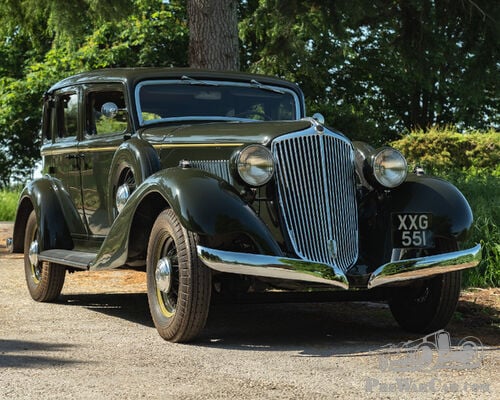
Graham Model 64 Standard Eight 'Blue Streak'
UK Registration No: XXG 551Chassis No: 1801069MOT: ExemptH&H ClassicsKelham Hall | Newark, Nottinghamshire