The global magazine and marketplace for classic car enthusiasts, by enthusiasts.


Filter
Classic Auburn, Duesenberg for sale - Auburn, Duesenberg cars for sale
-

Auburn 8-125 , 1930
Auburn Model 8-125, 8-cylinder, 4-door saloon, first registered in 1930, a lovely car in running order, with a German vehicle registration document and historical certification. Viewing and test drive by arrangement, price negotiable -
1935 Auburn 851 Supercharged Speedster | RM Sotheby's | The Hershey Auction
To Be OFFERED AT AUCTION at RM Sothebys' The Hershey Auction event, 7 - 8 October 2026. $850,000 - $950,000 USD The very first Auburn 851 Speedster produced, with numerous early production featuresKnown history back to the early 1950s, with several noted collectorsWell-preserved restoration by RM Auto Restoration; benef.. -
1936 Auburn 852 Super-Charged "Boattail" Speedster
Reimel Motor Cars is proud to offer this: stunning 1936 Auburn 852 Super-Charged "Boattail" Speedster. Penned by the legendary Gordon Buehrig, this Art Deco masterpiece is widely celebrated as one of the most breathtaking American cars ever produced. It balances show-ready elegance with tour-ready usability, perfectly prepared to anchor any .. -
Open to Offers! Duesenberg Model J Dual Cowl Phaeton coachwork built in the style of LaGrande with Engine J-241
Open to Offers! Duesenberg Model J Dual Cowl Phaeton coachwork built in the style of LaGrande with Engine J-241 Not complete - Great Restoration project -
1936 Auburn 852 SC Cabriolet
Presented in striking Auburn Onyx Black with a rich slate gray leather interior, this 1936 Auburn 852 Convertible Cabriolet is a true jewel of prewar American motoring. The car underwent a comprehensive, nut-and-bolt, frame-off restoration by renowned Auburn authority James Milligan and owner of Auburn West, a respected purveyor of Auburn new-ol.. -
1935 Auburn 851SC Speedster
Vehicle Highlights Chassis No. 32741EEngine No. GH537 Vehicle DescriptionThis vehicle was first sold to Mr. Schilling (A. Schilling & Company founded in 1881). After some degree of use by Mr. Schilling, he directed his mechanic to mount the Auburn Speedster body on a Lincoln V12 chassis... -
1931 Duesenberg Model J convertible sedan
Vehicle Highlights Chassis No. 2479Engine No. J 464ACD Category One Certified Original CarOne-Off CoachworkCCCA National First, Senior And Premier Award WinnerKnown Ownership History from New Vehicle DescriptionThis legendary Model J, with Chassis No. 2479.. -
1931 Duesenberg Model J Tourster by Derham | RM Sotheby's | The Monterey Auction
To Be OFFERED AT AUCTION at RM Sothebys' The Monterey Auction event, 13 - 15 August 2026. $2,250,000 - $3,250,000 USD One of the eight original, authentic Derham TourstersOriginal chassis, firewall, engine, and coachworkFormerly owned by Dr. Irwin Ginsberg, Andy Granatelli, and Joseph and Margie CassiniMeticulo.. -
1922 Duesenberg Model A Phaeton by Millspaugh & Irish For Sale
1922 Duesenberg Model A Phaeton by Millspaugh & Irish Chassis number: 798 Registration Number: Not currently registered. Engine Number 1111 Concours condition. This car when launched was a true standout. It was the very first seria.. -
Auburn 851 Phaeton Sedan 1935
A very well-driving Auburn with a powerful engine, excellent brakes, and light steering. This five-seat open convertible features a rebuilt engine and a well-functioning dual-ratio rear axle, ideal for relaxed cruising at around 90 km/h (56 mph). An older restoration, it's in remarkably good condition, with a new convertible top.


Auburn
US, 1900 – 1937
Auburn Automobile Co, Auburn, Ind.
One of the most famous of all American cars, the Auburn first appeared in 1900 when Frank and Morris Eckhart of the Eckhart Carriage Co, in Auburn, Ind., began experimenting with hand-built cars, selling them in and around Auburn. The first production Auburn car for sale appeared in 1903 as a single-cylinder chain-driven runabout with the engine under the body and the fuel tank under the bonnet. A touring Auburn model was added in 1904 and in 1905, 2-cylinder Auburn cars were introduced and continued until 1910, in which year a 4-cylinder type with a Mercedes-shaped radiator and a Rutenber engine was introduced. Both open and closed bodies were available on this larger chassis. In 1911 Auburn bought the Zimmerman Manufacturing Co, which had been producing high wheelers under that name, and continued to manufacture them. Auburn introduced a 6-cylinder car with electric lights as standard equipment in 1912. Right- or left-hand steering was optional in 1914 on Auburn cars for sale, and from 1914 to 1919, 4- and 6-cylinder Auburn cars were available with Teetor, Rutenber and Continental engines. In 1919, the company introduced its Auburn Beauty Six model featuring streamlined bodies with beveled edges on the sides. In 1921 this became the Auburn 6-51 sports model with cycle-type mudguards, step-plates instead of running-boards, disc wheels and a small luggage compartment behind the front bumper. Nickel trim was also featured, as well as leather upholstery and an abundance of bright colour schemes. The Auburn for sale in 1923 were powered by a Continental engine for the 6-43 or a Weidely ohv six for the larger model Auburn 6-63, or Auburn Supreme. In 1924, balloon low-pressure tyres were available on Auburn at extra cost. Up to now production figures had seldom exceeded 4000 units per year.
In 1924 E.L. Cord bought the Auburn company and from that point on, the Auburn took a leading position in the American automobile business. Cord had the entire range redesigned by J.M. Crawford, and the 1925 Auburn line consisted of 4-, 6- and 8-cylinder models. The new car had two-tone colour schemes and a novel belt moulding which extended at the cowl over the top of the bonnet with its apex at the radiator cap. The Auburn cars for sale were handsome and well built, although some of the larger models had ugly 6-spokes iron wheels more suited to truck design. These were soon discontinued and normal spoke or wire wheels became standard. The basic lines of the 1925 Auburn model were so advanced that the design remained practically the same until 1930. The 4-cylinder Auburn for sale was dropped in 1927 and sales climbed steadily. The 1931 Auburn was perhaps the sleekest car in the company’s history and sales reached a peak of 28.103 Auburn cars that year. The 1931 Auburn Straight-Eight was augmented in 1932 with a new 6.4-litre V12, both cars being equipped with a Columbia dual-ratio rear axle. This Auburn V12 was the first 12-cylinder car to sell under $1.000, and probably the only one, too. These lines were continued in 1933. In 1934 a new design replaced the basic 1931 type and a six was added to the range. In 1935 a new and handsome sports design was announced and a supercharged line of Auburns augmented the Auburn 653 six for sale and Auburn 851 eight for sale. The pointed-tail 150bhp Auburn speedster models were guaranteed to have been test driven at more than 100mph. The cars remained unchanged for 1936 and although a new range of Auburns had been planned for 1937, no cars were produced.
Source: Georgano, encyclopedia of motorcar; KM, GNG
The information is written with the greatest of care. However, if you have any suggested amendments please contact us at office@prewarcar.com
Duesenberg
US, 1920 – 1937, 1966
(1) Duesenberg Motor Co, Indianapolis, Ind., 1920 – 1937
(2) Duesenberg Corporation, Indianapolis, Ind., 1966
Fred Duesenberg began by making bicycles and designed his first Duesenberg car, the Mason, in 1904. He and his brother August made engines with horizontal overhead valves for the 1912 Mason racing cars, and founded Duesenberg Motors in the following year in order to produce marine engines and complete racing cars bearing the Duesenberg name. The most famous of the latter appeared in 1920: a 3-litre Bugatti-inspired Duesenberg straight-8 with single overhead camshaft and three (vertical) valves per cylinder. This Duesenberg won the 1921 French Grand Grand Prix. In the 1920s the Duesenberg racing cars were the great rivals of the Millers at Indianapolis, and victory was assured in 1924 by the adoption of a centrifugal blower on Duesenberg cars. Though a two-stroke 1½-litre 8-cylinder racing engine capable of 7.000rpm was made in 1926, this was not proceeded with. The horizontal-valve Duesenberg engine was taken over in 1920 by the Rochester Motor Manufacturing Co Inc and was used in various sporting and luxury cars.
Meanwhile, at the end of 1920, the first Duesenberg production car made its debut. This Duesenberg Model A was an extremely expensive, if very advanced, luxury car, embodying an 8-cylinder in-line engine – the first to be seen in an American production car – of 4.2 litres, basically similar to the Duesenberg racing unit, but with only two valves per cylinder and developing about 100bhp. There were also hydraulically-operated front wheel brakes – another ‘first’ as far as America was concerned. The Model A was current until 1926. A handful of its little-altered successor, the Duesenberg Model X, was made in 1926-1927, but in the former year E.L. Cord of Auburn acquired control of the Duesenberg company. He stipulated that Fred Duesenberg’s next car should be completely new, and a quite exceptional machine. In fact, the Duesenberg Model J, which made its bow at the end of 1928, was the most remarkable automobile in America: bigger, faster, more elaborate and more expensive than any other, yet also superior to them in refinement and good looks. Its 6.9-litre, 8-cylinder engine, made by Lycoming (a firm which Cord had also bought), had two chain-driven overhead camshafts operating four valves per cylinder; a layout of racing type unique among American cars at the time and said to develop 265bhp at 4250rpm – more than double the output of any rival. Although the complete Duesenberg car weighed more than 4980lb, it was claimed to be capable of 116mph in top gear and 89mph in second. Only Duesenberg Model J chassis were made for which $8500 was asked in 1929. Immensely long and strong and lowbuilt, Duesenberg cars were very popular with all the leading coachbuilders. The Duesenberg company preferred to sell cars complete with bodies designed by them but made by approved builders, such as Murphy, Bohman & Schwarts, Judkins, Derham and Le Baron. In this form, catalogued Duesenberg models cost up to $17.950. The transmission – apart form the double dry-plate clutch – was conventional, as was the suspension by half-elliptic springs and hydraulic shock absorbers. The brakes, of course, were hydraulic, with vacuum servo assistance from late 1929.
In 1932 a supercharged version of the Model J, the Duesenberg SJ, was added. To cope with the 320bhp now alleged to be available, bearings, reciprocating parts and valve springs were strengthened. Usually, the shortest Duesenberg J chassis was used, with the highest axle ratio and stronger front springs. A maximum speed of 129mph was attributed to the Duesenberg SJ, with an acceleration figure of 0-100mph in 17 seconds.
Duesenberg survived the Depression, but died in the collapse of the Cord Corporation in 1937. Attempts to revive the Duesenberg name were made in 1947 and in 1966. The first Duesenberg was unsuccessful, and in 1966 only one Duesenberg car was actually made, powered by a 7-litre V8 Chrysler engine with push-rod overhead valves, developing 431bhp at 5.000rpm. Transmission was automatic, front suspension was independent, and there were disc brakes. Body styling was by Ghia. This Duesenberg venture, too, collapsed.
Source: Georgano, encyclopedia of motorcar; TRN
The information is written with the greatest of care. However, if you have any suggested amendments please contact us at office@prewarcar.com


Featured
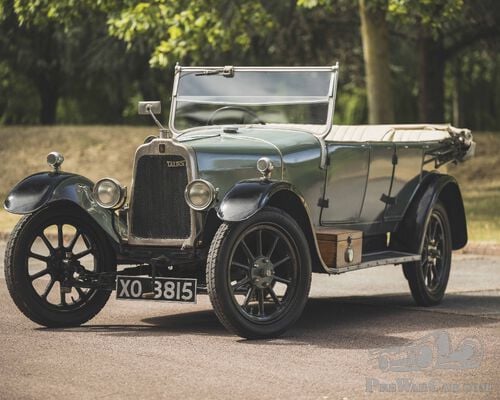
Rare RHD, low miles & great history file
This is an ONLINE-ONLY AUCTION at THE MARKET. The price shown here is the lower estimate. To see all the details, description, 250+ high-res photog..
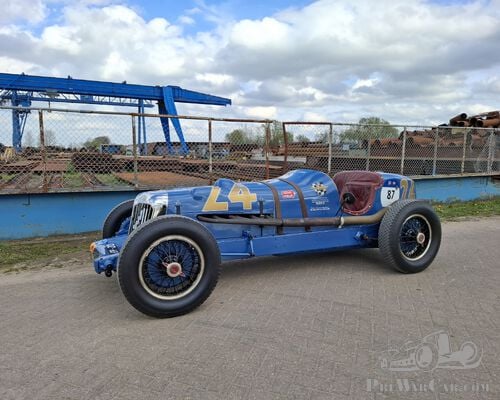
1932 - Graham " Lucenti " Indianapolis
Original participant of the 1932, 1934 and 1935 Indy 500. Best result: finishing 10th overall in the 1934 Indy 500 with driver “Herb” Ardinger...
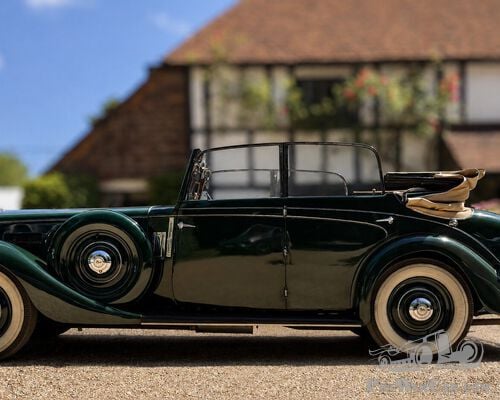
1936 Armstrong Siddeley 20/25 Cabriolet with Tickford coachwork by Salmons & Sons, Newport Pagnell
This exceptionally rare Armstrong Siddeley 20/25 Cabriolet with original Tickford coachwork by Salmons & Sons of Newport Pagnell was first reg..