The global magazine and marketplace for classic car enthusiasts, by enthusiasts.


Filter
Classic Auburn, Star for sale - Auburn, Star cars for sale
-

Auburn 851 Phaeton Sedan 1935
A very well-driving Auburn with a powerful engine, excellent brakes, and light steering.This five-seat open convertible features a rebuilt engine and a well-functioning dual-ratio rear axle, ideal for relaxed cruising at around 90 km/h (56 mph). An older restoration, it's in remarkably good condition, with a new convertible top.NL .. -
1936 Auburn 852 SC Cabriolet
Presented in striking Auburn Onyx Black with a rich slate gray leather interior, this 1936 Auburn 852 Convertible Cabriolet is a true jewel of prewar American motoring. The car underwent a comprehensive, nut-and-bolt, frame-off restoration by renowned Auburn authority James Milligan and owner of Auburn West, a respected purveyor of Auburn new-ol.. -
1935 Auburn 851SC Speedster
Vehicle Highlights Chassis No. 32741EEngine No. GH537 Vehicle DescriptionThis vehicle was first sold to Mr. Schilling (A. Schilling & Company founded in 1881). After some degree of use by Mr. Schilling, he directed his mechanic to mount the Auburn Speedster body on a Lincoln V12 chassis...


Auburn
US, 1900 – 1937
Auburn Automobile Co, Auburn, Ind.
One of the most famous of all American cars, the Auburn first appeared in 1900 when Frank and Morris Eckhart of the Eckhart Carriage Co, in Auburn, Ind., began experimenting with hand-built cars, selling them in and around Auburn. The first production Auburn car for sale appeared in 1903 as a single-cylinder chain-driven runabout with the engine under the body and the fuel tank under the bonnet. A touring Auburn model was added in 1904 and in 1905, 2-cylinder Auburn cars were introduced and continued until 1910, in which year a 4-cylinder type with a Mercedes-shaped radiator and a Rutenber engine was introduced. Both open and closed bodies were available on this larger chassis. In 1911 Auburn bought the Zimmerman Manufacturing Co, which had been producing high wheelers under that name, and continued to manufacture them. Auburn introduced a 6-cylinder car with electric lights as standard equipment in 1912. Right- or left-hand steering was optional in 1914 on Auburn cars for sale, and from 1914 to 1919, 4- and 6-cylinder Auburn cars were available with Teetor, Rutenber and Continental engines. In 1919, the company introduced its Auburn Beauty Six model featuring streamlined bodies with beveled edges on the sides. In 1921 this became the Auburn 6-51 sports model with cycle-type mudguards, step-plates instead of running-boards, disc wheels and a small luggage compartment behind the front bumper. Nickel trim was also featured, as well as leather upholstery and an abundance of bright colour schemes. The Auburn for sale in 1923 were powered by a Continental engine for the 6-43 or a Weidely ohv six for the larger model Auburn 6-63, or Auburn Supreme. In 1924, balloon low-pressure tyres were available on Auburn at extra cost. Up to now production figures had seldom exceeded 4000 units per year.
In 1924 E.L. Cord bought the Auburn company and from that point on, the Auburn took a leading position in the American automobile business. Cord had the entire range redesigned by J.M. Crawford, and the 1925 Auburn line consisted of 4-, 6- and 8-cylinder models. The new car had two-tone colour schemes and a novel belt moulding which extended at the cowl over the top of the bonnet with its apex at the radiator cap. The Auburn cars for sale were handsome and well built, although some of the larger models had ugly 6-spokes iron wheels more suited to truck design. These were soon discontinued and normal spoke or wire wheels became standard. The basic lines of the 1925 Auburn model were so advanced that the design remained practically the same until 1930. The 4-cylinder Auburn for sale was dropped in 1927 and sales climbed steadily. The 1931 Auburn was perhaps the sleekest car in the company’s history and sales reached a peak of 28.103 Auburn cars that year. The 1931 Auburn Straight-Eight was augmented in 1932 with a new 6.4-litre V12, both cars being equipped with a Columbia dual-ratio rear axle. This Auburn V12 was the first 12-cylinder car to sell under $1.000, and probably the only one, too. These lines were continued in 1933. In 1934 a new design replaced the basic 1931 type and a six was added to the range. In 1935 a new and handsome sports design was announced and a supercharged line of Auburns augmented the Auburn 653 six for sale and Auburn 851 eight for sale. The pointed-tail 150bhp Auburn speedster models were guaranteed to have been test driven at more than 100mph. The cars remained unchanged for 1936 and although a new range of Auburns had been planned for 1937, no cars were produced.
Source: Georgano, encyclopedia of motorcar; KM, GNG
The information is written with the greatest of care. However, if you have any suggested amendments please contact us at office@prewarcar.com
Star
GB, 1898 – 1932
Star/ Starling/ Stuart
(1) Star Motor Co, Wolverhampton, Staffs., 1898 – 1902
(2) Star Engineering Co, Wolverhampton, Staffs., 1902 – 1909
(3) Star Cycle Co, Wolverhampton, Staffs., 1905 – 1909
(4) Star Engineering Co Ltd, Wolverhampton, Staffs., 1909 – 1928
(5) Star Motor Co Ltd, Wolverhampton, Staffs., 1928 – 1932
Edward Lisle Sr’s Star Motor Co, an offshoot of the Star Cycle Co, produced its first Star car in 1898, and offered the Star car for sale in the following year. The Star car was a Benz-based machine, with a single-cylinder, water-cooled 3½hp engine, belt primary drive and chain final drive. It was an improvement in that water circulation on the Star car was assisted by a pump. In 1900 there followed a 2-cylinder Star car with 3 forward speeds, still on Benz lines. 1901 brougth De Dion-engined single-cylinder Star cars, and 1902 an 8hp twin of Panhard type in addition. Other, larger Star cars of Panhard ancestry joined the 8hp, up to a 20hp four Star car. By 1904, although a De Dion-powered single and Panhard-type twin were still there, the bigger machines were of Mercédès pattern, these Star cars came with honeycomb radiators, mechanically-operated inlet valves and pressed-steel frames. All veteran Star cars up to 1914 were extremely well-made, well-furnished, conventional, rather expensive cars lacking in technical originality, showing a line of development appearance in the 1907 range. The best-known Star car of the veteran period was the excellent 15hp Star car of 1909, a shaft-driven 2.8-litre four which had become the 3-litre 15.9hp by 1914. A great variety of other Star cars, basically similar models were turned out, not only by Star but also by the Star Cycle Co. The latter, run by Edward Lisle Jr, had made motor tricycles and bicycles, and produced the Starling car in 1905. It had 2 forward speeds and a De Dion single-cylinder engine, but was otherwise of Panhard type, with armoured wood frame and chain drive. One year later the Star car company supplemented it with the more modern Stuart car, which had 2-cylinders, 3-speeds and shaft drive. This name was dropped in 1908, all models being called Starlings, but these too, disappeared in 1909 when Star cars cheaper line was entrusted to the new Brion Motor Co, a more indepented concern that was still run by Edward Lisle Jr. So popular was the Star car that its makers were among the six largest in the country before 1914.
The 15.9hp Star car was continued after World War 1, together with another sv four Star car of pre-war origin, the 20hp Star car of 3.8-litres. A modern light Star car of fashionable type, the 11.9hp, arrived in 1921. This Star car used a 1.795cc sv engine with a detachable head, made in unit with a 3-speed gearbox which had central change. By 1924, the 11.9 Star car had grown up into the 2-litre 12/25hp Star car. It shared cylinder dimensions with the 18hp Star car, which was a new 3-litre six. The 12/25 Star car could be had as a very fine fast touring car with overhead valves and 54bhp, in which form the Star car was called 12/40hp. Thereafter, the Star car range reverted to its pre-war complexity. By 1927, there were three sv Star car models and two additional and more up-to-date Star cars with overhead valves. The 14/40hp Star car, new in 1926, was a solid 2-litre, ohv machine which in spite of having only 4-cylinders and 3 forward speeds, this Star car was a notably smooth and flexible car, thanks to a 5-bearing crankshaft. The ohv 20/60hp Star car, a 2½-litre six with the same bore and stroke as the 14/40 and a 7-bearing crankshaft, was the most luxurious Star car. A light six, the popular ohv 18/50hp, joined the Star car range in 1928, the year of the Star car company’s acquisition by Guy, and replaced the 14/40 Star car for 1929. By this time, the sv Star cars had gone, leaving the two sixes. As the 18hp Star Comet and the 21hp Star Planet, these Star cars were revised with handsome bodies and very full, luxurious equipment, including one-shot chassis lubrication, thermostatically-controlled radiator shutters and a built-in jacking system. Two other engines, of 14hp (2-litres) and 24hp (3.6-litres) were also obtainable in Star cars for 1932, as alternative Comet and Planet power units. These Star car were the last new Star cars, for they were too expensive to make, and the times favoured the mass-produced economy car. Production of Star cars ended in March 1932, but the unsold stock was sold by McKenzie and Denley of Birmingham, and the Star car was quoted in the Buyer’s Guide lists until 1935.
US, 1903 – 1904
(1) Star Automobile Co, Cleveland, Ohio
(2) H.S. Moore, Cleveland, Ohio
This Star car was driven by a single-cylinder, watercooled engine of 1.9-litres, mounted beneath the front seat, with false bonnet and coil radiator in front. A champion planetary transmission and double chain drive was used on this Star car. Both two- and five-seater Star cars were made, the latter with rear entrance.
US, 1908
Star Automobile Co, Chicago, Ill.
Star runabouts were offered in three models, selling for $500, $600 and $700 respectively. The smallest Star car was an open two-seater, and shaft drive was employed on all Star cars.
US, 1908
Model Automobile Co, Peru, Ind.
The short-lived Star car from Peru was offered in conventional 2- and 4-cylinder forms. The twin was chain-driven, while the big, expensive four Star car ($4.000) had shaft drive.
US, 1922 – 1928
Durant Motor Co of New Jersey, Elizabeth, N.J.; Lansing, Mich; Oakland, Calif.
William Crapo Durant’s Star Four was one of the most serious attempts to take away some of the Model T Ford’s market, for the cheapest practical car. Unlike the Ford, the Star car was an assembled machine.The Star car had a 2.2-litre, 4-cylinder engine by Continental, and was conventional in design in every way except the gearbox, which was separate; a feature common to all the vehicles in Durant’s empire, but very unusual in American mass-produced cars by the early 1920s. The touring Star car cost only $443 in 1923, which helped Star to be the seventh biggest seller in America that year. The Star car was sold outside the United States as the Rugby. In 1926, a 2.8-litre six Star car was introduced. Front wheel brakes appeared in 1927 but a year later the Star car make disappeared in the collapse of the Durant interests. By this time, 250 Star cars a day were being turned out. Only the Four was still called the Star car for the 1928 model year, as the Six was now known as the Durant Model 55.
Source: Georgano, encyclopedia of motorcar; TRN, GMN, MJWW, TRN
The information is written with the greatest of care. However, if you have any suggested amendments please contact us at office@prewarcar.com


Featured
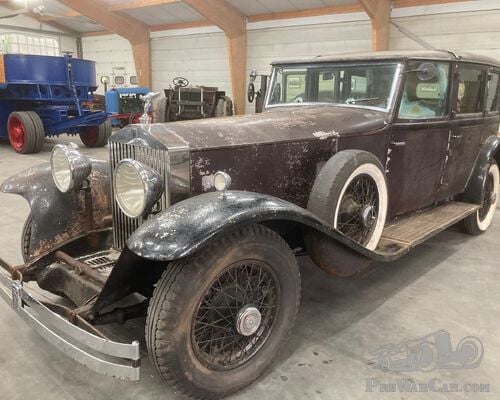
Rolls-Royce
Rolls-Royce Phantom ll chassisnummer 287 AJS. bouwjaar 1932, Links gestuurd, Brewster Keswick Sedance Towncar
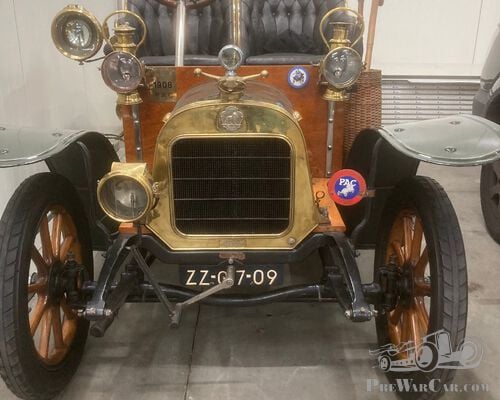

Lagonda LC Tourer 1934
The Lagonda story began in 1901 in Staines, a small town in the UK. The company enjoyed its greatest successes around 1935. During this period, the..