The global magazine and marketplace for classic car enthusiasts, by enthusiasts.


Filter
Classic Audi, Hansa for sale - Audi, Hansa cars for sale
-

Bugatti Type 30 short chassis roadster. Fully restored on a replica chassis
This car has had a full restoration and is build from a lot of original parts on a replice chassis built in Germany, It has chassis number BC 189 from the UK Bugatti Owners Club. Car has done only about 500km since restoration but health problems dictate that it must go. Please email for fullest details of the source of all the parts and a vide.. -
1930 Bentley Speed Six
1930 Bentley Speed Six Chassis Number: SB2774 Engine Number: SB2772 Reistration Number: GH8974 New to market & freshly restored to perfection. This car has over the past two years been fully rebuilt & built up as a LeMans style tourer by noted Rolls Royce &.. -
1936 Cadillac Series 60 Convertible Coupe | RM Sotheby's | The Hershey Auction
To Be OFFERED AT AUCTION WITHOUT RESERVE at RM Sothebys' The Hershey Auction event, 7 - 8 October 2026. Offered Without Reserve | $50,000 - $70,000 USD Please check back soon as our dedicated cataloguing team is preparing the description for this lot. To view this car and others currently consigned to this auction, please visit the RM website a.. -
Renault NN Torpedo Commerciale (1926)
Highlights Complete, coherent, unmodified exampleExcellent base for a full restorationAttractive 1920s torpedo body styleVery accessible entry priceIdeal for workshops or enthusiasts looking for a rewarding project Restoration project – Complete car – Solid base but major work r.. -
Renault 12 HP Coupé de Ville Carrosserie Kellner Type CB – 1911
HighlightsExceptional original conditionRare Kellner coachworkComplete, authentic, coherent exampleOriginal paint and interiorMuseum‑grade preservationIdeal for concours preservation class Kellner Coupé de Ville – Exceptional original condition This.. -
De Dion‑Bouton Type D (1899)
HighlightsRare early De Dion‑Bouton, highly collectibleBeautiful presentation and coherent historyEligible for major international veteran eventsA centrepiece for any prestigious collection Vis‑à‑vis “La Petite Voiture” – High‑quality restoration – Veteran car eligible .. -
1940 Buick Super Convertible Coupe | RM Sotheby's | The Hershey Auction
To Be OFFERED AT AUCTION WITHOUT RESERVE at RM Sothebys' The Hershey Auction event, 7 - 8 October 2026. Offered Without Reserve | $50,000 - $60,000 USD Please check back soon as our dedicated cataloguing team is preparing the description for this lot. To view this car and others currently consigned to this auction, please visit the RM website a.. -
1938 Rolls Royce Wraith Gurney Nutting Sedanca Coupe
1938 Rolls Royce Wraith Gurney Nutting Sedanca Coupe Chassis number: WRB2 Registration number: FLH5 This car may be paid for in Bitcoin. Approx 3 BTC Simply the best of the best & a Pebble Beach/Villa D'Este quality car. This wrait.. -
1934 Aston Martin 1.5 Litre Mark 2 Long chassis sports tourer.
1934 Aston Martin 1.5 Litre Mark 2 Long chassis sports tourer. Chassis Number: D-4/417/L Engine Number: D-4/417/L Registration Number: WD7623 Stunning condition and the best one of these we have seen. This car had a full restoration including a massive engine rebui.. -
Citroen AC4 1929
WANTEDSOLEX CARBURETTOR MOVD 6240 PARTS REQUIRED - JET CARRIER / HOLDER - NEEDLE VALVE - JETS3 SPEED MANUAL GEARBOX PARTS REQUIRED -- INPUT SHAFT - 3RD GEAR - LAYSHAFT SPINDLE - LAYSHAFT BUSHES - GASKETS


Audi
D, 1910 – 1939
Audi Automobilwerke GmbH, Zwickau/Sachsen, 1910 – 1939
After leaving the firm A. Horch, which he had founded, August Horch started a new company in 1909 which he at first named August Horch Automobilwerke GmbH, also in Zwickau. He was not allowed to use his own name for the new company, however, so he chose the name ‘Audi’ which is the latinized form of Horch. The first Audi for sale was the B 10/28ps with a 2.612cc engine which appeared in 1910, and was an immediate success. In the Austrian Alpine Trials in 1911 Horch himself drove one of these Audi cars without incurring any penalty points. He was also successful with the same type Audi in the same event in 1912. In 1912 the Audi Type C 14/35ps appeared. In a short-wheelbase version, it became a very well-known completion car and was called the Alpensieger because of its successes in the Austrian Alpine Trials of 1913 and 1914. Other pre-World War 1 Audi models were the Audi D 18/45ps and the Audi E 22/50ps. After the war the Audi G 8/28ps appeared as a new model and types C, D and E were carried were carried on. The 1922 ohv Audi type K succeeded the C, the 3.5-litre engine developing 50bhp. With the type Audi M 18/70ps ohc 6-cylinder of 1924 Audi started a range of 6- and 8-cylinder cars. The 1928 type Audi R or Audi Imperator 8-cylinder model for sale with a 4.872cc 100bhp engine was the last true Audi; all the following Audi-models were to some extent assembled cars.
J.S. Rasmussen became the main shareholder of Audi in 1928. He had acquired Rickenbacker machinery lines from the USA and engines of Rickenbacker type were fitted to the Zwickau (8-cylinder 4.371cc and 5130cc) and Dresden (6-cylinder 3.838cc) models. In 1931 a small Audi with 4-cylinder 1.1-litre Peugeot engine and D.K.W. chassis appeared. In 1932 Audi became a member of the Auto Union together with Wanderer, Horch and D.K.W. Two front-driven models (UW and 225) followed with 6-cylinder Wanderer engines. The last pre-war Audi was the Audi Type 920, rear-driven again and with 6-cylinder 3.281cc engine.
The Audi factory and the other Auto Union production plants were nationalized in 1945.
Source: Georgano, encyclopedia of motorcar; HON
The information is written with the greatest of care. However, if you have any suggested amendments please contact us at office@prewarcar.com
Hansa
D, 1906 – 1939
(1) Hansa Automobil – Gesellschaft mbH, Varel, 1906 – 1914, Bielefeld, 1913 – 1914
(2) Hansa-Lloyd-Werke AG, Varel, 1914 – 1929, Bremen, 1929 – 1931
(3) Hansa-Lloyd und Goliath-Werke Borgward & Tecklenborg, Bremen, 1931 – 1937
(4) Hansa Lloyd-Goliath-Werke Carl F.W. Borgward, Bremen, 1937 – 1939
The Hansa works were founded with the intention of producing small cars. The first was a Hansa 7/9ps car with a single-cylinder 720cc De Dion engine based on the French Alcyon. The Hansa appeared in 1906, and was sold under the name HAG. After a few more models with proprietary engines such as Fafnir the Hansa 6/14ps appeared in 1907 with a 4-cylinder engine of the Hansa company’s own design. A wide range of models was offered during the following years. Among them were the Hansa Types D (10/30PS, 2.612cc) and Hansa E (15/50PS, 3.815cc) of 1911 with overhead valves, a feature which was rare at that time. Hansa cars were produced in considerable numbers and Hansa cars were renowned for their high technical standard and their good workmanship.
In 1913 Hansa took over the Westfalia works at Bielefeld and Hansa cars were built there in 1913 and 1914. The Hansa Type F (2.515cc) took part successfully in the 1914 Austrian Alpine Trial. In 1914 Hansa merged with Lloyd, the firm adopting the name Hansa-Lloyd. The production of Hansa cars was carried on until World War 1. After the war Hansa concentrated on light and medium-sized cars which were marketed as Hansa. The Lloyd factory specialized in the heavier cars and commercials, which were sold as Hansa-Lloyds. Post-war models were the Hansa P 8/36PS with a 4-cylinder 2.063cc engine, also available in a short-wheelbase sports version, and two cars, a 13/60PS (6-cylinder, 3.262cc) and a 16/70PS (8-cylinder, 3.996cc) which were equipped with American Continental engines.
In 1929 Hansa was taken over by Borgward-Goliath. Production in the Varel works ceased and Hansa private cars were subsequently built only in Bremen. The Hansa Konsul, Hansa Senator, Hansa Matador and Hansa Imperator were family and prestige cars with 4-, 6-, and 8-cylinder engines with capacities up to 5.8-litres and outputs to 100bhp. The 3.2-litre Hansa Senator was an unusually large four for the period, and the Hansa Matador had a 2.6-litre Continental engine, and the combination of independent rear suspension and a backbone frame. In 1933 the small Hansa 400 was introduced. It had a 2-cylinder 2-stroke rear engine of 400cc and was later available with a 500cc engine. A new model, the Hansa 1100, with all independent suspension appeared in 1934. It was in production until 1939 and became very popular. Other models were the 6-cylinder ‘Hansa 1700’ (also available in a twin-carburettor sports version), the ‘Hansa 2000’ and the ‘Hansa 3500’ Privat.
After 1938 Hansa cars were marketed as Borgwards. In 1958 the Hansa name was revived for the flat-four Goliath; it had previously been used as a type name for some Borgwards.
Source: Georgano, encyclopedia of motorcar; HON
The information is written with the greatest of care. However, if you have any suggested amendments please contact us at office@prewarcar.com


Featured
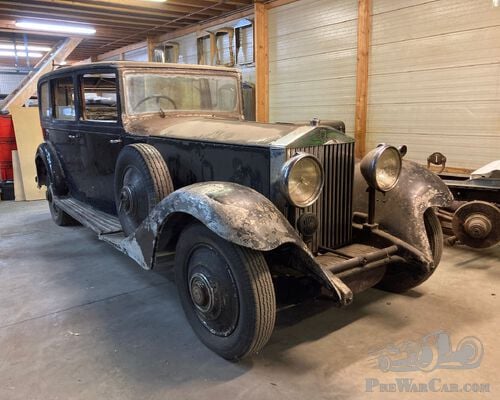
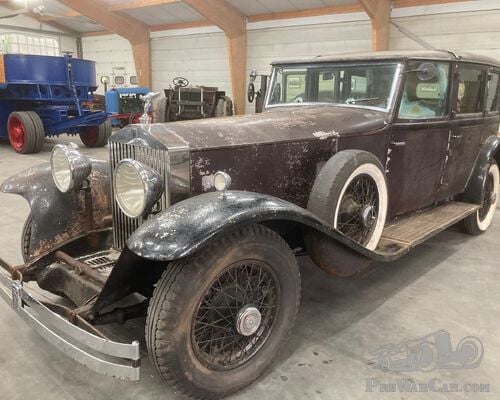
Rolls-Royce
Rolls-Royce Phantom ll chassisnummer 287 AJS. bouwjaar 1932, Links gestuurd, Brewster Keswick Sedance Towncar
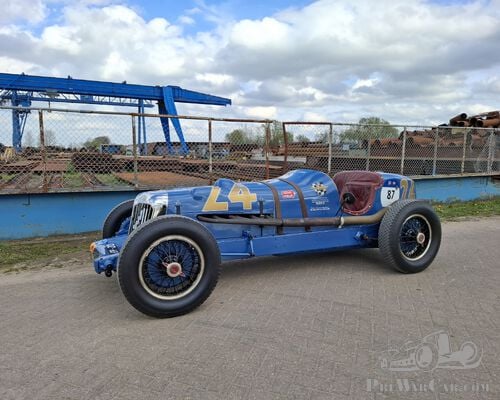
1932 - Graham " Lucenti " Indianapolis
Original participant of the 1932, 1934 and 1935 Indy 500. Best result: finishing 10th overall in the 1934 Indy 500 with driver “Herb” Ardinger...