The global magazine and marketplace for classic car enthusiasts, by enthusiasts.


Filter
Classic Audi, Simplex for sale - Audi, Simplex cars for sale
-

Bentley 4½ Litre Blower Continuation 1 of 12 (Chassis No.8)
A final opportunity to acquire a 100% original Blower Bentley, newly crafted by the manufacturer itself.Ninety years after the original Birkin Blowers defined an era, Bentley Mulliner undertook one of the most ambitious heritage projects in the marque’s history: the Blower Continuation Series. Built using original 1920s drawings, period t.. -
Bentley 4½ Litre Blower 1930 - Birkin Spec
Some cars are admired. Others are experienced. This Bentley Blower belongs firmly in the latter category. Shaped in period by the respected H.J.K. Townshend, a craftsman trusted by original Team Bentley owners, this example reflects a deep understanding of what defines a true Blower. Authentic in spirit and purposeful in execution,.. -
1923 Rolls Royce Silver Ghost Alpine Eagle
1923 Rolls Royce Silver Ghost Alpine Eagle. Chassis Number: 44SG Registration Number: Spanish Registered. An extraordinary car with an extraordinary story: This Silver Ghost was bricked up in a Spanish nobleman's mansion in 1936. It slumbered there .. -
Packard single six convertible
Rare 1925 Packard Six Sedan – Unique 7-Seater Project with Belgian PapersA solid, rust-free base for the true vintage enthusiast.We are proud to offer this rare and stately 1925 Packard Six. In the 1920s, Packard was the ultimate symbol of American luxury and engineering. This specific model is a grand 7-seater, complete with the.. -
1930 Standard Avon Alvis 12/50 Supercharged Special
1930 Standard Avon Alvis 12/50 Supercharged Special Chassis Number: 29035 Registration Number: BF9202 The present owner began building the A-A in 1965. He had enjoyed driving his first real car, a 1929 12/50 Alvis Betleback and when he acquired a 1930 Standard Avon, he found tha.. -
1928 Cadillac Model 7980 convertible coupe
Cadillac is one of the pristine cars in American history, here we have a 1928 model 7980 convertible coupewith all options as twin wooden spare wheels, trunk rack, pilot ray lights (who follow the direction of the front wheels) etc.The engine is a V8 with 5588cc on a 3560 wheelbase. At 2200kg it is not a lightweight.We parti.. -
MG NA Magnette (Ex Beryl Markham)
MODEL OVERVIEW: By the early 1930s, MG had joined the fashionable trend of six cylinder sports and racing cars with the K and N Magnette models. MG’s road going overhead camshaft six cylinder cars we’re directly related to the works racing cars used to achieve phenomenal international competition success in period.The N Magnette series of.. -
1924 Bentley 3 4 ½ Litre
•Sold new to Major EG Thomson of Edinburgh, of Ecuire Ecosse fame •Owned for more than 50 years by the Martin family•Upgraded to 4.5 Litre spec using original crankcase•Extensive history file includes factory records and buff logbooks•Fully restored by Paul Grist to his ‘ultimate’ period look and specification .. -
HORCH 930 V
For SaleHorch 930 VManufacturer: HorchModel and Variant: 930 VBody Type: 4-door sedanChassis Number: 931906Color: Dark bluePower: 93 kWEngine Capacity: 3,796 ccFirst Registration: 01/07/1939Engine Type: Petrol, 8-cylinderMileage: 12,125 km -
1921 Rolls Royce 20hp Experimental tourer
1921 Rolls Royce 20hp Experimental tourer. Chassis number: 4G2 Registration Number: CH2892 Sir Henry Royces' personal car used for development of the 20HP chassis. He is pictured in it both at his French house; La Villa Mimosa in Le Canadel & also near his UK home "Elmsted" ..


Audi
D, 1910 – 1939
Audi Automobilwerke GmbH, Zwickau/Sachsen, 1910 – 1939
After leaving the firm A. Horch, which he had founded, August Horch started a new company in 1909 which he at first named August Horch Automobilwerke GmbH, also in Zwickau. He was not allowed to use his own name for the new company, however, so he chose the name ‘Audi’ which is the latinized form of Horch. The first Audi for sale was the B 10/28ps with a 2.612cc engine which appeared in 1910, and was an immediate success. In the Austrian Alpine Trials in 1911 Horch himself drove one of these Audi cars without incurring any penalty points. He was also successful with the same type Audi in the same event in 1912. In 1912 the Audi Type C 14/35ps appeared. In a short-wheelbase version, it became a very well-known completion car and was called the Alpensieger because of its successes in the Austrian Alpine Trials of 1913 and 1914. Other pre-World War 1 Audi models were the Audi D 18/45ps and the Audi E 22/50ps. After the war the Audi G 8/28ps appeared as a new model and types C, D and E were carried were carried on. The 1922 ohv Audi type K succeeded the C, the 3.5-litre engine developing 50bhp. With the type Audi M 18/70ps ohc 6-cylinder of 1924 Audi started a range of 6- and 8-cylinder cars. The 1928 type Audi R or Audi Imperator 8-cylinder model for sale with a 4.872cc 100bhp engine was the last true Audi; all the following Audi-models were to some extent assembled cars.
J.S. Rasmussen became the main shareholder of Audi in 1928. He had acquired Rickenbacker machinery lines from the USA and engines of Rickenbacker type were fitted to the Zwickau (8-cylinder 4.371cc and 5130cc) and Dresden (6-cylinder 3.838cc) models. In 1931 a small Audi with 4-cylinder 1.1-litre Peugeot engine and D.K.W. chassis appeared. In 1932 Audi became a member of the Auto Union together with Wanderer, Horch and D.K.W. Two front-driven models (UW and 225) followed with 6-cylinder Wanderer engines. The last pre-war Audi was the Audi Type 920, rear-driven again and with 6-cylinder 3.281cc engine.
The Audi factory and the other Auto Union production plants were nationalized in 1945.
Source: Georgano, encyclopedia of motorcar; HON
The information is written with the greatest of care. However, if you have any suggested amendments please contact us at office@prewarcar.com
Simplex
NL, 1899 – 1914
NV Maatschappij Simplex, Amsterdam
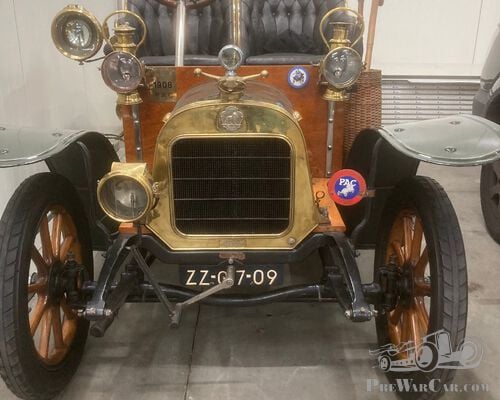
The first Simplex car was a belt-driven vis-à-vis made on Benz-lines, but by 1902 a new model Simplex car was introduced with a vertical single-cylinder Fafnir engine mounted at the front, wheel steering and single chain drive. Shaft drive came in soon on the Simplex car afterwards, and 1907 an 8hp 2-cylinder and 14/16hp 4-cylinder Simplex car were made. The largest model Simplex car was the 35hp 4-cylinder model of 1911, still with Fafnir engine. A considerable number of the smaller Simplex cars were sent, partly knocked down, to the Nederlands East Indies, and assembled there. Production of Simplex cars ceased with World War 1, and although a prototype 3-wheeler Simplex car with 10hp V-twin engine was shown in 1919, this Simplex car never went into production.
US, 1907 – 1917
Simplex Automobile Co Inc, New Brunswick, N.J.
After the 1907 bankruptcy of Smith & Mabley, the firm was taken over by Herman Broesel, who formed the Simplex Automobile Company. The best-known model of the new Simplex car company was the 50hp Simplex car, a massive chain-driven car of high quality whose 4-cylinder T-head engine had a capacity of 10 litres. The chassis price of the Simplex car was $4.500 and bodies were made for Simplex under contract by such firms as Quimby, Demarest, Holbrook and Brewster. In 1908 a stripped down version Simplex car won the 24 hour race at Brighton Beach, and famous drivers who drove for Simplex cars included George Robertson, Al Poole and Joe Tracy. The Simplex cars were designed by Edward Franquist who introduced a 38hp 7.8-litre shaft-drive model in 1911, and a 75hp 10-litre chain-drive roadster in 1912. By 1914 this Simplex car was the only chain-driven model in the range, and this Simplex car was said to be the last chain-driven American car. Some of these Simplex cars had a sharply-pointed V-radiator, although most Simplex cars used a flat, Mercedes-type radiator.
The 1914 Simplex car range consisted of the 38hp, 50hp and 75hp fours, and a 50hp six, but towards the end of that year a new Simplex car appeared with heralded a complete change in the Simplex car company. This was the 46hp L-head Simplex Crane Model 5, designed by Henry M. Crane who had replaced Franquist as chief designer of the Simplex cars after a company reorganization. The new Simplex car was a very high quality machine and carried beautiful coachwork, mainly by Brewster, but it lacked the sporting qualities of ìt predecessor. The Simplex car was made until 1917, and bodies were still being fitted to Crane chassis in 1921. By this time the Simplex car company had been bought by Hare’s Motors, and a re-organized company, the Crane-Simplex Company of New-York, made a few cars in 1923 and 1924.
France, 1920
The French Simplex car was quite a large open tourer with a bullnose radiator, but underneath the bonnet of the Simplex car there was a horizontal single-cylinder engine of 735cc. A special balance weight coupled to the connecting rod and to an eccentric was supposed to avoid vibration. Front wheel brakes were fitted on the Simplex car.
Source: Georgano, encyclopedia of motorcar; GNG
The information is written with the greatest of care. However, if you have any suggested amendments please contact us at office@prewarcar.com


Featured
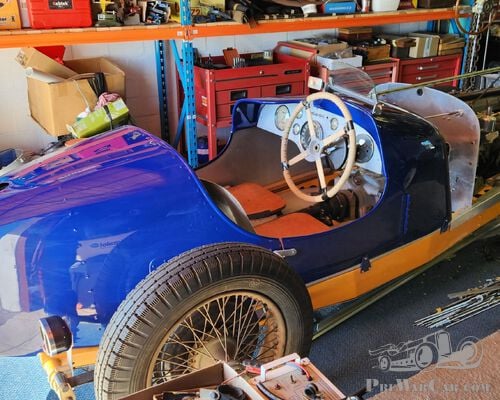
Riley TT Sprite
1935 6-cylinder TT Sprite replica. Chassis # 46A2722. Engine # 6A2722. Original Ulster Imp body. Restoration nearing completion. Engine, Ge..
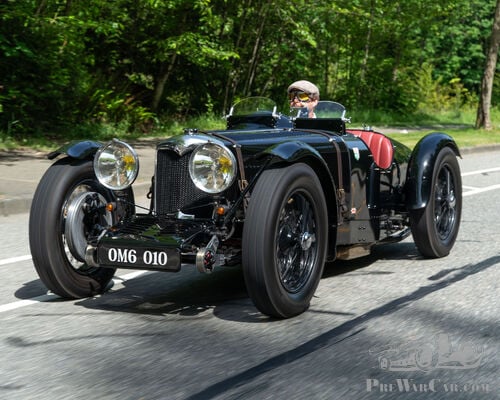
Riley 14/6 Special 1933
The ExperienceStep into the golden age of British motoring. This 1933 Riley 14/6 Special is a masterclass in pre-w..