The global magazine and marketplace for classic car enthusiasts, by enthusiasts.


Filter
Classic Austin, Duesenberg for sale - Austin, Duesenberg cars for sale
-

1927 Austin Seven | Brightwells | Auction Ends: Wed 05th Aug
Currently owned from March 1997; history file included in the sale; invoices showing some of the work carried out First registered in August 1927, this charming Austin Seven Tourer is powered by the iconic 747cc engine and is offered with just two former keepers recorded on the current V5C. The current vendor has cherished t.. -
1927 Austin Seven Chummy | Brightwells | Auction Ends: Wed 05th Aug
VSCC Eligibility Document; imported from New Zealand; registration paperwork and a selection of invoices relating to maintenance and upkeep; a number of thoughtful upgrades and improvements that enhance its usability while remaining sympathetic to its vintage character Few cars embody the charm and simplicity of vintage moto.. -
1937 Austin 7 Ruby | Brightwells | Auction Ends: Wed 05th Aug
Invoices present showing some of the work carried out over the years; The odometer currently displays 36,391 miles, although this figure cannot be warranted due to the age of the vehicle First registered in July 1937, this charming Austin Seven Ruby is a delightful example of one of Britain's most iconic pre-war motor cars. .. -
Open to Offers! Duesenberg Model J Dual Cowl Phaeton coachwork built in the style of LaGrande with Engine J-241
Open to Offers! Duesenberg Model J Dual Cowl Phaeton coachwork built in the style of LaGrande with Engine J-241 Not complete - Great Restoration project -
Austin 7 Swallow Saloon
The company co-founded by William Walmsley and William Lyons in 1922, which traded under the name Swallow Sidecar Company, progressively developed into a coachbuilder following its start making stylish sidecars for motorcycles. In May 1927, Swallow announced that it would make a 2-seater body to fit the Austin 7 chassis and running gear. The result.. -
Austin 7 Swallow Open Two-Seater
The company co-founded by William Walmsley and William Lyons in 1922, which traded under the name Swallow Sidecar Company, progressively developed into a coachbuilder following its start making stylish sidecars for motorcycles. In May 1927, Swallow announced that it would make a 2-seater body to fit the Austin 7 chassis and running gear. The res.. -
Austin Seven RP Saloon 1934 / in good condition
Austin Seven RP Saloon 1934 Company / History The Austin Seven was introduced to the public in 1922. Sir Herbert Austin, later known as Lord Austin, was responsible for the original design of the Seven. Much of the detailed engineering and development work was carried out by Stanley Edge, who became one of the key fig.. -
1931 Duesenberg Model J convertible sedan
Vehicle Highlights Chassis No. 2479Engine No. J 464ACD Category One Certified Original CarOne-Off CoachworkCCCA National First, Senior And Premier Award WinnerKnown Ownership History from New Vehicle DescriptionThis legendary Model J, with Chassis No. 2479.. -
1931 Duesenberg Model J Tourster by Derham | RM Sotheby's | The Monterey Auction
To Be OFFERED AT AUCTION at RM Sothebys' The Monterey Auction event, 13 - 15 August 2026. $2,250,000 - $3,250,000 USD One of the eight original, authentic Derham TourstersOriginal chassis, firewall, engine, and coachworkFormerly owned by Dr. Irwin Ginsberg, Andy Granatelli, and Joseph and Margie CassiniMeticulo.. -
1922 Duesenberg Model A Phaeton by Millspaugh & Irish For Sale
1922 Duesenberg Model A Phaeton by Millspaugh & Irish Chassis number: 798 Registration Number: Not currently registered. Engine Number 1111 Concours condition. This car when launched was a true standout. It was the very first seria..


Austin
US, 1901 – 1921
Austin Automobile Co, Grand Rapids, Mich.
The early American Austin was known as The Highway King. Despite an output of 50 or less units per year, it was something of a pioneer in a number of ways. The 1902 2-cylinder Austin models were much larger than most contemporary makes and for several years, although colours were optional, most of these big Austin cars for sale were painted either white with tan trim or light brown. By 1911, the Austin cars were equipped with electric lights and left-hand steering. Two years later, Austins featured a highly successful two-speed axle, with wheel-base up to 11ft 10in. After 1915, this Austin company attempted to market smaller and cheaper cars and also introduced a 12-cylinder model in 1917 which was produced until the firm ceased operations. About 1000 cars were made altogether.
GB, 1906 to date
(1) Austin-Motor Co Ltd, Longbridge, Birmingham, 1906 – 1970
(2) Austin-Morris Division, British Leyland Motor Corporation Ltd, Longbridge, Birmingham, 1970 to date
Herbert Austin resigned from the general managership of Wolseley in 1905, and formed his own company: Austin-Motor Co Ltd. Austin did not, however, pursue the development of the horizontal engine, but switched to more conventional designs using sv in-line units with T-heads, separately-cast cylinders and chain drive, first supplemented and then supplanted by shaft-driven cars. Most Austins of the pre-1914 period, were fours, though sixes were marketed from 1908 to 1913, the Austin 60hp being a really big machine of 9.7 litres’ capacity. There was also an Austin 1100cc single for sale in the 1909-1911 period, but this was really a Swift distinguishable only from the Coventry company’s version by its radiator. In 1909 Austin marketed a 15hp 4-cylinder town carriage with cab-over-engine layout at £475; at this time they were also making Gladiators for the British market. In 1910 a 1.6-litre 4-cylinder Austin Ten was made for export only, being introduced to the home market the following year. In 1914, when Austin became a public company, three 4-cylinder Austin models were listed, the largest, a Austin 30 of nearly 6-litres’ capacity, having electric lighting and starting.
After World War 1, Austin tried a one-model policy with a 3.6-litre Monobloc sv 4-cylinder Austin Twenty; the price had to be raised from £495 to £695 during the first year of production, which landed Austin in the hands of the official receiver, though the Austin Twenty car proved a great success and was made and for sale until 1929. Despite financial troubles, however, the Austin company came up in 1921 with their second great vintage design, the 1661cc Austin Twelve, one of the hardest-wearing machines of all time.
Enlarged to 1.9-litres in 1927, it remained in the Austin-catalogue, always with magneto ignition, right up to 1936, and survived in production as a taxicab into the 1940s. Finally, 1922 saw the Austin Seven for sale, one of the greatest of all baby cars; it gave 13bhp from 747cc, killed the cyclecar and boasted 4-wheel brakes, though these were not coupled until late 1930. The pedal worked the front ones and the lever the rear. By 1929, an Austin Seven supercharged sports version had 32bhp, still with a 2-bearing crankshaft; the 3-bearing crankshaft came out with the 1937 Austin Seven models. The Seven was extensively raced by the Austin works; among its countless successes were a third place in the 1929 TT, and a win in the 1930 B.R.D.C. 500-Mile Race at Brooklands. Its descendants were legion; the Austin Seven was made in Germany by Dixi and their successors BMW; In France by Rosengart, In Japan by Datsun and in the USA by the American Austin Co. Even after production ceased at Longbridge at the end of 1938, manufacture of the engine was taken over by Reliant and continued up to 1962.
6-cylinder Austin cars reappeared in the range in 1927 with a 3.4-litre Austin Twenty for sale, usually found with limousine bodywork, followed by a 2 ¼-litre coil-ignition Austin Sixteen for sale in 1928. A less successful 1 ½-litre Austin Six was introduced in 1931, but Austin found another winner in the 1.1-litre Austin Ten for sale in 1932, which was made until 1947. In 1934 the company offered a choice of over 50 models – the Austin Seven, the Austin Ten, a 1 ½-litre Light Austin 12/4, the old Austin Twelve and five Austin Sixes from 1496cc to 3400cc – not to mention semisports versions of some of the smaller Austin cars. Synchromesh was now standard, with the option of the American Hayes automatic gearbox on 16 and 18hp models only. In 1936 the Austin company sponsored a team of three short-stroke twin ohc 750cc supercharged Austin racing cars designed by Murray Jamieson, which had nothing in common with the ordinary Seven except for the transverse-leaf front suspension. Their engines developed 116bhp at 9000rpm and they were raced until the outbreak of World War 2.
Austin styling received a face-lift in 1937, and again in 1939 when alligator bonnets came in with the 900cc 8hp which replaced the Austin Seven, but the image remained the same – solid and well-furnished cars of great durability appealing to the more conservative type of owner. Girling mechanical brakes were used. The first sign of a more progressive attitude came in 1945, when a 2.2-litre ohv 4-cylinder Austin Sixteen came out using the chassis and body of the 1940 Austin Twelve; this proved quite as durable as the famous Austins of the 1920s, and the engine was still being used in taxis and the 4x4 Gipsy in 1967. Coil and wishbone independent front suspension appeared in 1947 on the luxurious and traditionally-styled ohv 4-litre 6-cylinder Austin Sheerline and Austin Princess, and these were followed by the 1.2-litre Austin A40 Dorset and Austin Devon saloons with overhead valves and independently sprung at the front, which did well in America and helped Austin to sell over 85.000 cars in 1928. A further bid for dollar exports came with the big 4-cylinder Austin A90 power-top convertible – successful long-distance record work at Indianapolis failed to attract many buyers, though the engine had a long run in the first Austin-Healeys.
Austin merged with Morris to form the British Motor Corporation in 1952, when there appeared their first unitary-construction car, the 803cc Austin A30. The Healey sports car came under Austin’s aegis that year, and in 1954 Austin-Healeyy started to make the little Metropolitan coupés and convertibles for Nash. In style these were Nash Airflytes in miniature, with 3-speed gearboxes. They were powered initially by the Austin A40 engine and later by the 1 ½-litre Austin A50. Production continued until 1961. From 1955 onwards all Austins save the 4-litre models had unitary construction, new models that year being the Austin Cambridge with A40 and A50 engines, and the 2.6-litre 6-cylinder Austin Westminster. The big Austin Princess saloon went over to automatic transmission in 1957, and these Vanden Plas-bodied models subsequently (in 1960) became a make in their own right, under the name of Vanden Plas Princess. In 1959 the 948cc Austin A40 appeared with Farina styling; this was later made in Italy under licence by Innocenti and pave the way to a rationalized range of 1½-litre saloons in the Farina idiom, made in Morris, MG, Wolsely, and Riley forms as well as the basic Austin Cambridge.
1960 saw a new Austin Seven, the first of Alec Issigonis’s Minis, which Morris sold as the Mini-Minor. It had a 848cc ohv 4-cylinder engine mounted transversely and driving the front wheels, the 4-speed gearbox lived in the sump, all wheels were independently sprung by rubber in torsion, and it had an unmistakable box-like silhouette. The name Mini was soon applied to all versions, Austin as well as Morris, and the car not only became a best-seller, but distinguished itself in competition as well, with numerous rally wins to its credit. Mini-Cooper versions joined the range in 1962, the hottest standard version in 1968 being the 1.275cc Cooper S with 76bhp and front disc brakes; later developments include a 4x4 Mini-Moke for off-the-road travel. Logical developments were the 4-door 1100 saloon with interlinked Hydrolastic suspension (introduced as a Morris in 1963, with an Austin version listed in 1964), and the bigger 1800 of 1965. Minis acquired Hydrolastic suspension in 1965, and all the smaller fwd cars were available with an automatic gearbox in 1967. Both the Mini and the 1100 are made for the Italian market by Innocenti.
Improvements in 1968 included all-synchromesh gearboxes for Minis and an alternative 1275cc engine for the 1100. A special ‘federalized’ version of this Austin 1300, the 2-door Austin America with automatic transmission, went on sale in the USA. At the same time the 6-cylinder A110 gave way to a new 3-litre, combining the Austin 1800’s hull design and Hydrolastic suspension with the existing engine and conventional rear-wheel drive. This one, however, coincided with the merger of B.M.C and Leyland interests in January 1968; it was slow into production, never caught on, and was discontinued in 1971. Later in the year came Mk II versions of the Austin 1800 with 86bhp engines and optional power steering, made as Morrises and Wolseley as well as Austins. An A60 replacement came in 1969; the 1½-litre Maxi in the Issigonis tradition with fwd and transverse engine. New were the 5-bearing engine with chain-driven ohc, the 5-speed all-synchromesh gearbox, and the 5-door semi-estate car body; by 1971 it had acquired a more satisfactory rod-operated gearchange and the option of a 1748cc power unit.
In 1970 rationalization led to the replacement of the MG 1300 by the Austin 1300GT, and that August the former Austin and Nuffield elements in the British Leyland empire (Austin, MG, Morris, Vanden Plas and Wolseley) were merged to form the Austin-Morris devision. Already at the 1969 Earls Court Show the Mini had been made a marque in its own right, and by early 1971 basic versions of the 1100/ 1300 theme were sold as Austins only, Morris variants being dropped. The 3-litre six’s replacement appeared in 1972. This ADO 17 was based on the C6 already announced by British Leyland’s Australian branch, and was in essence an enlarged Maxi on which the transversely-mounted ohc 2.227cc engine drove the front wheels. Basic price was £1.246. With the 1100/1300, the Maxi and the 1800 making up the 1973 range, Austin now offered only fwd cars, a far cry from the conservatism of pre-World War 2 days. Automatic and high-performance variants were also added in 1973.
Source: Georgano, encyclopedia of motorcar; KM, MCS
The information is written with the greatest of care. However, if you have any suggested amendments please contact us at office@prewarcar.com
Duesenberg
US, 1920 – 1937, 1966
(1) Duesenberg Motor Co, Indianapolis, Ind., 1920 – 1937
(2) Duesenberg Corporation, Indianapolis, Ind., 1966
Fred Duesenberg began by making bicycles and designed his first Duesenberg car, the Mason, in 1904. He and his brother August made engines with horizontal overhead valves for the 1912 Mason racing cars, and founded Duesenberg Motors in the following year in order to produce marine engines and complete racing cars bearing the Duesenberg name. The most famous of the latter appeared in 1920: a 3-litre Bugatti-inspired Duesenberg straight-8 with single overhead camshaft and three (vertical) valves per cylinder. This Duesenberg won the 1921 French Grand Grand Prix. In the 1920s the Duesenberg racing cars were the great rivals of the Millers at Indianapolis, and victory was assured in 1924 by the adoption of a centrifugal blower on Duesenberg cars. Though a two-stroke 1½-litre 8-cylinder racing engine capable of 7.000rpm was made in 1926, this was not proceeded with. The horizontal-valve Duesenberg engine was taken over in 1920 by the Rochester Motor Manufacturing Co Inc and was used in various sporting and luxury cars.
Meanwhile, at the end of 1920, the first Duesenberg production car made its debut. This Duesenberg Model A was an extremely expensive, if very advanced, luxury car, embodying an 8-cylinder in-line engine – the first to be seen in an American production car – of 4.2 litres, basically similar to the Duesenberg racing unit, but with only two valves per cylinder and developing about 100bhp. There were also hydraulically-operated front wheel brakes – another ‘first’ as far as America was concerned. The Model A was current until 1926. A handful of its little-altered successor, the Duesenberg Model X, was made in 1926-1927, but in the former year E.L. Cord of Auburn acquired control of the Duesenberg company. He stipulated that Fred Duesenberg’s next car should be completely new, and a quite exceptional machine. In fact, the Duesenberg Model J, which made its bow at the end of 1928, was the most remarkable automobile in America: bigger, faster, more elaborate and more expensive than any other, yet also superior to them in refinement and good looks. Its 6.9-litre, 8-cylinder engine, made by Lycoming (a firm which Cord had also bought), had two chain-driven overhead camshafts operating four valves per cylinder; a layout of racing type unique among American cars at the time and said to develop 265bhp at 4250rpm – more than double the output of any rival. Although the complete Duesenberg car weighed more than 4980lb, it was claimed to be capable of 116mph in top gear and 89mph in second. Only Duesenberg Model J chassis were made for which $8500 was asked in 1929. Immensely long and strong and lowbuilt, Duesenberg cars were very popular with all the leading coachbuilders. The Duesenberg company preferred to sell cars complete with bodies designed by them but made by approved builders, such as Murphy, Bohman & Schwarts, Judkins, Derham and Le Baron. In this form, catalogued Duesenberg models cost up to $17.950. The transmission – apart form the double dry-plate clutch – was conventional, as was the suspension by half-elliptic springs and hydraulic shock absorbers. The brakes, of course, were hydraulic, with vacuum servo assistance from late 1929.
In 1932 a supercharged version of the Model J, the Duesenberg SJ, was added. To cope with the 320bhp now alleged to be available, bearings, reciprocating parts and valve springs were strengthened. Usually, the shortest Duesenberg J chassis was used, with the highest axle ratio and stronger front springs. A maximum speed of 129mph was attributed to the Duesenberg SJ, with an acceleration figure of 0-100mph in 17 seconds.
Duesenberg survived the Depression, but died in the collapse of the Cord Corporation in 1937. Attempts to revive the Duesenberg name were made in 1947 and in 1966. The first Duesenberg was unsuccessful, and in 1966 only one Duesenberg car was actually made, powered by a 7-litre V8 Chrysler engine with push-rod overhead valves, developing 431bhp at 5.000rpm. Transmission was automatic, front suspension was independent, and there were disc brakes. Body styling was by Ghia. This Duesenberg venture, too, collapsed.
Source: Georgano, encyclopedia of motorcar; TRN
The information is written with the greatest of care. However, if you have any suggested amendments please contact us at office@prewarcar.com


Featured
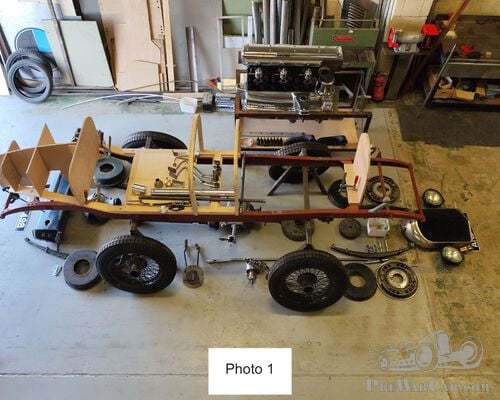
Bentley 3/6 litre sports racing car kit with V5C
I am a specialist vintage and classic car restorer with decades of hands-on experience. For some time I have been collecting parts for a special pr..
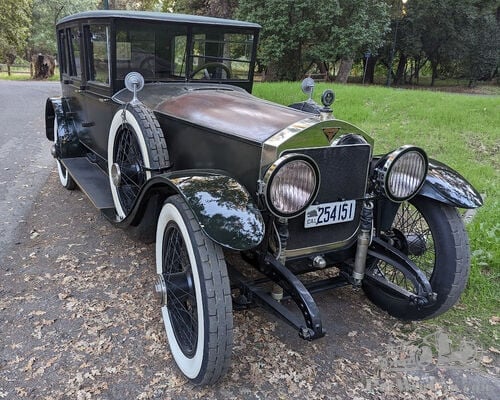
1916 Simplex, Crane model 5
1916 Simplex, Crane MODEL 5CUSTOM MADE HISTORIC PRESERVATION VEHICLE – READY TO TOUR!This Simplex recently completed th..
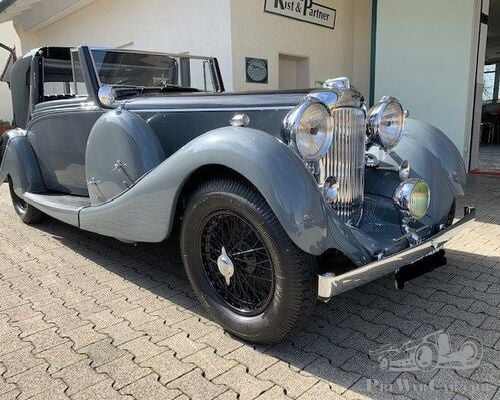
Lagonda LG 45 Coupe de Ville Sedanca by Mayfair
The successor to the M45, the LG45 was built around the same highly capable, competition-proven 4.5-litre Meadows inline-six engine, but featured r..