The global magazine and marketplace for classic car enthusiasts, by enthusiasts.


Filter
Classic Austro Daimler, Léon Bollee for sale - Austro Daimler, Léon Bollee cars for sale
-

Austro Daimler AD6 Restoration project
Austro Daimler AD6 open tourer restoration project. More details on application...Looking also for all spare parts of AD six cylinder 6-17 or ADV.

Austro-Daimler
Austria, 1899 – 1936
(1) Österreichische Daimler Motoren AG, Wiener-Neustadt, 1899 – 1934
(2) Steyr—Daimler-Puch AG, Wiener-Neustadt, 1934 – 1936
Austria’s most famous motor car, the Austro-Daimler, was born when Daimler of Cannstatt established a factory in Vienna for the manufacture of about 100 of its Daimler cars annually. The Austro-Daimler was a copy of its German parent. In 1906 the Austro-Daimler concern became a separate financial entity, and a year earlier, Ferdinand Porsche had replaced Paul Daimler at Wiener-Neustadt as director. A new era began, for Porsche was a designer with original ideas. He did not exercise them at once; the two 1909 Austro-Daimler models for sale were large well-made fours with side valves in a T-head and a choice of chain or live-axle drive. World-wide fame came to the Austro-Daimler company with their 1910 models, especially the Austro-Daimler 22/80ps model originally designed to win the Prince Henry Tour of that year. It accomplished this very convincingly. The five large valves per cylinder – one inlet, four exhaust – were actuated by a single overhead camshaft. A combination of well-shaped combustion chambers and light reciprocating parts made for an engine of an efficiency never before seen in a catalogued, non-racing car. Its 5.7-litres produced 95bhp. Even Porsche, however, felt that so much power could not be safely transmitted by a live axle, and chain drive was used initially. The Austro-Daimler 22/80’s small brother, the Austro-Daimler 16/18ps, had a side-valve L-head engine. After it had swept the board in the Austrian Alpine Tour of 1911, the Austro-Daimler 16/25ps Alpine variant was also for sale. In 1914 the range consisted of these three cars, the sv Austro-Daimler 20/30ps, and the luxurious Austro-Daimler 35/60ps also with side valves. Both Austro-Daimler and Daimler sold the Lohner-Porsche, the name given to the electric and petrol-electric cars designed by Porsche before he went to Wiener-Neustadt. The Vienna Austro-Daimler firm was Austria’s largest manufacturer of motorcars.
Immediately after World War 1 a few cars were assembled in Liège from pre-war Austro-Daimler parts by M. Klinkenhammers, and sold under the Alfa-Legia. On their home ground the company returned to high-grade fast tourers. As well as the old ‘Austro-Daimler 16/18’ and ‘Austro-Daimler 20/30’, they made the new Austro-Daimler AD617 for sale, a 6-cylinder car of 4.4-litres with a single overhead camshaft, that was succeeded in 1923 by its development, the Austro-Daimler ADV17/60ps for sale, which was the same but for its front wheel brakes. Four years earlier, Porsche had maintained his reputation for really exciting design by producing the Sascha-type Austro-Daimler, a 1100cc – later 1½-litre – racing voiturette. Its four cylinders, like the six of the Austro-Daimler AD617, were of aluminium, with detachable steel liners. There were two overhead camshafts, however, and dry sump lubrication. The power output was 50bhp. Four-wheel brakes were, of course, fitted.
Although Porsche left Vienna in 1923 to return to Daimler, he was mainly responsible for the new ADM type, which was offered alongside the Austro-Daimler ADV17/60 from that year. The Austro-Daimler ADM1 was basically similar, but had a smaller engine of 2½-litres, and its rounded radiator was a departure for the hitherto traditional Austro-Daimler V-shape. It was sold in sports from in 1925 as the Austro-Daimler ADMII. After 1926, the old Austro-Daimler ADV17/60 was dropped and the ADM engine was enlarged to three litres by increasing the bore. This Austro-Daimler ADMIII in sports form developed 100bhp at 400rpm, and could do more than 100mph. Porsche’s successor, Karl Rabe, designed the even more advanced ADR type. Its tubular backbone chassis and swing-axle independent rear suspension so resembled that of the Tatra that legal action was taken against Austro-Daimler. The Austro-Daimler ADR was available in sports or normal form. At first, the Austro-Daimler ADR used the old ADMIII engine, but the Austro-Daimler ADR6 Bergmeister of 1929, one of the most glamorous Austro-Daimler built, had a new 3.6-litre power unit providing 120bhp. This car was made until production ceased shortly after the Steyr-Daimler-Puch amalgamation in 1934. The Austro-Daimler ADR8, the firm’s first and last 8-cylinder car, designed for more formal bodies, had disappeared in 1933 after a life of three years.
Source: Georgano, encyclopedia of motorcar; TRN
The information is written with the greatest of care. However, if you have any suggested amendments please contact us at office@prewarcar.com
Léon Bollee
France, 1895 – 1933
(1) Automobiles Léon Bollée, Le Mans, 1895 – 1924
(2) Morris Motors Ltd, Usines Léon Bollée, Le Mans, 1925 – 1931
(3) Sté Nouvelle Léon Bollée, Le Mans, 1931 – 1933
Leon Bollee was a son of Amédée Bolllée père, the most important pioneer of steam road vehicles in France. Leon Bollee, however, turned to really small petrol Leon Bollee cars. He was the first to do so, and therefore had to invent a new name for his Leon Bollee car of 1895 – he called it a Leon Bollee voiturette. This Leon Bollee car was a tandem two-seater 3-wheeler that was faster than any other petrol-engined vehicle on the road when the Leon Bollee car was working, thanks to a powerful 3hp engine and light weight, but the power unit was unreliable on the Leon Bollee car. The Leon Bollee car had a single air-cooled cylinder of 650cc and used hot-tube ignition. There were 3 forward speeds on the Leon Bollee car, with belt final drive. The frame was tubular. Four years after the Leon Bollee voiturette appeared, Leon Bollee superseded it with a 4-wheeler with independent front suspension by double transverse leaf springs. This Leon Bollee car had a single-cylinder, water-cooled engine. Unlike the Leon Bollee voiturette, this Leon Bollee car made no mark. The design rights were sold to Darracq, and around 1901 the name of Leon Bollee cars vanished. Meanwhile, the term voiturette had been taken up by the trade and public in general as the name for a small light car.
The Leon Bollee car reappeared in 1903 as an entirely normal, full-sized car in the more expensive class, backed by Vanderbilt money and designed for the American market. This Leon Bollee car was made in 28hp (4.6-litres) and 45hp (8-litres) versions, with four cylinders and chain drive, and led on to a 11.9-litre six Leon Bollee car in 1907, in which year the first shaft driven Leon Bollee car appeared. From 1909 there was also a small modern four, the Leon Bollee 10/14hp. The 1910 range embraced 9 Leon Bollee cars, including 2 of over 10-litres capacity. Electric lighting became available on Leon Bollee cars in 1913, but the Leon Bollee grew increasingly old-fashioned after World War 1 despite the introduction of ohv in 1922 on Leon Bollee cars and front wheel brakes in 1923. Late in 1924 Sir William Morris bought the Le Mans Leon Bollee car factory. From making a wide range of conservative French Leon Bollee fours, it turned to thinly-disguised products of Cowley, Oxford, the idea being to breach the French tariff walls from the inside. The first Morris- Leon Bollee had a 12CV 2½-litre 4-cylinder unit-construction engine made by Hotchkiss, the engine manufacturers controlled by Morris, but it had push-rod overhead valves and bore little evidence of its parentage. Not so the 18CV Morris- Leon Bollee car of 1928. This was a 3-litre straight-8 with single overhead camshaft that reflected Morris’ takeover of Wolseley two years earlier. Morris’ own new six of 1928 was mirrored in the 15CV 2.6-litre Le Mans product of 1929. The bodies for the Morris- Leon Bollee car were all made in France and were usually considerably more dashing and attractive than their British counterparts. Chassis of this Morris- Leon Bollee car were made in France, and all cars had a 4-speed gearbox. At one time, 50 12CV Morris- Leon Bollee cars were being turned out each week. However, Morris’ enterprise was not a success, and he discontinued it in the hard times of the Depression. A new syndicate was formed in September 1931 to sell the same range of cars under the name of Leon Bollee cars. This lasted for less than two years and few Leon Bollee cars were made.
Source: Georgano, encyclopedia of motorcar; TRN
The information is written with the greatest of care. However, if you have any suggested amendments please contact us at office@prewarcar.com


Featured
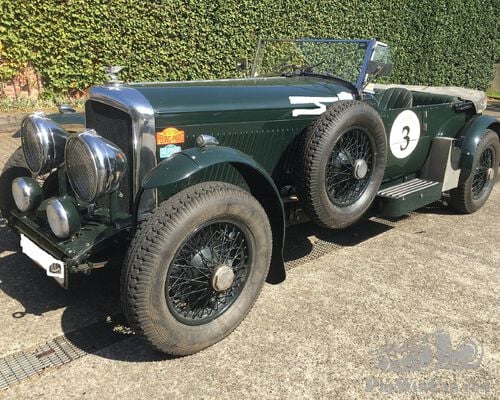
Bentley Derby Special Open Rally Car
This Bentley Derby, manufactured in 1935, has been rebuilt into a short and long-distance rally car. Full rebuilt engine in 2021, Since 2021 low mi..
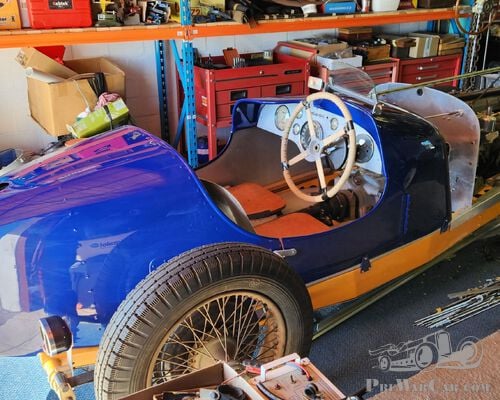
Riley TT Sprite
1935 6-cylinder TT Sprite replica. Chassis # 46A2722. Engine # 6A2722. Original Ulster Imp body. Restoration nearing completion. Engine, Ge..
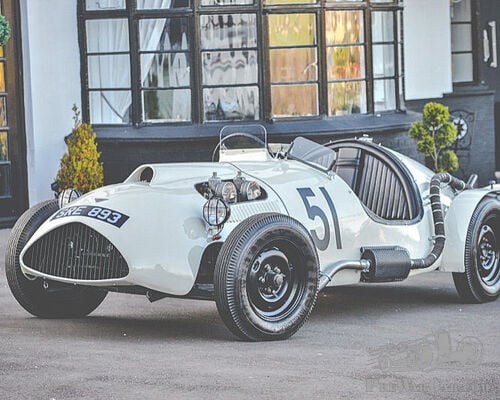
1933 Alvis 3.0 Special - One-Off Alloy Body | Period Competition Car | Featured in “Alvis – A Century of Drivers”
1933 Alvis 3. 0 Special - One-Off Alloy-Body | Period Competition Car | Featured in “Alvis – A Century of Drivers”