The global magazine and marketplace for classic car enthusiasts, by enthusiasts.


Filter
Classic Bean, Du Pont for sale - Bean, Du Pont cars for sale
-

1925 Bean 14HP Tourer | Brightwells | Auction Ends: Wed 24th Jun
Bean 14 HP Tourer; Member of the Bean Car Club; 1,701cc engine; converted to 12 volts; showing just 5 owners in totalUp for auction is a 1925 Bean 14HP, a true vintage vehicle and a rare piece of British automotive history. This delightful beige example, currently owned since August 2024, has had five former keepers and boasts a 1,.. -
1924 Bean 12hp four-seat tourer | The Ernie Warren Collection Auction | 13th June 2026
A 1924 Bean 12hp four-seat tourer.Reg No. YA 9847.Car No. 22844.Engine No. 2324.Blue with black interior.Bean cars were manufactured by A Harper & Sons & Bean, in Dudley, Worcs, between 1919 and 1930. The 12hp model was added to the range in 1924.This example, originally painted wh.. -
1929 Du Pont Model G Two-Passenger Speedster by Merrimac | RM Sotheby's | The Monterey Auction
To Be OFFERED AT AUCTION at RM Sothebys' The Monterey Auction event, 13 - 15 August 2026. $800,000 - $1,200,000 USD One of the most beautiful American automobiles of its generationThe 1929 New York International Automobile Show display carOne of three two-passenger “taper tail” models with an external spareOne .. -
Circa 1928 Bean 14 hp rolling chassis
Circa 1928 Bean 14 hp rolling chassis for sale. This would be an ideal project to build a special sporty body on . Look at the large frontwheel brakes a la Delage and more powerful engine. Not many of these 14hp Beans are around . The price includes all shipping costs to Europe and the import vat . £ 8500.


Bean
GB, 1919 – 1929
(1) A. Harper, Sons & Bean Ltd, Tipton, Dudley, Worcs., 1919 – 1926
(2) Bean Cars Ltd, Tipton, Dudley, Staffs., 1926 – 1929
The Bean was a remodeling of the Perry light car, whose manufacturers were taken over by Harper Sons & Bean, motor components makers, after World War 1. The Bean was to be mass-produced, in one 11.9hp model only. Its makers were members of a consortium of firms, including the famous, old-established names of Swift and Vulcan, Hadfields, the engineers of Sheffield, Gallay Radiators and Marles Steering, that was intended to achieve efficient quantity production by rationalization of parts. In fact, Bean carried cost cutting too far with this car. Its 4-cylinder, side-valve 1794cc engine was rough, the gear change difficult and the suspension harsh. The Bean four-seater open body cost only £80. However, 1922 customers were car-starved and undiscriminating, and 80 Bean cars a week were made that year, even if the first target of 50.000 Beam cars per annum remained a dream. The bigger, 2.3-litre Bean Fourteen introduced for 1924 was more modern machine, with its unit construction of engine and gearbox.
Hadfields took over Bean early in 1926. For 1927, the Bean company followed fashion by introducing a six, the ‘Bean 18/50’. Its 2.7-litre, overhead-valve engine was made by Meadows, and a rather square radiator replaced the well-known rounded Bean shape. Also new in 1927 was the Bean Imperial Six, the first Bean designed specifically for export. Unlike the Bean 18/50 for sale this had a Bean-built engine of 3.8-litres with a Ricardo cylinder head. The Australian explorer Francis Birtles drove a disintegrating Bean prototype from England to India, and in fact the Bean Imperial Six was never put into production. From 1927 all cars were called Hadfield-Beans. The 2.3-litre 14/40 Hadfield-Bean, which joined the range in 1928, was no better, with its unreliable engine and overhead-worm drive rear axle, bad brakes and difficult clutch- and gear-change. It was also old-fashioned in that it used a fairly large, long-stroke, side-valve 4-cylinder engine. The latter was economical, and the 14/40 Hadfield-Bean for sale was cheap, but cost cutting presumably dictated the fitting of quarter-elliptic rear springs, which cannot have improved comfort. There was a Bean 14/70hp sports version, which had better brakes, with Dewandre vacuum servo assistance, but the only good car in the range, the old Hadfield-Bean Fourteen for sale, was desperately out-dated and no Hadfield-Beans at all were made after 1929.
Source: Georgano, encyclopedia of motorcar; TRN
The information is written with the greatest of care. However, if you have any suggested amendments please contact us at office@prewarcar.com
Du Pont
US, 1920 – 1932
(1) Du Pont Motors Inc, Wilmington, Del., 1920 – 1923
(2) Du Pont Motors Inc, Moore, Pa., 1923 – 1932
E. Paul du Pont’s company built quality cars in limited numbers, total production being 537 vehicles of all Du Pont types. First of the line was a Du Pont 4.1-litre sv four with their own engine, selling for $2.600, but this gave way to proprietary-engined sixes, initially powered by Herschell-Spillman. The 1925 Du Pont Model D had a 6-cylinder 5-litre Wisconsin engine with overhead valves that developed 75bhp, a constant-mesh gearbox, and Lockheed hydraulic brakes to all four wheels. Its successor, the Du Pont Model E, could be had with a supercharger, but the best-known, and best, Du Pont was the Du Pont Model G speedster introduced in 1928. With its narrow straight wings copied from the Amilcar, Woodlite headlamps and grille concealing the radiator, the last a pioneering feature, the Du Pont Model G was not a good-looking car, but it was a very effective one. Like all the DuPont speedsters it had four forward speeds. The 5.3-litre, sv straight-8 engine, by Continental, gave 114bhp at 3600rpm with catalogued modifications. With the latter, 100mph was guaranteed. In the 1929 Le Mans 24 Hours race the Du Pont Model G proved itself faster than the other American entries, Stutz and Chrysler. Touring bodywork was, of course, available on the Du Pont car, and in 1931 came the long wheelbase (12ft 2 in) Du Pont Model H, built in a Stearns Knight frame. The later Du Pont cars were assembled in the Indian motorcycle factory at Springfield, after E. Paul du Pont had acquired this concern.
Source: Georgano, encyclopedia of motorcar; TRN
The information is written with the greatest of care. However, if you have any suggested amendments please contact us at office@prewarcar.com


Featured
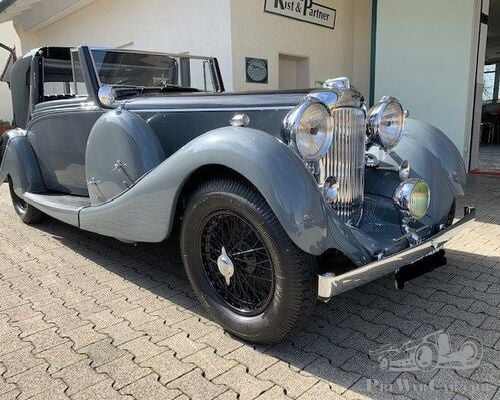
Lagonda LG 45 Coupe de Ville Sedanca by Mayfair
The successor to the M45, the LG45 was built around the same highly capable, competition-proven 4.5-litre Meadows inline-six engine, but featured r..
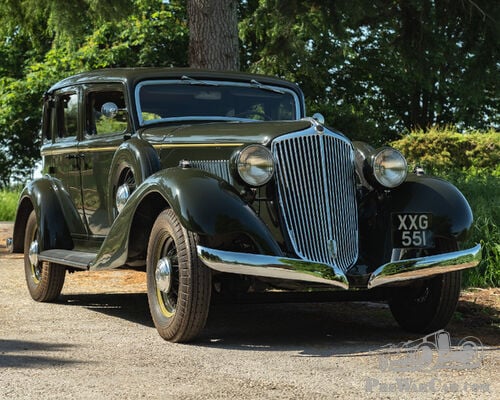
Graham Model 64 Standard Eight 'Blue Streak'
UK Registration No: XXG 551Chassis No: 1801069MOT: ExemptH&H ClassicsKelham Hall | Newark, Nottinghamshire
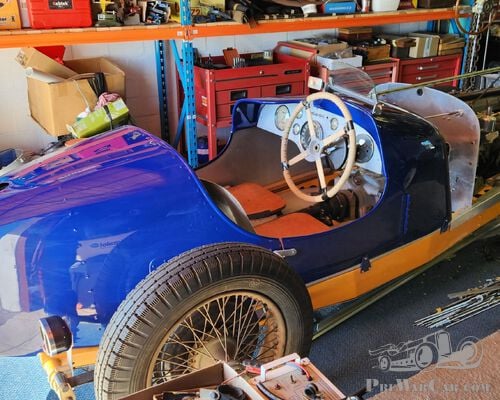
Riley TT Sprite
1935 6-cylinder TT Sprite replica. Chassis # 46A2722. Engine # 6A2722. Original Ulster Imp body. Restoration nearing completion. Engine, G..