The global magazine and marketplace for classic car enthusiasts, by enthusiasts.


Filter
Classic Bean, Rauch & Lang for sale - Bean, Rauch & Lang cars for sale
-

1918 Rauch & Lang Model B26 Brougham | RM Sotheby's | The Hershey Auction
To Be OFFERED AT AUCTION at RM Sothebys' The Hershey Auction event, 7 - 8 October 2026. $150,000 - $175,000 USD One of the finest surviving examples of the Rauch & Lang electric carBeautiful show-quality, AACA First Junior-winning restorationKnown history, with only three long-term caretakers since the 1950s -
Circa 1928 Bean 14 hp rolling chassis
Circa 1928 Bean 14 hp rolling chassis for sale. This would be an ideal project to build a special sporty body on . Look at the large frontwheel brakes a la Delage and more powerful engine. Not many of these 14hp Beans are around . The price includes all shipping costs to Europe and the import vat . £ 8500.


Bean
GB, 1919 – 1929
(1) A. Harper, Sons & Bean Ltd, Tipton, Dudley, Worcs., 1919 – 1926
(2) Bean Cars Ltd, Tipton, Dudley, Staffs., 1926 – 1929
The Bean was a remodeling of the Perry light car, whose manufacturers were taken over by Harper Sons & Bean, motor components makers, after World War 1. The Bean was to be mass-produced, in one 11.9hp model only. Its makers were members of a consortium of firms, including the famous, old-established names of Swift and Vulcan, Hadfields, the engineers of Sheffield, Gallay Radiators and Marles Steering, that was intended to achieve efficient quantity production by rationalization of parts. In fact, Bean carried cost cutting too far with this car. Its 4-cylinder, side-valve 1794cc engine was rough, the gear change difficult and the suspension harsh. The Bean four-seater open body cost only £80. However, 1922 customers were car-starved and undiscriminating, and 80 Bean cars a week were made that year, even if the first target of 50.000 Beam cars per annum remained a dream. The bigger, 2.3-litre Bean Fourteen introduced for 1924 was more modern machine, with its unit construction of engine and gearbox.
Hadfields took over Bean early in 1926. For 1927, the Bean company followed fashion by introducing a six, the ‘Bean 18/50’. Its 2.7-litre, overhead-valve engine was made by Meadows, and a rather square radiator replaced the well-known rounded Bean shape. Also new in 1927 was the Bean Imperial Six, the first Bean designed specifically for export. Unlike the Bean 18/50 for sale this had a Bean-built engine of 3.8-litres with a Ricardo cylinder head. The Australian explorer Francis Birtles drove a disintegrating Bean prototype from England to India, and in fact the Bean Imperial Six was never put into production. From 1927 all cars were called Hadfield-Beans. The 2.3-litre 14/40 Hadfield-Bean, which joined the range in 1928, was no better, with its unreliable engine and overhead-worm drive rear axle, bad brakes and difficult clutch- and gear-change. It was also old-fashioned in that it used a fairly large, long-stroke, side-valve 4-cylinder engine. The latter was economical, and the 14/40 Hadfield-Bean for sale was cheap, but cost cutting presumably dictated the fitting of quarter-elliptic rear springs, which cannot have improved comfort. There was a Bean 14/70hp sports version, which had better brakes, with Dewandre vacuum servo assistance, but the only good car in the range, the old Hadfield-Bean Fourteen for sale, was desperately out-dated and no Hadfield-Beans at all were made after 1929.
Source: Georgano, encyclopedia of motorcar; TRN
The information is written with the greatest of care. However, if you have any suggested amendments please contact us at office@prewarcar.com
Rauch & Lang
US, 1905 – 1928
(1) Rauch & Lang Carriage Co, Cleveland, Ohio, 1905 – 1916
(2) Baker, Rauch & Lang Co, Cleveland, Ohio, 1916 – 1922
(3) Rauch & Lang Electric Car Manufacturing Co, Chicopee Falls, Mass., 1922 – 1928
Rauch & Lang were an old-established carriage building firm (founded 1853) when they began to make electric Rauch & Lang cars in 1905. These Rauch & Lang cars followed the usual pattern for such electric vehicles, being mainly closed town cars, although a few open phaeton Rauch & Lang cars were also made. The biggest Rauch & Lang cars were heavier vehicles and included a six-seater limousine with separate outside seat for the chauffeur. Some Rauch & Lang cars had 4-doors, a very unusual feature in electric cars. In 1916 the Rauch & Lang cars became part of the Baker, Rauch & Lane group and production declined. From 1919 onwards the Rauch & Lang cars were sometimes listed as Raulangs, and from 1922 this became the official name of the Rauch & Lang cars.
By this time production of Rauch & Lang cars had been transferred to the Stevens-Duryea factory at Chicopee Falls where the number of private cars made was very small. The factory, which was still turning out a few Stevens-Duryeas, also made petrol and electric taxi-cabs under the name Rauch & Lang cars, and bodies for Stanley Steamers.
Source: Georgano, encyclopedia of motorcar; GNG
The information is written with the greatest of care. However, if you have any suggested amendments please contact us at office@prewarcar.com


Featured
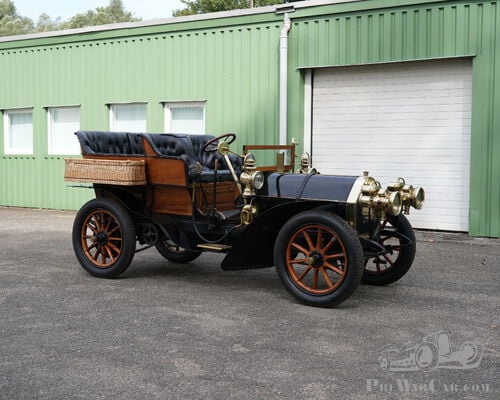
1904 Aster 16/20 HP Four-Cylinder Five-Seat Rear-Entrance Tonneau
Powerful four-cylinder engineFour-speed gearboxChain driveFive seatsMore than €100,000 recently invested
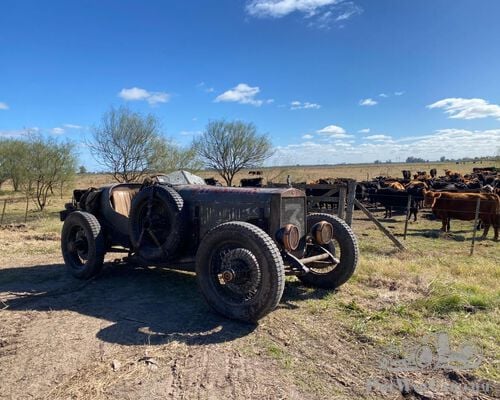
Studebaker 1927 for sale
Authentic race car of the time - Everything is working - All parts of its original mechanics - I have the history of the car - 6 cylinders - Ready ..
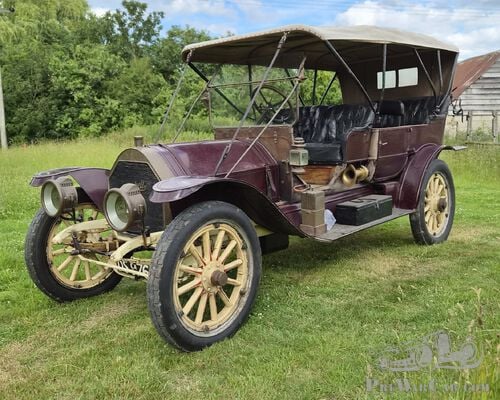
1910 Mitchell Model S - 50HP Six Cylinder
Based in Racine, Wisconsin and being the largest wagon manufacturer in the USA, Mitchell-Lewis produced their first motor car in 1903. Sales grew ..