The global magazine and marketplace for classic car enthusiasts, by enthusiasts.


Filter
Classic Bean, Stoewer for sale - Bean, Stoewer cars for sale
-

1925 Bean 14HP Tourer | Brightwells | Auction Ends: Wed 24th Jun
Bean 14 HP Tourer; Member of the Bean Car Club; 1,701cc engine; converted to 12 volts; showing just 5 owners in totalUp for auction is a 1925 Bean 14HP, a true vintage vehicle and a rare piece of British automotive history. This delightful beige example, currently owned since August 2024, has had five former keepers and boasts a 1,.. -
1924 Stoewer type D3 roadster
Rare opportunity to buy a vintage 1924 Stoewer type D3 roadster in fully restored condition. More than € 50K were spent in 2018 and 2019 on its restoration . Detailed work invoices come with the car. A video can be sent on request . Price € 64000 ex Eibergen Netherlands imported EEC. -
Circa 1928 Bean 14 hp rolling chassis
Circa 1928 Bean 14 hp rolling chassis for sale. This would be an ideal project to build a special sporty body on . Look at the large frontwheel brakes a la Delage and more powerful engine. Not many of these 14hp Beans are around . The price includes all shipping costs to Europe and the import vat . £ 8500.


Bean
GB, 1919 – 1929
(1) A. Harper, Sons & Bean Ltd, Tipton, Dudley, Worcs., 1919 – 1926
(2) Bean Cars Ltd, Tipton, Dudley, Staffs., 1926 – 1929
The Bean was a remodeling of the Perry light car, whose manufacturers were taken over by Harper Sons & Bean, motor components makers, after World War 1. The Bean was to be mass-produced, in one 11.9hp model only. Its makers were members of a consortium of firms, including the famous, old-established names of Swift and Vulcan, Hadfields, the engineers of Sheffield, Gallay Radiators and Marles Steering, that was intended to achieve efficient quantity production by rationalization of parts. In fact, Bean carried cost cutting too far with this car. Its 4-cylinder, side-valve 1794cc engine was rough, the gear change difficult and the suspension harsh. The Bean four-seater open body cost only £80. However, 1922 customers were car-starved and undiscriminating, and 80 Bean cars a week were made that year, even if the first target of 50.000 Beam cars per annum remained a dream. The bigger, 2.3-litre Bean Fourteen introduced for 1924 was more modern machine, with its unit construction of engine and gearbox.
Hadfields took over Bean early in 1926. For 1927, the Bean company followed fashion by introducing a six, the ‘Bean 18/50’. Its 2.7-litre, overhead-valve engine was made by Meadows, and a rather square radiator replaced the well-known rounded Bean shape. Also new in 1927 was the Bean Imperial Six, the first Bean designed specifically for export. Unlike the Bean 18/50 for sale this had a Bean-built engine of 3.8-litres with a Ricardo cylinder head. The Australian explorer Francis Birtles drove a disintegrating Bean prototype from England to India, and in fact the Bean Imperial Six was never put into production. From 1927 all cars were called Hadfield-Beans. The 2.3-litre 14/40 Hadfield-Bean, which joined the range in 1928, was no better, with its unreliable engine and overhead-worm drive rear axle, bad brakes and difficult clutch- and gear-change. It was also old-fashioned in that it used a fairly large, long-stroke, side-valve 4-cylinder engine. The latter was economical, and the 14/40 Hadfield-Bean for sale was cheap, but cost cutting presumably dictated the fitting of quarter-elliptic rear springs, which cannot have improved comfort. There was a Bean 14/70hp sports version, which had better brakes, with Dewandre vacuum servo assistance, but the only good car in the range, the old Hadfield-Bean Fourteen for sale, was desperately out-dated and no Hadfield-Beans at all were made after 1929.
Source: Georgano, encyclopedia of motorcar; TRN
The information is written with the greatest of care. However, if you have any suggested amendments please contact us at office@prewarcar.com
Stoewer
D, 1899 – 1939
(1) Gebrüder Stoewer, Fabrik für Motorfahrzeuge, Stettin, 1899 – 1916
(2) Stoewer-Werke AG vorm. Gebr. Stoewer, Stettin, 1916 – 1939
The Stoewer car factory developed out of the Stoewer ironworks and was among the pioneers of the German car industry. After manufacturing motor cycles, tricycles and quadricycles for two years, Stoewer turned to cars in 1899. The first Stoewer car had a rear-mounted 2-cylinder engine. 4-cylinder Stoewer cars followed in 1901, and electric Stoewer cars were also produced. Best known were the 2-cylinder Type T Stoewer car (2.280cc and 3/12PS), the 4-cylinder Stoewer P4 (3.052cc and 11/22PS), the Stoewer G4 (1.500cc and 6/12PS) and the 6-cylinder Stoewer P6 (8.820cc and 34/60PS), evolved in the 1905-1907 period all Stoewer cars with shaft-drive. The Stoewer B1 of 6/16PS and the Stoewer B6 of 9/22PS which appeared in 1910 were also built by Mathis under licence. The G4 Stoewer car was the basis for the Stoewer B5, which Stoewer car in 1912 became famous by setting up a record at Brooklands with 67.7mph. The new range of Stoewer cars which appeared in 1913 was also based on successful earlier cars. They were the Stoewer C1 (6/18PS), Stoewer C2 (10/28PS) and C3 Stoewer car (6-cylinder and 19/45PS). Shortly before the outbreak of World War 1 the Stoewer car range was headed by the F4 Stoewer car with a 4-cylinder, 8.8-litre 33/100PS ohc engine. After the war an enormous Stoewer car appeared, the Stoewer D7, using a 6-cylinder 11.2-litre 42/120PS aero engine, as well as some conservative sv 4- and 6-cylinder Stoewer cars with rear wheel and transmission brakes. Front wheel brakes appeared on Stoewer cars in 1925. Stoewer introduced 8-cylinder Stoewer cars in 1928. These were the Stoewer Superior, Stoewer Marschall, Stoewer Gigant and Stoewer Repräsentant with engines ranging from 2-litres and 45bhp to 4.9-litres and 100bhp. The Stoewer car firm re-entered the economy class in 1931 with the V5, a front-driven Stoewer car with a V4 1.188cc engine, followed by the front-drive models R140 (1.369cc), R150 (1.488cc) and R180 (1.769cc). Another 8-cylinder was the front wheel drive Greif V8 with a 2.488cc engine, which was replaced by the conventional 6-cylinder 3.609cc Arcona Stoewer car in 1938. In 1934 the 1½-litre 4-cylinder Stoewer car and 2½-litre V8 Stoewer car were shown at the Brussels Salon by Monsieur Dewaet under the name D.S. (Dewaet-Stoewer). The Greif Junior was built under Tatra licence with an opposed 4-cylinder 1.474cc engine. It succeeded the Röhr Junior. In the middle of the range was the Stoewer Sedina with a 4-cylinder engine of 2.4-litres.
Production of private Stoewer cars was given up at the outbreak of World War 2 in 1939. The Stoewer car factory was destroyed during the war and production of Stoewer cars was not resumed.
Source: Georgano, encyclopedia of motorcar; HON
The information is written with the greatest of care. However, if you have any suggested amendments please contact us at office@prewarcar.com


Featured
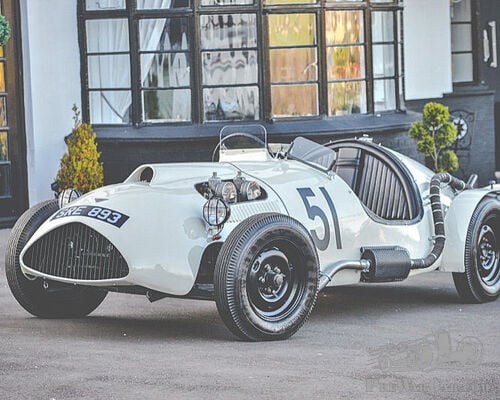
1933 Alvis 3.0 Special - One-Off Alloy Body | Period Competition Car | Featured in “Alvis – A Century of Drivers”
1933 Alvis 3. 0 Special - One-Off Alloy-Body | Period Competition Car | Featured in “Alvis – A Century of Drivers”

K3 Replica on KN Chassis
"The K3 Magnette must rank in the history books as the most famous and successful of all the record breaking MGs. With only 33 examples produced durin..
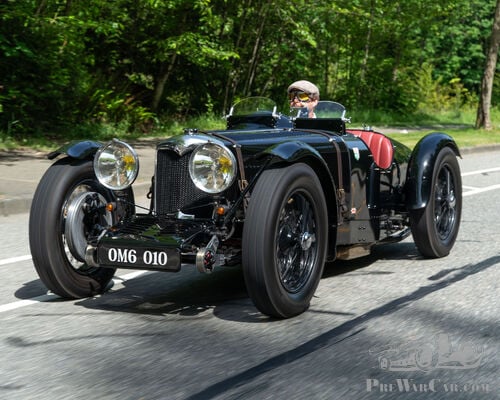
Riley 14/6 Special 1933
The ExperienceStep into the golden age of British motoring. This 1933 Riley 14/6 Special is a masterclass in pre-w..