The global magazine and marketplace for classic car enthusiasts, by enthusiasts.


Filter
Classic Bentley, Léon Bollee for sale - Bentley, Léon Bollee cars for sale
-

1937 Derby Bentley 4.25 Litre Park Ward Drophead Coupe.
1937 Derby Bentley 4.25 Litre Park Ward Drophead Coupe.Chassis number: B111JYRegistration number: TXS554Coming to us from 50 years of ownership by a California Doctor. This is an unmolested car in good running order with a strong quiet engine. We have just given the car a full service. The dry California Climate has done.. -
1936 Bentley 4¼-Litre Vanden Plas Tourer
1936 Bentley 4¼-Litre Vanden Plas Tourer Chassis number: B200GA Registration number: CXR5 First registered to Sir Norman Watson Bt, to whom it was delivered on 4th June 1936, this particularly stylish Derby Bentley on the 4¼-Litre chassis has been clothed in well-proportioned op.. -
BENTLEY 4L1/4 PARK WARD 1937 « The Silent Sport Car »
Cette voiture qui a appartenu à notre père depuis 2007, fait partie de la famille des Derby Bentley construites dans l’usine Rolls-Royce en 1234 exemplaires, sa carrosserie tout acier est signée Park-Ward. Commercialisée par "Jack Barclay London", la plus grande et la plus ancienne concession Bentley au monde, elle allie le confort d’une Rolls-Royc.. -
1931 Bentley 8 Litre Vandenplas Style Tourer
1931 Bentley 8 Litre Vandenplas Style TourerChassis number YM5045Registration number: GX2423One of a Pair of similar 8 litres we have in stock.A magnificent completely matching numbers Vanden Plas Style Tourer. This car started life as a Freestone & Webb Saloon & was delivered new to Major CH Stevens, and own.. -
1929 Bentley 4.5 litre Blower
1929 Bentley 4.5 litre Blower. Chassis number: PL3481 Registration Number: SV4904 (To be reinstated.) Chassis PL3481 was originally fitted with a saloon body and registered in 1929. The car suffered an accident in the 1940's at which time it went off the road prior to being rebu.. -
Bentley 4 1/4 Sedanca de ville open top tourer
Bentley Sedanca De-Ville for sale 1936 Bentley 4 ¼ with beautiful and possibly unique Sedanca De-ville two door open top convertible coachwork by Thrupp and Maberly. Tinished in period correct black cellulose paint with light tan leather interior and everflex roof. Extensively restored over a long period by marque experts with invoices f.. -
Bentley 4½ Litre Blower Continuation 1 of 12 (Chassis No.8)
A final opportunity to acquire a 100% original Blower Bentley, newly crafted by the manufacturer itself.Ninety years after the original Birkin Blowers defined an era, Bentley Mulliner undertook one of the most ambitious heritage projects in the marque’s history: the Blower Continuation Series. Built using original 1920s drawings, period t.. -
Bentley 4½ Litre Blower 1930 - Birkin Spec
Some cars are admired. Others are experienced. This Bentley Blower belongs firmly in the latter category. Shaped in period by the respected H.J.K. Townshend, a craftsman trusted by original Team Bentley owners, this example reflects a deep understanding of what defines a true Blower. Authentic in spirit and purposeful in execution,.. -
1924 Bentley 3 4 ½ Litre
•Sold new to Major EG Thomson of Edinburgh, of Ecuire Ecosse fame •Owned for more than 50 years by the Martin family•Upgraded to 4.5 Litre spec using original crankcase•Extensive history file includes factory records and buff logbooks•Fully restored by Paul Grist to his ‘ultimate’ period look and specification .. -
4 ½ Litre Vanden Plas Tourer
Chassis AD3652 was delivered 90 years ago from Mayfair by Jack Olring & Co to a Mr Grout. A sports four seater with fully valanced wings in green. This heavy chassis 4 ½ model was built to the latest specification including self-wrapping brakes, electron engine etc. and was unusually delivered with an aluminium sump and long bonnet. Dr William ..


Bentley
GB, 1920 to date
(1) Bentley Motors Ltd, Cricklewood, London N.W.2., 1920 – 1931
(2) Bentley Motors (1931) Ltd, Derby, 1933 – 1945
(3) Bentley Motors (1931 Ltd, Crewe, Cheshire, 1946 to date
W.O. Bentley was already well-known as the importer of the D.F.P. car, a pioneer of aluminium pistons and a designer of successful rotary aircraft engines when his first Bentley 3-litre car for sale appeared at the 1919 London Show. This Bentley model, indelibly imprinted in the layman’s mind as the archetype of the Vintage sports car, had a long-stroke (80x149mm) single ohc engine with fixed head and dual magneto ignition developing about 70bhp in its early form. The Bentley 3-litre was at its best in long-distance events; a team of Bentley 3-litres with flat radiators (the only instance of this apart from the same year’s Indianapolis car) finished 2nd, 3rd, and 5th in the 1922 T.T., and the model accounted for the first two of the marque’s Le Mans wins, those of Duff/ Clement in 1924 and Davis/ Benjafield in 1927 on the badly damaged ‘Bentley Old No. 7’ – one of the legends of motor-racin history. Up to 1929 1.630 3-litres Bentley motorcars were made. 1924 saw the introduction of front wheel brakes and also the famous sports four-seater ‘Bentley Speed Model’ by Vanden Plas. Bentley cars are popularly known by the colours of the enamel on their radiator badges – ‘Bentley Red Label’ signifying a Speed Model short-chassis 3-litre, ‘Bentley Blue Label’ the early short, and long chassis which could and sometimes did carry limousine coachwork, and ‘Bentley Green Label’, a special 100mph Bentley type made in very small numbers.
In 1926 the Bentley company made a bid for the carriage trade with a big Bentley 6½-ltre six for sale on similar lines. A chassis cost £1.450, but the Bentley image made no impression in this market. However, the model was developed into the 180bhp ‘Bentley Speed 6’ of 1929, considered by many to be the best of the old-school Bentleys for sale, and responsible for the firm’s last two Le Mans wins – Barnato/ Clement in 1929, and Barnato/Kidston in 1930. In 1927 the Bentley 3-litre was developed into the Bentley 4½-litre, still with four cylinder, but with a 100bhp engine which was giving 130bhp by the time production ended. This admirable car could exceed 90mph in standard form, and was used by Barnato and Rubin to win LeMans in 1928. A supercharged version was listed in 1930; it had 182bhp, and did not have the approval of Bentley himself, but it was an excellent if thirsty road car, and won Sir Henry Birkin an unexpected 2nd place in the formule libre French G.P. of 1930. Bentley finances were always shaky, and even Woolf Barnato’s aid of 1927 did not last long; the Bentley company went down in the early summer of 1931 to the accompaniment of a splendid gesture – a 220bhp ohc Bentley 8-litre six, made in two wheelbase lengths, 12ft and 13ft. Only 100 of these eight-litres Bentleys were made, plus 50 examples of a rather uninspired inlet over exhaust valve 4-litre car.
Napier made an unsuccessful bid for the assets of the Bentley company, but were beaten by Rolls-Royce, who introduced their version of the Bentley at Olympia in 1933. This was an entirely different type, based on Derby’s contemporary 3.7-litre ohv push-rod ’20-25’. It had a 4-speed synchromesh gearbox, Rolls-Royce servo brakes, and sold for £1.460 with saloon bodywork. In this form, it could reach 90mph and merited its slogan ‘The Silent Sports Car’. It was not raced, of course, apart from E.R. Hall’s three consecutive second places in the T.T. (1934, 1935 and 1936). By 1936 it had grown into a Bentley 4¼-litre, the increase of capacity being necessitated by the rising weight of bespoke coachwork. An overdrive gearbox was standardized in 1939, and the 1940 Bentley Mk V had independent front suspension, though only a handful were made because of the war. The Derby Bentley car’s swansong was a creditable 6th place by H.S.F. Hay at Le Mans in 1949, on a ten-year-old machine with 60.000 road miles behind it. Cylinder capacity was unchanged at 4.257cc in 1946, but independent front suspension, was standard, and Bentely, like Rolls-Royce, had gone over to inlet over exhaust valves. Prices for the Bentley motorcars for sale rose from £2.997 to £4.474 in 1951 for the standard steel saloon, the first Rolls-Royce product to have a regular series-produced factory body.
Thereafter the Rolls-Royce and Bentley identities merges, though in 1952 there was a special ‘Bentley Continental’ version of the latter with fastback 2-door saloon body by H.J. Mulliner which gave 120mph on a 3.077:1 top gear. Capacity went up to 4.6 litres in 1952 and 4.9 litres in 1955. Automatic transmissions, already optional, became standard that year; power-assisted steering and air conditioning followed In 1957, and for 1960 the old six at long last gave way to a 6.2-litre V8 with full overhead valves, by which time only the radiator style distinguished one make from the other. The ‘Bentley Continental’ with separate chassis was discontinued at the end of 1966; 1972 Bentleys were the 6.745cc Bentley T saloon and the Bentley Corniche 2-door saloon and convertible. Even the price differential between the two sister makes was now a thing of the past, the Bentley T-series selling for the same £10.455 as the Rolls-Royce Silver Shadow.
Source: Georgano, encyclopedia of motorcar; MCS
The information is written with the greatest of care. However, if you have any suggested amendments please contact us at office@prewarcar.com
Léon Bollee
France, 1895 – 1933
(1) Automobiles Léon Bollée, Le Mans, 1895 – 1924
(2) Morris Motors Ltd, Usines Léon Bollée, Le Mans, 1925 – 1931
(3) Sté Nouvelle Léon Bollée, Le Mans, 1931 – 1933
Leon Bollee was a son of Amédée Bolllée père, the most important pioneer of steam road vehicles in France. Leon Bollee, however, turned to really small petrol Leon Bollee cars. He was the first to do so, and therefore had to invent a new name for his Leon Bollee car of 1895 – he called it a Leon Bollee voiturette. This Leon Bollee car was a tandem two-seater 3-wheeler that was faster than any other petrol-engined vehicle on the road when the Leon Bollee car was working, thanks to a powerful 3hp engine and light weight, but the power unit was unreliable on the Leon Bollee car. The Leon Bollee car had a single air-cooled cylinder of 650cc and used hot-tube ignition. There were 3 forward speeds on the Leon Bollee car, with belt final drive. The frame was tubular. Four years after the Leon Bollee voiturette appeared, Leon Bollee superseded it with a 4-wheeler with independent front suspension by double transverse leaf springs. This Leon Bollee car had a single-cylinder, water-cooled engine. Unlike the Leon Bollee voiturette, this Leon Bollee car made no mark. The design rights were sold to Darracq, and around 1901 the name of Leon Bollee cars vanished. Meanwhile, the term voiturette had been taken up by the trade and public in general as the name for a small light car.
The Leon Bollee car reappeared in 1903 as an entirely normal, full-sized car in the more expensive class, backed by Vanderbilt money and designed for the American market. This Leon Bollee car was made in 28hp (4.6-litres) and 45hp (8-litres) versions, with four cylinders and chain drive, and led on to a 11.9-litre six Leon Bollee car in 1907, in which year the first shaft driven Leon Bollee car appeared. From 1909 there was also a small modern four, the Leon Bollee 10/14hp. The 1910 range embraced 9 Leon Bollee cars, including 2 of over 10-litres capacity. Electric lighting became available on Leon Bollee cars in 1913, but the Leon Bollee grew increasingly old-fashioned after World War 1 despite the introduction of ohv in 1922 on Leon Bollee cars and front wheel brakes in 1923. Late in 1924 Sir William Morris bought the Le Mans Leon Bollee car factory. From making a wide range of conservative French Leon Bollee fours, it turned to thinly-disguised products of Cowley, Oxford, the idea being to breach the French tariff walls from the inside. The first Morris- Leon Bollee had a 12CV 2½-litre 4-cylinder unit-construction engine made by Hotchkiss, the engine manufacturers controlled by Morris, but it had push-rod overhead valves and bore little evidence of its parentage. Not so the 18CV Morris- Leon Bollee car of 1928. This was a 3-litre straight-8 with single overhead camshaft that reflected Morris’ takeover of Wolseley two years earlier. Morris’ own new six of 1928 was mirrored in the 15CV 2.6-litre Le Mans product of 1929. The bodies for the Morris- Leon Bollee car were all made in France and were usually considerably more dashing and attractive than their British counterparts. Chassis of this Morris- Leon Bollee car were made in France, and all cars had a 4-speed gearbox. At one time, 50 12CV Morris- Leon Bollee cars were being turned out each week. However, Morris’ enterprise was not a success, and he discontinued it in the hard times of the Depression. A new syndicate was formed in September 1931 to sell the same range of cars under the name of Leon Bollee cars. This lasted for less than two years and few Leon Bollee cars were made.
Source: Georgano, encyclopedia of motorcar; TRN
The information is written with the greatest of care. However, if you have any suggested amendments please contact us at office@prewarcar.com


Featured
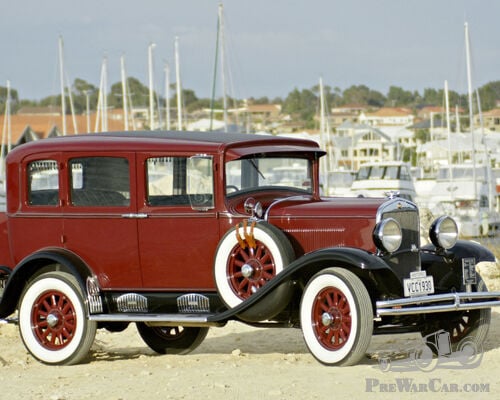
1930 Chrysler 66 Six-Wheel Equipped Royal Sedan
An exceptionally well restored and highly awarded Chrysler 66 Royal Sedan, with only two owners in nearly 97 years.The present owner ..

HORCH 930 V
For SaleHorch 930 VManufacturer: HorchModel and Variant: 930 VBody Type: 4-door sedanChassis Number: ..
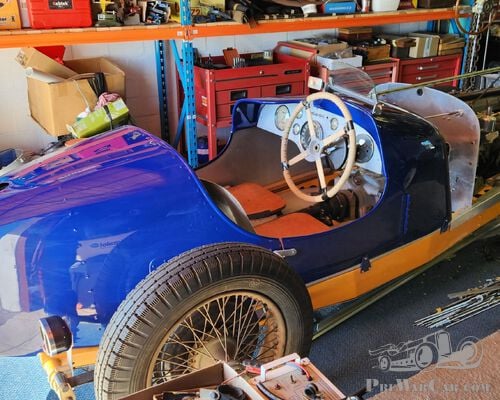
Riley TT Sprite
1935 6-cylinder TT Sprite replica. Chassis # 46A2722. Engine # 6A2722. Original Ulster Imp body. Restoration nearing completion. Engine, Ge..